



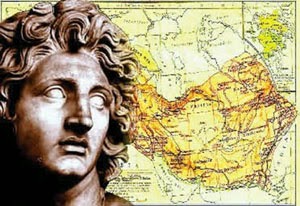
The Hellenistic period commencing from death M.. Alexandrou (323 e.g.) and ends with the conquest of Egypt by the Romans (30 e.g.) called Hellenistic [ The empire created by his conquests M. Alexandrou, although ephemeral, formed new economic, social and political data for Hellenism.
After the sudden death of the author was destroyed into smaller kingdoms due to constant conflicts of successors. The Hellenistic kingdoms ruled by dynasties that founded the generals of m. Alexandrou.
So cemented a new political system, the absolute monarchy. The center of gravity shifted from the main cities of Eastern Greece. Only a few City-States in Greece mainly retained their internal organization, While some other regions formed federations, as were the sympoliteies. From the 2nd century. e.g.. though he began the gradual extension of the Romans in Greece and in East.

Immediately after the death of Alexander showed intense problem of succession, Since no legitimate and able successor. At the moment the problem is addressed with the recognition of the half-brother of joint reign, Philip Arridaio (Philip Iii), Unable to govern, and the expected son of Roxane (Alexander D '). However, both were not the conditions to pursue dynamic power and to maintain the throne. Immediately expressed disruptive tendencies in the Empire who took the form of counterinsurgency, Liberation Wars and conflicts for the succession.
Rebellions and liberation struggles
 The Athenians with the Aitolians were among the first brought against the Macedonians, When they learned of the death of Alexandroy1. But the antimakedoniko front, that was essentially motivated by Ypereidi and Athenians orators Demosthenes, After the clashes that took place in the area of Lamia (Lamian war, 322 e.g.) and in Thessaly was dissolved. The prevalence of the Macedonians had the following consequences:
♦ The Athenians were forced to replace democracy with oligarchic, to pay financial compensation and accept a Macedonian garrison at Munychia, one of the ports of Piraeus.
♦ The Demosthenes and Hypereides was murdered committed suicide, in order to avoid dishonour.
♦ Peloponnesian cities were forced to accept Macedonian garrisons.
The Macedonian generals are not prevented from going to punishment of Aitolo, why I had to go back in time in Asia, where had started the quarrels of the successors.
In the eastern provinces of the Empire, where the Macedonian power was relaxed, indigenous populations but revolts occurred and Greeks who had settled in Bactria.
 The rebellion was suppressed, the Greek Commander of the Midias, the Persuader, who then declared himself an independent Governor of the upper satrapies elsewhere of Empire
Conflicts of successors. The settlement of the issue of succession, as it turned out in retrospect, It was temporary. In this regard attributed the ambitions of Alexander's generals and the absence of a strong central authority. Conflicts of generals lasted twenty years until the Division of the Empire into individual kingdoms and now have continued between the rulers of the Hellenistic kingdoms until the stabilisation of their power.
The first period of conflict (321-301 e.g.) started with the murders of the prevailing legal successors and generals and continued with the first distribution of power in Syria Triparadeiso (321 e.g.). There the Antipater, as the oldest, He was appointed by the army commissary Emperor and others took over the administration of a region of the Empire. In the course of preponderant and strongest of all was Antigonus, who declared himself emperor and gave the same title to his son, Dimitrios, the so-called Demetrius Poliorcetes.

The other generals, that attitude is not tolerated of Antigonus, rallied against him. In the battle of Phrygia in Ipso (301 e.g.) It was ultimately the fate of the Empire. The forces of Antigonus defeated and killed himself. The Demetrius Poliorkitis escaped arrest and with abilities that had managed later to become King of Macedonia (294 e.g.).
The victorious generals shared territories of the Empire of m. Alexandrou and anagoreythikan Kings. So, from the battle in the four kingdoms arose Ipso: the Kingdom of Egypt with Tolomeo, Syria to Seleucus, of Macedonia by cassander and Lysimachus of Thrace with the.

The clashes continued with now the main rivals Lysimachus of Thrace,
whose sovereignty had been extended in the area of m. Asia, and Seleucus.
After the battle in the Koyropedion of Lydia (281 e.g.) and the death of Lysimachos, his lands were shared between the Kingdom of Macedonia and Syria.
Later in m. Asia founded a new Kingdom centred on the city of Pergamum. Clawed and other territories from Seleucid domination which ruled by native rulers.
So, in parallel with the Hellenistic kingdoms in Asia created space and other smaller States, as of Bithynia, Armenia, of Pontus, Cappadocia and other.


