Found the oldest (;) painting (design) on the planet

Group of scientists announced that found the oldest planet's plan and it is a revolutionary discovery.

The plan dates back to before 500.000 years, It is a few lines of zik ZAK and found in Indonesia. It is not the
I first discovered the oldest design painted by human hand.

Many years ago, the researcher prehistory Francesco d'Errico, from the laboratory of Bordeaux Pacea, discovered what, in the opinion of the, It was the oldest painted representation. It was engraved on a piece of red ochre found in Africa's Blombos.


Source: hellenes-romaion.blogspot.gr

Amphipolis :New photos with Centaurs and Greek tripods.

Αποκαλύπτονται παραστάσεις και διακόσμηση ιωνικού κυματίου στα επιστύλια

Kas the maintenance work in the seven fragments of marble "epistyles"-they belong to the third and most sophisticated space funerary monument, the Hill Kasta- revealed, gradually, performances. Specifies that the position of the marble members, which are part of these, bear black and white decoration. They were mounted on top of the uprights of the walls and beneath the marble ceiling joists, which, as has been announced, bear, also, black and white decor, namely, imitation panels, with registered rosettes.

The upper part of a marble epistyle bring Ionic Wavelet decoration.

A Greek Sphinx and a Greek ' Delphic ' thousands of years Greek symbol tripod

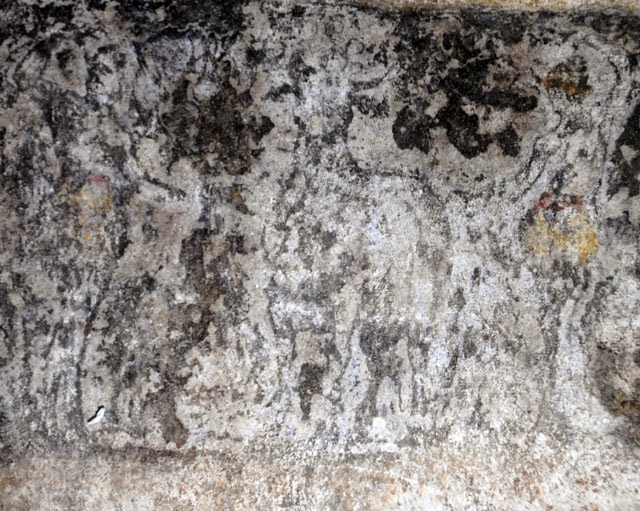
In one of the sections of "epistyles", during the first phase of maintenance work, which is still in progress, distinguished in the Centre animal, likely a bull and two forms, on the go, female and male (Photo 1,2,3,4). The right of female and male ydries distinguished left and rotors forms. The right winged form directed to a three-legged boiler (foto 5). In many parts of the show, as to the garment and at the head of the female form, in the garb of male and winged form and on tripods, are evident traces of colors red, Blue and ochre

[youtube http://www.youtube.com/watch?v = FKUac4Kdicg?rel=0]


Source: hellenes-romaion.blogspot.gr

Painted decoration in Amphipolis

Amphipolis_new fotosPainted decoration is revealed gradually as maintenance work is progressing in the seven sections of marble architraves belonging to the third and most sophisticated chamber of the funerary monument, in the Casta hill of Amphipolis, announced the Greek Culture Ministry earlier today.

amphipolis2

The marbles, on which the decoration is painted, were placed over the uprights of the walls and beneath the roof's marble beams, which, as announced, also have painted decoration, namely imitation panels with attached rosettes.

amphipolis3

As stated in the announcement, in one of the segments of architraves, an animal figure can be seen in the middle, probably a bull and two forms on either side, in movement, one female and one male. Urns and winged creatures can be seen on each side, while the right winged creature is heading to a tripod boiler. In many areas of the depiction, such as the garment and the female figueres head, the males clothes, the winged creature and the boiler, one can observe traces from red, blue and ocher.

amphipolis4

Finally, the upper part of the architrave is also decorated in Ionian style.

http://greece.greekreporter.com

THE FORMS PARAPEMPOYN IN MARIA'S VICTORIES

Τι δική του άποψη σχετικά με τις παραστάσεις που είναι ζωγραφισμένες στα επιστύλια, expressed by the archaeologist Petros Themelis.

l_15423

In light of the publicity gave the Wednesday noon (03/12/2014) the Ministry of culture new photos from Amphipolis.

A few days after the marathon press conference that announced the end of the first phase of the excavations in Amphipolis, the Ministry of culture gave publicity photos from the third and Fourth Chamber!

This is for photos of the epistylia found in the third place of burial monument. In epistylia can discern an animal in the Center, likely going to bull and either two forms, on the go, one female and one male.

The newscast of NERIT, the archaeologist, Petros Themelis expressed the view around the shows that are painted in the epistylia found on the site of Karyatidon and for which was fuss!

Specific, Mr. Themelis stresses that the shapes and symbols that we see in epistylia mentioning all the victories of the dead. «We have to do symbolic victories of the deceased in races. The styles have a hand up, in "dancing" stops, It is a ritual that I do not know exactly which refers, in Thessaly was sacrifice Bull for example», reports by Mr. Themelis.

«Has a victory at least with wings, with a vessel down that is not pitcher, Maybe it's amphora Panathinaikos, symbolizing victory and also the right tripod, that and he's winning Prize», Stressing that the performances are dedicated to great victories of the dead.

NOTICE OF THE MINISTRY OF CULTURE

As they progress maintenance on seven marble sections of "epistyles"-they belong to the third and most sophisticated space funerary monument, the Hill Kasta- revealed, gradually, performances. Specifies that the position of the marble members, which are part of these, bear black and white decoration. CONTINUE THE READING

Amphipolis: He joined marquetry and fragments of the mosaic, of Karyatidas, of wings

ASSEMBLING WORK IN PROGRESS
Amphipolis: He joined marquetry and fragments of the mosaic, of Karyatidas, of wings
«Tell us, are of great artistic value; We see that they are beautiful, but they are really works of art;"we asked shortly after the end of the marathon presentation of excavation in Amphipolis. The answer was absolute and clear "are masterpieces. Unique creations attic workshops. "

Despite objections, the ambiguities, the questions, the questions that flared up more than taϊstikan with elements in excavation travelogue for Amphipolis which made Jamie Peristeri together with the architect Dimitris Lefantzi and the civil engineer Dimitri Egglezo, the undeniable fact is that it is a unique monument in the world. There is no precedent and this is obvious even now has not revealed any secret. It has only reveal the beauty of.

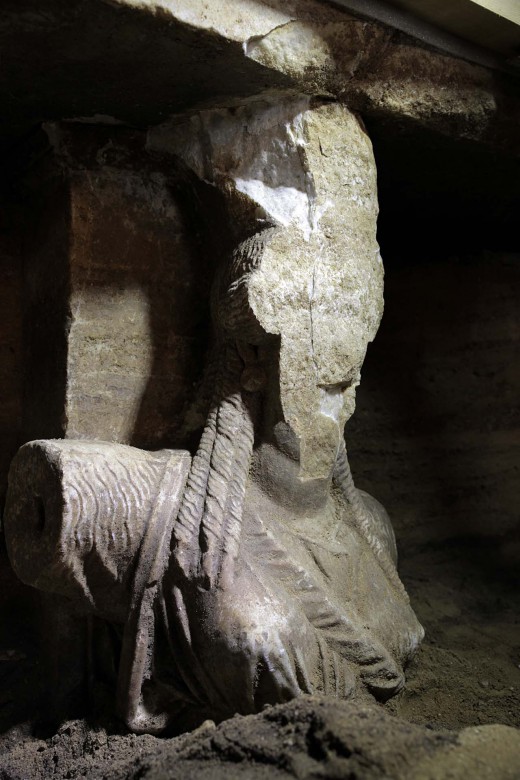
A beauty that will continue to unfold as became clear last Saturday in the presentation to the Ministry of culture. Experts are working intensively to assemble or to restore to life representations and images: The Caryatid without face, the mosaic with the abduction of Persephone and the wings of the Sphinx will continue to be disclosed if you acquire House. And cause even emotion in their Viewer.

The mosaics of Rapture of Persephone.
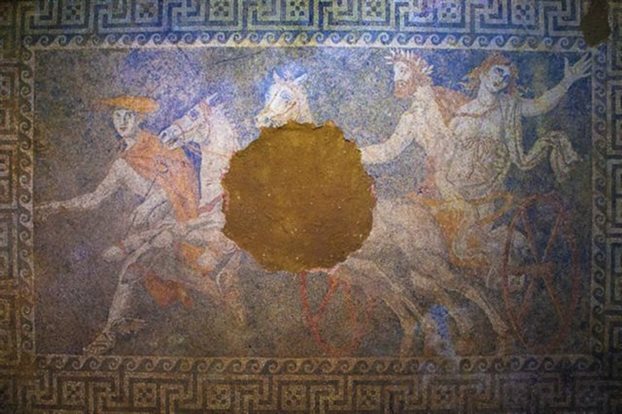
With speculation about why the large hole in the center of the mosaic depicting the abduction of Persephone to continue (There was an altar, looking for something the Tomb robbers, and so on.) the Peristeri Katerina revealed that Digger have found several pixels. Have cleaned studied and already has begun the process of assembling, They fitted in its correct position. The mosaic will reveal even more secrets, Although it is not clear yet to what extent. It is noted that the mosaic and the edging is one of the elements used by the excavation team for the dating of the monument in the last quarter of the 4th century BC.

The Caryatid without face
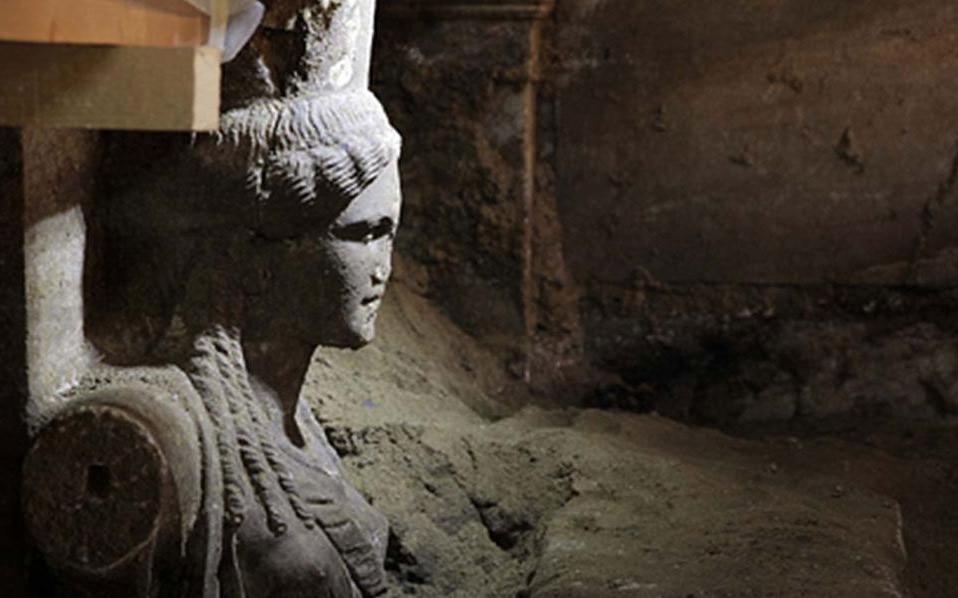
Won the face of Karyatidas the Tomb robbers; No, This was not, Katerina Peristeri and assures Jamie Lefantzis. The fall of a spar broke the face. If it had been removed with a chisel or other tool would be no cracking horizontal in sculpture. Apparently tumbling the beam hit the nerve of marble and took away the whole piece.

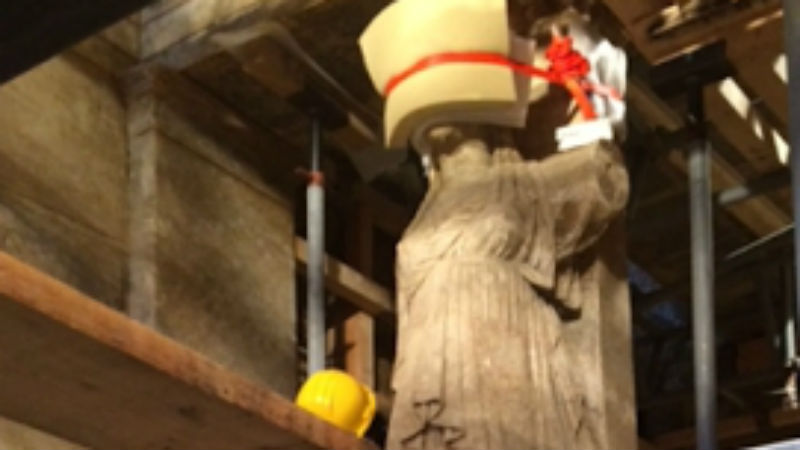
We found fragments and pieces of, gathered, studied and will be followed by an effort to join in person, to complete the picture.

The Sphinxes will "fly"
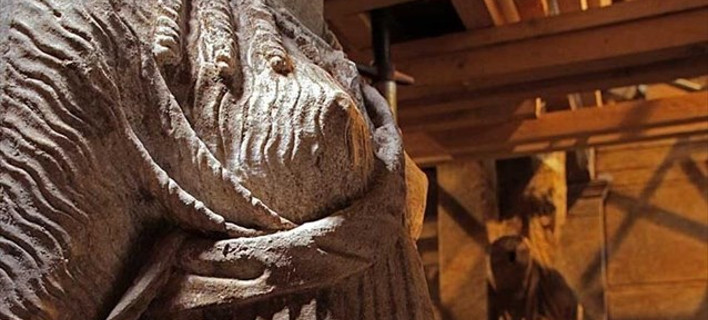
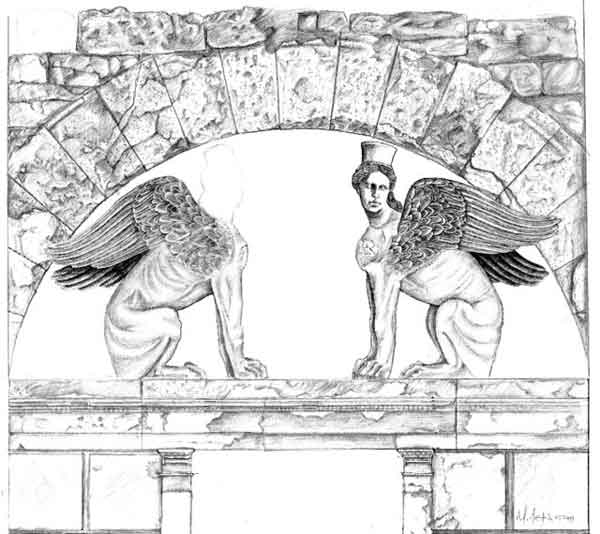
It was the first finding which caused AWE, and global interest and suspense: The Sphinxes guards at the entrance of the monument. There we saw the Prime Minister bends over with admiration. The Lady Peristeri explained how they have found several fragments of feathers which have already made their welding in order to create as much as possible the spread of wings (without prejudice to the possibility of full recovery) and to complement the beauty and art of Sphinxes. We remind that the height of the statues are 1,45 m while in their bodies that are crafted with fine ntisilidiko, imprinted the plasticity and the high art of sculptors of the era.

The secrets that will tell us the human figures
And for the end we kept a finding which I never saw and revealed himself as the Minister Kostas Tasoylas in recent visit to Amphipolis: Performances with human forms in epistylia, detected before about two months and transferred in secrecy at the Museum of Amphipolis (meaning a local alarm and foyntwnontas rumors that matching signs). We know that you are going to faint human figures in red and blue color, without ruling out according to some archaeologists to ' show ', to include and the dead. Unfortunately currently has no procedure for the nomination and study, not even a photo shoot with ultraviolet to learn more facts about the show. But when revealed will definitely be another possible element of storytelling of this monument, the Tomb that so far talks with beauty symbols, AWE and prestigious.

British Brigade Was Planning An Elgin-Style Robbery At Amphipolis

Messagetoeagle.com – Apparently stolen coins from the ancient site of Amphipolis are at the British Museum and in Germany.

They are believed to have been smuggled to these countries by soldiers passing through the area, such as the 2nd Kings Shopshire Light Infantry in 1916 and Nazi soldiers passing through the area during the German Occupation of Greece in WW2,” reported Protothema.

Artefacts at the British Museum are dated back to the 6th century B.C. They were probably stolen by British soldiers fighting Bulgarians in the region from 1916-1918 and some of the antiquities were donated to the museum by the soldiers.

Lion of Amphipolis

There has been no official request by the Ministry of Culture for the return of the smuggled antiquities as had been the case with the Parthenon Marbles.
“A British brigade was planning to transfer to London 1,000 pieces of the monument precinct, along with the statue of the lion.

Mr. Michalis Lefantzis, the architect who elaborated the draft of Kasta Tomb for the Ministry of Culture made a shocking revelation today, at the event dedicated to ancient Amphipolis.


Citing historical evidence, Mr. Lefantzis told the journalists attending the presentation that a British brigade was planning to transfer to London 1,000 pieces of the monument precinct, along with the statue of the lion.

On the day of the transfer, Austrian and Bulgarian troops attacked the British convoy and, as a result, the barges sunk in the river Strymonas and the ancient artifacts were "saved", reports Protothema.

Mr. Lefantzis also revealed that several local residents have been secretly returning parts of the precinct which they kept as mementos in their homes!”

The proud Lion of Amphipolis has been a trademark of the Greek region of Serres and a symbol of Macedonia in Northern Greece.

The 5.3-meter tall statue was found in 1912 after the 7th division of the Greek army found it at the base of the Strymonas River during drainage works there. A legend was started that no doubt the unknown sculptor of the work, realising that the Lion missed its tongue, threw it into the river so that nobody would see it.

Parthenon Marbles – c. 447–438 BCE – British Museum, London. Source: Wikipedia


August 1916, British soldiers building fortifications at the bridge of Amphipolis found the marble parts and tried to smuggle them to England, however their efforts were stopped when Bulgarians who had just seized Paggaion attacked them.

According to archaeologists, the "material of the Lions base had been re-used as a dam since the Roman era."

Historians and archaeologists initially believed that it was erected as a symbolic monument to express the power of Amphipolis. It is reminded that a few months ago, photo documents have emerged showing British soldiers of the 2nd Kings Shopshire Light Infantry posing with skulls excavated during the construction of trenches and dugouts in the area of Amphipolis.

Artifacts at the British Museum are believed to have been stolen by soldiers like them, fighting Bulgarians in the region from 1916-1918.

Mysterious Identity Of Amphipolis Tomb: Kasta Hill Still Has Many Secrets To Be Revealed

Messagetoeagle.com – Among the recent findings of Amphipolis’ Kasta Hill, there are coins of the era of Alexander III along with Roman coins and pottery.

There are no signs that Christians ever entered the tomb, the officials informed.

Coins depicting the face of Alexander the Great were discovered inside the Amphipolis tomb, Greece, announced head of excavations Katerina Peristeri during a press conference on Saturday.


According to Katerina Peristeri, head of excavations, the coins are dated around the 2nd century B.C., the era of the last Macedonian kings.

More from news conference

The coins will be photographed to be shown to the public after they are cleaned.

Another important finding was painted pottery that belongs to the 4th century B.C.

"We have so many pottery pieces we have hardly counted them,"Peristeri said.

Meanwhile, the suspense continues on who is buried in the magnificent tomb, the largest archaeological burial monument in Greece. Reporters asked several questions on the identity of the skeleton found and the condition it was found in,” reports The Greek Reporter.

"The bones were found inside and outside the burial pit,"said General Secretary of Culture Lina Mendoni.


"The skull was quite some distance away from the pit, the lower jaw was just outside the pit and the largest part of the skeleton was inside the pit.

A close look shows that the legs and arms are almost intact, rib bones and parts of the spine as well as the pelvic bones are in fragmentary condition, therefore it is impossible for archaeologists to say if they belong to a man or a woman. "

The depictions of human shapes and the inscriptions on the epistyle and other marble plates that may give more clues on the identity of the dead will be studied via ultraviolet rays, a process that has not started yet.

The monument was originally open to the public. It is estimated that it was looted some time during the Roman era and then it was sealed.

Τα μάρμαρα της Αμφίπολης έχουν τη δική τους ιστορία

Μόλις η στάθμη των νερών στη λίμνη Κερκίνη των Σερρών χαμήλωσε, What was an open secret for locals came back to light. More than a hundred of the scattered large marbles of the ancient Mound Kasta Amphipolis, cornices, uprights and stepseis, parts of the monumental enclosure at burial Hill complex, suddenly appeared again through the waters.

794412702A99AFCA5E1985759D601C8F

The images gave in recent days published in the Ministry of culture, show some of the approximately 500 architectural members are left here and there in the broader drama Earth. Already since last March, in the 27th scientific meeting for the archaeological project in Macedonia and Thrace, in Thessaloniki, the head of KI Ephorate of prehistoric and classical Antiquities, the digger Katerina Peristeri, had announced that two years ago the Conservancy survey in the region of Amphipolis were detected in the area of the monument of Leo scattered architectural parts, to open at the base and height of 5 m. Lion.

Based on the archaeological considerations, much of it was apoxilwthei in Roman times from the burial grounds of the Mound. Came, i.e., from the unique in the world, because of the size of (length 497 measures, height of three meters), funerary enclosure of Mound Kasta, dating between 325 and 300 eg (last quarter of the 4th century). According to Ms. Peristeri, the precinct that carries the signature of renowned architect at that time Deinokrati, a friend of Alexander the great. These marbles that were built from Aliki Thassos. From there, with special boats transported to ancient Amphipolis.

Today, scientists who study the excavation of Amphipolis is talking about four rows of marble per meter, IE for about 2.000 pieces of stones (for the total length of 497m.).

From these, as you point out, they have been found up to now about the 600, They identified by archaeologists as belonging to the burial grounds of the Mound Kasta. The 500 It is now in the lion of Amphipolis, While the remaining 100 the village Lithotopos, where are found under the mud or surface. In other words, the exact location remains unknown where are today the remaining 1.400 heavy marmaropetres that marking out the ancient this funerary enclosure. From as many, However, found, already several loaded from the excavation crew and transferred, to further study, in their inscriptions.

What the locals are saying today

"The marbles were sections-the yard of lining Mound of Amphipolis. As it is said, the Romans the xilwsan and threw in the Struma, in order to become passable the river, like a bridge, to can pass.

In there they threw and the lion, for’ It was found in disrepair, by Englishmen in 1917, "says Dimitris Dimoudis, President of the society for the study and Research of history of Serres (ERE). And complements: "The 1912, during the release, passed from the Hellenic Army and saw, for’ This and there are references for’ These. OTAN anymore in the 1930s took over the company Oylen to do projects so that the river might not fill the entire Valley, and began to clean the bed of, He found many of these marble stones. And because it was large and square, the loaded and transported elsewhere. Used to make the 1932 the basis of Kerkini dam in the village of Lithotopos».

"These stones were transported-unknown from whom, However, according to one version of the Romans- from the funerary enclosure and used in the construction of the original dam of kerkini in former Lake Achinos, which apoxiranthike the 1936. During the drying of, the Oylen the pulled out. Some found next to Lion. Others were moved farther away from where found, in the mid 1930s resulted in Lithotopos, the dam's artificial lake kerkini. Since the levees protecting of Lake "says in turn Costas Melitos, Mayor of Amphipolis.

"Where is currently about a hundred from the marbles, my peers and I remember from the 1965. Four years old I was then and up to the 1974-75, were swimming around the. We did dives beside s.’ these marbles, on the shore of the Lithotopoy dam in kerkini, Since then the waters of the Lake were spotless "remembers and the Mayor of Iraclia Serron, Kleanthis Kotsakiachidis. «

Always June-July fall the level of. Half marbles we then seemed, all the children of Lithotopoy, without knowing their origin, We played among them, pastured there and animals. This area was the threshing floor, with machinery then everyone was gathering the kritharia. "remember today.

Marbles and the new dam

On the premiership of Eleftherios Venizelos, 20 October 1928 the Greek Government-with contract comprising 35 articles, signed on behalf of Transport Minister Ant. Christomanos and Finance Minister c. Maris- commissioned in the u.s. (from New York) Monks and Oylen companies ("John Monks and Sons ' and ' Ulen and Company») to intervene in the hydrographic system of the region. To implement, i.e., appropriate land reclamation works in the plain of Serres. To settle the estuary and its tributaries of the Struma and to stabilize, After the Lake kerkini modeled only when River had been Downing too much water, When it was flooded the Plains Serron-Dramas.

In practice, in the context of the work, apostraggistikan the marshland of the plain and Lake Achinos (the once known as Kerkinitida)- until then, the main Lake of the Struma, in front of Amphipolis, occupied 80.000-140.000 acres, in the southeastern part of the serraϊkis plain. Beyond, Since then the river moved and thrown in the Lake large amounts of debris, he needed the construction of a new, the highest dam in kerkini, the elevation and expansion of embankments, so is feasible-controlled and irrigation.

In this work the Monks and Oylen manufacturers, that completed a two-year (1929-1930) the preliminary study of, used and marble cornices, uprights and stepseis from the precincts of Mound Kasta. That's because water remain unaltered as the marbles, It was the best material for the foundations-prop of the first dam in the waters of the river Strymon, next to the village Lithotopos: artificial reservoir which basically formed the Lake Kerkini, When the project was delivered ready, the 1932.

Along the way, the geography of the area changed again. This is because of the 1974 until the 1980 There were new, major land reclamation projects. Made, i.e., the new dam of Lithotopoy, to keep more waters, to irrigated kampos of Serres.

Later, in the mid-90s, next to the dam, created and the port of Lithotopoy, a floating platform-Hill to get inside the boats and protected, but also to parked cars, After you have started tourism. Done and asphalt, by Lithotopos-southwest of Kerkini, up to the village of Kerkini-Northwest, to be connected and drive, at a distance 18 km, the Lake of’ Tip s.’ edge.

The Kerkini now

Today, only one Lake lies in the Valley of Serres, in the land of ancient Strymonia: the Kerkini, to the Northwest of serraϊkis Valley, 40 kilometers from the city of Serres, about 100 from Thessaloniki. Stretched out in 80.000 acres (from the 700.000 of the plain), is the unique wetland that (the 2006) declared as a National Park.

At The Same Time, is one of the 10 Wetlands of international importance in Greece, based on the international Ramsar Convention. Owned and in the network of protected areas of the European Union "Natura 2000".

The total area of the protected area, the care which is taken from the 2002 Lake Kerkini Management body (www.kerkini.gr), arrives in 830.000 acres. There live 26 reptile species, 11 amphibian species, 44 mammalian species, 31 fish species, more from 300 bird species, at least 4.300 insect species, While some grow 1.300 plant species. Visitors and scientists get info for’ These spot, and Wetland Kerkini information center, that works in the village of kerkini.

Reportage: Peter Stefanis

Newsroom DOL

Tomb skeleton to undergo DNA testing

Athens – Greek Culture Ministry officials said the recent discovery of a skeleton buried at the Amphipolis tomb from the time of Alexander the Great will undergo DNA testing to determine his or her identity.

Experts will then proceed to the second phase, using the skeleton to reconstruct a real-life figure of the Amphipolis occupant.

University of Athens Professor of Orthodontics Manolis Papagrigorakis explains the procedure.


DPA: What can we find out about the Amphipolis skeleton through DNA testing?

Papagrigorakis: Once (DNA) is found it should be easy to determine the sex of the skeleton as well as its age, height, what it ate, the cause of death and even the colour of his or her hair and eyes. The DNA material can also show whether the person died from a disease, was killed in battle or suffered an accident. l_14847-

DPA: How long does this normally take?

Papagrigorakis: It varies from six months to a year.

DPA: Will experts be able to compare the DNA material with samples belonging to Alexander the Great's father, Phillip II, to determine whether they were related?

Papagrigorakis: This will be very difficult to do because the skeleton of Alexander the Great's father was burned, so it is impossible to take DNA material from it and thus compare it with the Amphipolis skeleton. Without being able to compare genetic material it may be impossible to determine the exact identity of the Amphipolis skeleton and whether he or she was from royalty.

DPA: What is the procedure of reconstructing the face of the Amphipolis skeleton?

Papagrigorakis: First we would make a replica of the original skull using three-dimensional modeling and rapid prototyping techniques. Then we would need to place wooden markers around the skull to outline the average tissue depth based on data for people of various genders and ages. After that we would need to mould clay to form the necessary muscles around the face. The dental arch also helps to determine the position of the jaw and lips.

The features which are the hardest to reconstruct are the lips, tip of the nose and ears because we have no bone to guide us. All the soft tissues and cartilage have long since vanished. – Sapa-dpa

source: iol.co.za