Oops! It appears that you have disabled your Javascript. In order for you to see this page as it is meant to appear, we ask that you please re-enable your Javascript!

12 Great Facts About Alexander the Great

  1. The day he was born was a big day

Alexander_the_Great_mosaic

The day Alexander was born, his father (King Philip) was off preparing a siege on the Greek city of Potidaea. On the same day Alexander was born, his father got news that one of his generals (named Parmenion) had defeated the combined armies of Illyria and Paeonia, and that his horses had won at the Olympic Games. Strangely, the Temple of Artemis (one of the seven wonders of the ancient world) apparently burned down on that day. One historian mused that this probably occurred because Artemis herself was off attending Alexander's birth.

  1. He had a serious crush on his horse

When Alexander was 10, a trader came to see King Philip. He offered to sell the horse to the king, but when people tried to mount the horse, it fought, refusing to be mounted. Philip, a busy King, ordered the horse away. However, Alexander asked to tame the horse, correctly thinking that the horse was afraid of its own shadow. Eventually, he succeeded, Philip bought the horse for him, and Alexander named it Bucephalas, meaning "ox-head." When the horse died (of old age at 30 years old), Alexander named a city after him – Bucephala.

  1. His childhood tutor was Leonidas

Sorry, not that Leonidas. Image from the 300

This was Leonidas of Epirus, who may have influenced Alexander's later conquests. Once, when Alexander threw large amounts of incense into the fire as an offering to the gods, Leonidas told him to be more sparing unless he had conquered the country where the incense came from. Later, after conquering much of Asia, Alexander sent his teacher 600 talents ' worth of incense.

  1. He learned from Aristotle

Yes, that Aristotle. When Alexander turned 13, his father looked for a tutor for young Alexander. In return for his services, Philip rebuilt Aristotle's hometown Stageira (which Philip had destroyed) and repopulate it by buying back all the people who used to live there, but had been sold as slaves.

  1. The first thing he did in power was repel an invasion and found a city... named after himself

When Alexander was 16, his father left for war against Byzantion and left his son in charge. The Thracian Mahdi revolted against Macedonia, and Alexander reacted quickly, driving the Mahdi from their territory and filling the area with Greeks in a city which he called Alexandropolis.

  1. His relationship with his father was... complicated

Image by Ny Carlsberg Glyptotek

King Philip was not a very good father. He was often away at war, leaving young Alexander behind in Macedonia. Things seemed to look up when Alexander helped his father defeat the combined armies of Athens and Thebes. However, after his father united Greece (except for Sparta), he remarried a woman named Cleopatra Eurydice, ousting Alexander's mother Olympia, and by extension, him. Should Philip have had a son with Cleopatra, that child would have been a more legitimate heir than Alexander. He and his mother were forced to flee Macedonia until a family friend reunited father and son.

  1. Alexander took power at age 20, and it was not easy

King Philip was assassinated in 336 B.C. at his daughters wedding. Shortly after, Alexander was named the king. This led to many people dying. These included threats to his power (three Macedonian princes who could have contested his claim), his mother-in-law Cleopatra and half-sister Europa (his mother Olympia had them burned to death) and the leader of Macedonia's advance guard into Asia, who was considering defecting to Athens. Beyond those specific deaths, several city-states, on hearing of Philip's death, took the opportunity to rebel, forcing Alexander to retake each.

  1. Alexander had hackers

Your mother was a hamster.

During the revolts, Alexander stopped in Thermopylae, where he was met by many noblemen and dignitaries. However, one man was missing – Diogenes of Sinope, a famous philosopher who was unfazed by the arrival of Alexander. Alexander went to meet him, and asked him what he wanted, to which Diogenes replied something to the effect of "for you to step out of my sunlight."

  1. He just couldn't seem to catch a break

From the beginning, Alexander seemed to intend to invade Persia. After retaking many of the city-states in Greece, he was given the authority to do so on behalf of the members of his league of city-states. Before he could do so, however, he needed to march north and conquer the Thracian Triballians to secure Macedonia's northern border. After he had accomplished this, he found out that the Illyrians and Taulantians were in open revolt, forcing him to march to reconquer the groups. Then Athens and Thebes rebelled again, making him march south. Only after razing Thebes did he finally turn to Asia.

  1. He was generous to the families of the fallen

Alexander rewarded his own fallen soldiers ' families with immunity from taxation and obligation for public service. Alexander also erected statues and honored the fallen soldiers of his enemies.

  1. After invading Persia, he picked up some Persian habits

While invading Persia, Alexander began a policy of adding the native Persians to his existing army. However, this was not the only pro-Persian change he made. He also took the Persian title of "King of kings,"began dressing in the Persian fashion and began having his subordinates either kiss his hand or prostrate themselves on the ground before him. To the Greeks, these were troubling signs, especially making his subordinates prostrate themselves before him – to the Greeks, this was sacrilegious, as a person was only supposed to prostrate themselves before a god.

  1. He may have been poisoned

Alexander's death is shrouded in argument. Accounts differ, but they either say that Alexander fell ill with a fever or had a sharp pain after drinking undiluted wine, before falling to weakness and dying. Several historians, given that Macedonians often died due to poison, possibly fingering a recently removed Macedonian viceroy named Antipater.

phactual.com

25 Ancient Greek Cities that No Longer Exist or Are No Longer Greek

Εικοσιπέντε Ελληνικές πόλεις που δεν υπάρχουν πια ή δεν ανήκουν στην Ελλάδα τη σημερινή εποχή.

By taking a look at the world map today you would never believe that Greece, which is nothing but a small country, currently known as a beautiful tourist destination in southern Europe, had once dominated and colonized most parts of the then-known world. For those who love history though, Greece is without a doubt one of the most significant and influential nations of all time with amazing contributions to human culture including philosophy, various sciences, architecture, the Olympic Games, and democracy just to name the most prominent few. CONTINUE THE READING

The Apotheosis of Homer

Στην “apotheosis of Homer” (1827), located in the Louvre, Homer is crowned as immortal. His legs are distinguished, the Iliad (with red) and the Odyssey. Around him, tributes tribute some of the largest Western artists and writers, including Pindar (with the Lyra) and Sophocles (with Papyrus)

In The Apotheosis of Homer (1827), on display in the Louvre, in Paris, the bard is crowned as immortal. At his feet are figures representing The Iliad (red) and The Odyssey (green)

Reactions began in the FYROM for Kitsch “monuments” (incurred in brutally poverty)

Macedonian Protesters Say No to Architectural KitschProtesters encircling the GTC in Skopje on December 29 (photo by Vasilka Dimitrovska / Twitter)

Two nights before New Years Eve, more than a thousand Macedonians gathered in the snow to hold hands and form a ring around a large shopping mall in the capital city of Skopje. That may sound like the beginning to some strange joke, but the crowd was assembled in earnest, to express its love of the modernist building known as GTC, and to protest a government plan to give it a new, baroque façade.

CONTINUE THE READING

Archeologists discover mythical tomb of the god of the dead in Egypt (Osiris)

Archeologists discover mythical tomb of the god of the dead in Egypt

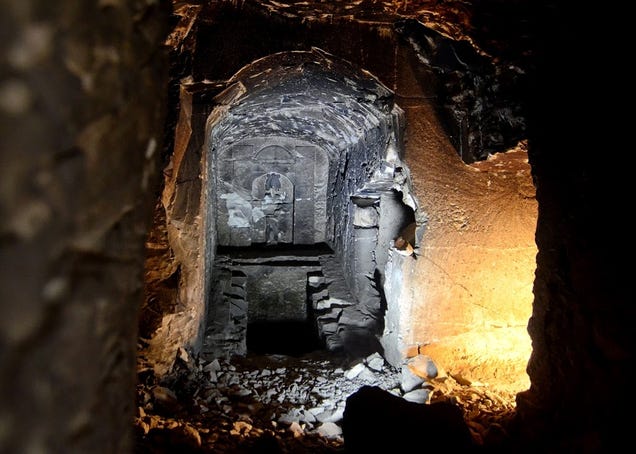
A reproduction of the mythical Tomb of Osiris as described by Egyptian lore has been discovered in the necropolis of Sheikh Abd el-Qurna, on the West Bank at Thebes, Egypt. The complex includes a shaft that connects to multiple chambers, including one with demons holding knives.

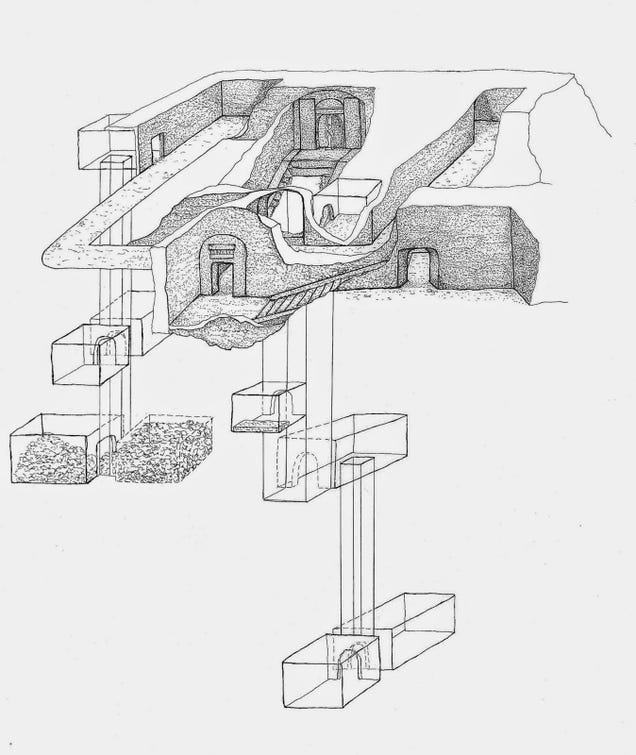
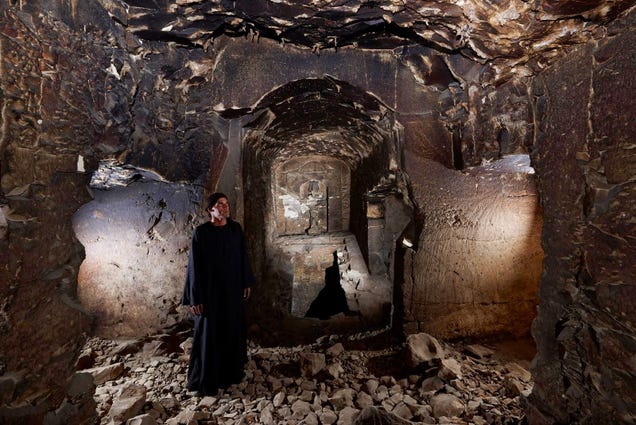
The tomb—which was built following the descriptions of the Tomb of Osiris, like the Osireion in Abydos, one of the oldest cities of ancient Egypt—is centered around a statue of the god of the afterlife, Osiris. The emerald skinned deity is sitting in a central vaulted chapel facing a staircase with a 29.5-foot (9-meter) shaft in it. The shaft (in the center in the diagram below) connects to another room with a second shaft that goes down for 19.6 feet (6 meters) into two rooms.

Archeologists discover mythical tomb of the god of the dead in Egypt

Drawing of the tomb's architecture made by Raffaella Carrera, of the Minute Project.

The funerary room with the reliefs of demons holding knives is located west of the central chapel (on the left in the picture above.) It's connected to a 23-foot (7-meter) shaft right in front to another empty room. At the bottom of the same shaft there are two rooms full of debris.

Talking to the Spanish news agency EFE, the leader of the Spanish-Italian team that has uncovered the tomb, Dr. María Milagros Álvarez Sosa, said these demons are there to protect the body of the deceased. According to Alvarez Sosa, it's a tomb of “great importance”:

It's a unique tomb in the Necropolis of Thebes because it embodies all the features of the mythological Tomb of Osiris.

Archeologists discover mythical tomb of the god of the dead in Egypt

The main chamber. You can see the statue of Osiris at the back, with the stairs and central shaft going down.

Archeologists discover mythical tomb of the god of the dead in Egypt

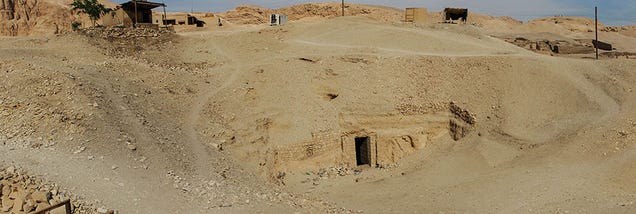
The entrance of the main structure of the tomb.

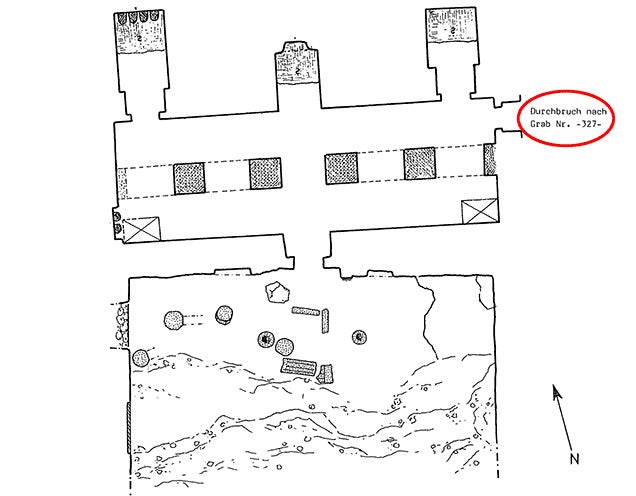
The tomb was initially catalogued by Philippe Virey in 1887. Later in the 20th century there were some attempts to draw a plan of the main structure. Tomb Kamp -327- however (marked in red in the plan below) was never described and published. Álvarez told EFE that her team will start revealing the chambers during the next archeological campaign, in the fall of 2015.

Archeologists discover mythical tomb of the god of the dead in Egypt

Archeologists discover mythical tomb of the god of the dead in Egypt

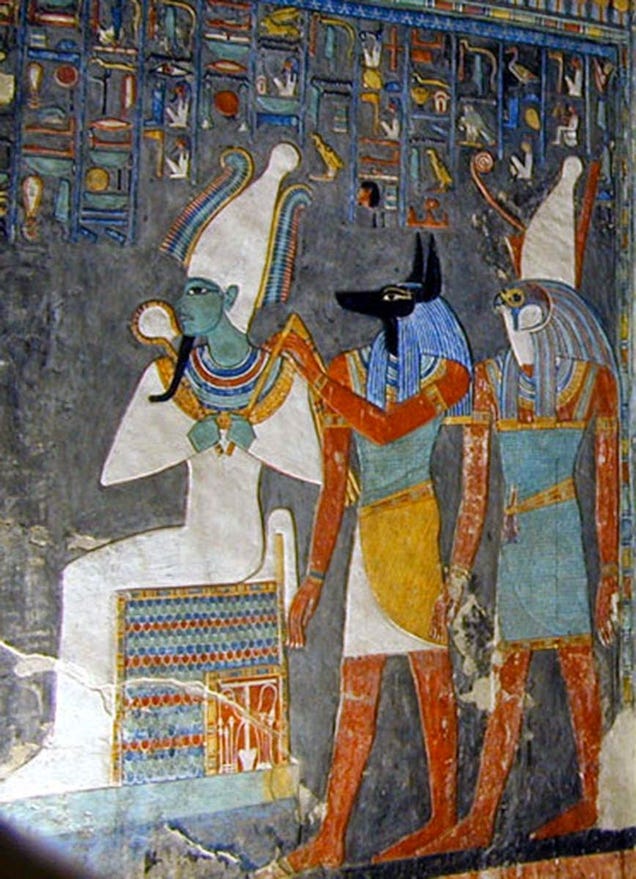
Included for reference, from left to right: Osiris, Anubis—protector of graves—and Horus—god of the sun, war and protection.

http://sploid.gizmodo.com

Pointe-à-Callière presents the largest exhibition on ancient Greece ever produced in North America

`pointe-2
MONTREAL.- Pointe-à-Callière, the Montréal Archaeology and History Complex, is presenting the world premiere of the original exhibition The Greeks – Agamemnon to Alexander the Great. The exhibition spans over 5,000 years of Greek history and culture and takes visitors on an exceptional and fascinating journey back to the origins of the cradle of Western civilization, its heritage and the traces it has left in the hearts and minds of the Greek people. The exhibition begins its North American odyssey in the countrys leading archaeology museum before continuing to the Canadian Museum of History in Gatineau, The Field Museum in Chicago and the National Geographic Museum in Washington. It brings together more than 500 priceless artifacts from 21 Greek museums, co-ordinated by the Hellenic Ministry of Culture and Sports. For Pointe-à-Callière, this achievement is another in the series of great international exhibitions it has produced over the years, including Archaeology and the Bible – From King David to the Dead Sea Scrolls and Japan, introducing Montrealers and visitors to some of humanity's most impressive treasures. A fascinating period Greek Antiquity is a rich and spell-binding period, a time populated by mythical heroes and historical figures, under the watchful gaze of the gods on Mount Olympus. The exhibition is divided into six zones that introduce us to this great civilization and showcase rare and priceless artifacts. Visitors will meet many famous characters in Greek history, from Homer to Aristotle, Plato, King Philip II of Macedon and King Leonidas of Sparta. The heritage of ancient Greece, which we can still see all around us today in our politics, philosophy, arts and literature, mathematics, architecture, medicine and sports, is clearly illustrated in the exhibition. Visitors are invited on a tour of Greek history, starting in the 6th millennium BCE, explaining all these roots. From Agamemnon and the siege of Troy… We learned about the exploits and adventures of the heroic and legendary figures in the Trojan War through Homer's epic poem the Iliad. Led by Agamemnon, the Greeks sailed a thousand ships all the way to Troy, where the Trojan Prince Paris was holding Helen captive. After laying siege to the city for ten years, the Greeks left an unexpected gift outside the gates: a giant wooden horse, filled with Greek soldiers. The unsuspecting Trojans brought the horse inside the city walls, leading to the fall of their city. In the 19th century, German archaeologist Heinrich Schliemann, convinced that the accounts in the ancient Iliad were historically accurate, found "Royal Tombs" at Mycenae containing the remains of ancient elites and their fabulous grave goods. Schliemann was in no doubt that these remains were in fact those of Agamemnon's. The exhibition showcases objects from the tombs of the Grave Circle A, including two magnificent golden burial masks originally attributed to Agamemnon. One of them, the original golden mask, has in fact never been shown outside Greece before. To Alexander, larger than life The exhibition takes us all the way up to the days of Alexander the Great, a larger-than-life figure who was only 20 years old when his father, Philip II, was assassinated. But Alexander was ready to succeed him, thanks to his education, his training and the formidable Macedonian army. Within barely a single generation, the ancient world was transformed from a series of independent city-states into a unified empire under Alexander the Great. The young prince who became king, emperor then god in the eyes of the world, died of a malignant fever at the age of 32. But his legend survived, as did Greece extraordinary legacy to the Western world. The Golden Age of Ancient Greece Between these two crucial figures, the exhibition focuses on the Golden Age of ancient Greece, in the 5th and 4th centuries BCE, when philosophy, theatre and the visual arts flourished, particularly in Athens. This was also the birthplace, under Pericles, of Greece greatest gift to humanity: democracy, government by the people. For the first time, citizens could express themselves, debate issues and vote. The exhibition also looks at the founding of the Olympic Games in 776 BCE, when athletes converged in Olympia from all Greek city states to take part in the Games. Treasures of humanity Among the highlights of the exhibition are a number of items never before displayed outside Greece: gold offerings from the royal tombs of Mycenae, including the mask that Schliemann first associated with Agamemnon, as well as a double-eagle necklace worn by one of the deceased, dated to the 16th century BCE. Elsewhere in the exhibition, visitors will be able to admire a marble figurine from the island of Amorgos in Cyclades, dating to the 3rd millennium BCE and a superb ritual vase from Minoan Crete. There also are exhibited bronze helmets with gold funerary masks from the graves of the Bottiaean rulers, not to mention a magnificent funerary vase illustrating the scene of Achilles avenging the death of his friend Patroclus, from the island of Delos and dating to the late 6th century BCE. They will also see sculptures of Homer and other famous historic figures, and a superb votive relief to Asklepios, showing the god of medicine leaning on his staff, around which a snake is coiled, accompanied by his children as he receives the tributes of mortals whom he has cured. Lastly, there is a magnificent gold wreath of Queen Meda featuring two incredibly lifelike branches of myrtle, an aromatic plant, symbol of immortality, associated with goddess Aphrodite. A hands-on experience The exhibition offers visitors a whole range of interactives and items to handle, from a Cycladic female figurine to a reproduction of a warrior's helmet and a sword. There are over twenty videos in the various exhibition zones, most of them produced by the National Geographic Society, the Acropolis Museum, the Museum of Cycladic Art in Athens and the Canadian Museum of History. Complementing the exhibition Many activities have been organized in conjunction with the exhibition. A free digital application designed by the New Media Laboratory of the Stavros Niarchos Foundation Centre for Greek Studies at Simon Fraser University in British Columbia will keep visitors informed before, during and after their tour of the exhibition. There is also a prestigious publication on the Greek collection, produced by the Hellenic Ministry of Culture and Sports; a catalogue has also been produced by the Canadian Museum of History and the partner museums in the consortium, surveying the themes and the key items in the exhibition. A number of major lectures will be given, at both Pointe-à-Callière and the Université de Montréal in early 2015, looking at major figures in Ancient Greece and archaeology issues. Tours and visitor activities, the Port Symphonies, Greek Independence Day, Greek cuisine on the menu at the Museum's restaurant and films are just some of the events and attractions surrounding the exhibition.

More Information: http://artdaily.com/news/75445/pointe–agrave–Cali-egrave-re-presents-the-largest-exhibition-on-ancient-Greece-ever-produced-in-North-America#.Vkaddnupmdc[/url] Copyright © artdaily.org

My personal involvement in the adventure of Amphipolis – Sarantoy I. Kargakoy.

10384203_305572526303338_6335120286265488843_n

The OSA on Alexander had to say, I wrote extensively in several of my books and my speeches in numerous. If it happened at last my schedules to support with a lot of "If" and "maybe" and "probably" the tomb of the great doriktitoros, After not found in Egypt, must be sought in Macedonia and, If here and one in my 15 years as a more likely site of Amphipolis, This is the fruit of studies, meditations and on-the-spot investigations. As I have said often in tilopsia and on the radio, and even kat΄epanalipsi, I am not crystal ball fortune telling I. My historical intuition, for decades now, It has strongly been honed so that spawns in me some suspicions, some premonitions that often – too often confirmed. For the possible imposition of a dictatorship in our country had informed verbally and in writing an influential political strains in the country two years ago from its establishment. There are writings. The same happened with the collapse of our language. From the 1976 I am sounding the alarm.
And in what,What concerns at recent excavations in Amphipolis, probably I cause to start; as for the noise that was, He was not my own fault. Quite simply, in my latest book for Alexander write:
"In the view of the writer – never suspected is not missing from the historic stylus – , If once the Tomb found – and rather has been found – the landfill will be – and is – probably some point of Macedonia» («Megas Alexandros: the man Phenomenon "Tom. G΄s. 213).
A few pages above in the main text and more in the footnote I write:
"My guess is based on the following thought: the Olympias would do everything possible to bring the relics of her son in Macedonia and to make emblems of its own power. The site of Amphipolis is most likely. Maybe the Leo who has erected (…) It was the culmination of the mound where he had buried the body of Alexander. If the body was left in Egypt – naturally at a similar monument – we would have a description of the site and of the monument by some Alexandrian writer. Visits of eminent Romans referred to the supposed relics of Alexander was probably in some substitute " (d.p., s.. 206).
The fact that three of my project, Thanks to the newspaper "Real Neus ' came into 110.000 homes and was cause for the resumption of excavations in Amphipolis, makes me happy. It doesn't matter if I win; will it matter that thanks to my 20 year obsession found something wondrous. And this is me enough. But some told radio station was probably something sexy: Now I see it has overwhelmed everyone Alexandromania and Alexandrolagneia. There will be plenty of course and the necessary Alexandromachoi or Alexandromastiges that I speak always derisive to alive in folk soul undefeated paida. The spithamiaio up ( regardless of their ' boy ') gives greater dimension to the greatness of the invincible ' children.
There were also some who attacked against me. I agonized whether said or wrote something bad, If these were so good to me. There was even an eminent archaeologist – academic, I appreciate his work and often the quote on my own work, that before I even started the dialogue – and while his partner knew you am I – said akompsws, before you say anything,what he had to say, that those who argue that the tomb of Alexander is located in Macedonia, say nonsense. Thereby exposed and a ellogimi Lady, Kelly Tablaridoy-Grocer, to write articles sometimes disapproving against him for lack of good upbringing. I encountered with composure and eventually the k. academic was forced (We were at the beginning of the excavations) agree with me that the monument has despoiled, Although I only have one photo of the first door!
I tried throughout this long period be seemly. Due to origin and education do not belch, do not taunt. I respect and meditate on what is being said. Though something I disagree, I try to make my tension due to gravity and composure scientist. Because I know that nothing in science is not stable. Even two parallel lines might to infinity to meet. The amfiballontes, Let's read the geometry of Riemann and Lobachevskij. Don't work all in science with the Euclidean sense.
From my first interview I did at the beginning of August, however, a few caveats that are useful even. Firstly, before you proceed with excavations, need around the Hill – tumulus to place shelter many acres, not lost this time nor "scale» latypis, as old. Rainfall was near and I had not a speck to lost. Secondly, do not start the ira and studia, because instead of, Thanks to finding this to problithoyme, There is a risk to rezileytoyme. Already a gossip who revels beatify God, who in the eynoia Of aperantw, He began to do selectively deaf. I hear you need or what you want to hear. And thirdly, We are not in a hurry. Political factor was wrong to State from the outset that in two weeks we'll know. With courtesy indicated that at least two years will be time small. This said by radio, because I have the privilege of being close to Minister.
Alexander and the folk soul
IF TODAY (3 November 2014) incise those lines because on 3 months Amphipolis monopolizes the interest of the Greek people. A poll, even now, in all layers of the population would indicate that most of our fellow citizens want to believe that the finding in the tumulus of Kasta (other sleeker name does not exist;) is the tomb of Alexander. If you look in depth at this popular torque, you will come out a thought shocking: Our people stopped waiting for salvation from the living, that the rule, and wait for the salvation of the dead. As I said on one broadcast, the most alive Greeks are dead. And more alive than the living of the past is Alexander. In the same show I said something sarcastic: – "Why you call constantly to speak for the dead, not the living; Inwardly you convinced that some deaths are more alive than the living, that, However, is dead but have forgotten to lie down "!
It is not surprising that. Always save the Greeks their dead. Julius Caesar once said to the Athenians poignantly! "As when will save you the glory of your ancestors;». Always, seeing the issue of Amphipolis from a political point of view, I reach a conclusion of optimism. I think amazing is not the finding itself. The impressive is that – despite the crisis and tax storm – the enigmatic underground construction for three months – I repeat – the comes first in our people's interests. And this despite the decades some policies and ellinomachwn effort imaginable to eliminate the historical memory of our people, to extinguish the ancient tradition of our lives. Maybe somehow I wrote and spoke for Alexander's Tomb. Alexander damage and still reigns in the pure soul of the people. In antique times, When the storm ederne the mountains, the prizewinners tsopanides Alexander's sister's prayer, the Lady Calling, the Queen of neraϊdwn and say:
– «Kira Call, tell your brother of Alexander not to make bad»!
In the minds of ordinary people Alexander continues to damage like a agathopoios legend. In the difficult days that we need and Alexander and Kira Urge, to see ... good! Yet what, what he has learned our people for Alexander, He owes mainly to some inspirational teachers, in that once we did in high school the "C anabasin" by Alexander Arrianoy, but more to the "Stretched" and Hero of the ' shadow ' Troupe, the kosmagapito Shadows. I won't say that Greek historians their debt did not. Those who do not have their debt are the writers and poets more. In school reading there is no poem for Alexander! Nor know anyone poet – from known – that wrote a poem gi΄ayton1 . Instead you can find poems on Stalin, his Zahariadi, for the season I won't say bad poems. The Skopianoi have written many poems about Alexander birria volume. Leave anymore the giant "kitsoeideis" statues. In the capital of Greece and the statue of Alexander remains stored for years. This Alexander, who will unearth;

YPOSIMEIWSEIS
1. Even the Cavafy refers to Alexander occasionally.

From the book "the adventure of Amphipolis», of Sarantoy I. Kargakoy, which kykloforithike on Sunday 7 Dec 2014, from the newspaper, Realnews.

Powered by Tempera & WordPress.
>

By continuing to use the site, you agree to the use of cookies. more information

The cookie settings on this website are set to "allow cookies" to give you the best browsing experience possible. If you continue to use this website without changing your cookie settings or you click "Accept" below then you are consenting to this.

Close