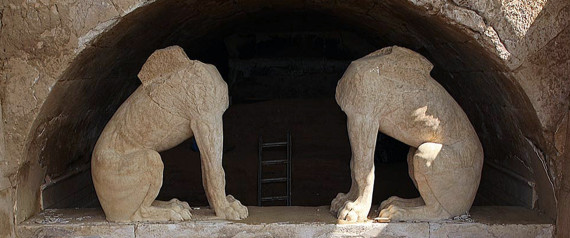
Mystery deepens over ancient tomb

A geologist who took part in the excavation of the ancient burial mound in Amphipolis in northern Greece appears to have poured cold water on the theory, saying that the ancient tomb was not built at the same time as a series of vaulted rooms which were discovered, but was added later.

Geologist Evangelos Kambouroglou added that the mound inside which the rooms and the tomb were found is not man-made, as archaeologists had assumed, but a natural hill.

He also said that the Lion of Amphipolis, a huge 4th century BC sculpture of a lion on a pedestal, which is more than 25 feet tall, was too heavy to have stood at the top of the tomb, as archaeologists had claimed.

“The walls (of the tomb structure) can barely withstand half a tonne, not 1,500 tones that the Lion sculpture is estimated to weigh,” Mr Kambouroglou said.

As for the box-like tomb that contained the remnants of five bodies, possibly more, “it is posterior to the main burial monument … the main tomb has been destroyed by looters, who left nothing,” said Mr Kambouroglou.

“The marble doors (of the monument) contain signs of heavy use, which means many visitors came and went.”

The tomb is thought to date back to the 4th century BC (AP) Open Gallery 1
The tomb is thought to date back to the 4th century BC (AP)

Controversy surrounds the excavation of an ancient tomb in Greece which a leading archaeologist had suggested could be linked to the family of Alexander the Great.

The vaulted rooms had been dated to between 325 BC – two years before the death of ancient Greek warrior-king Alexander the Great – and 300 BC, although some archaeologists had claimed a later date.

Katerina Peristeri, the chief archaeologist in the recent excavation, had advanced the theory that a member of Alexander's family, or one of his generals, could be buried in the tomb.

But the discovery of the boxy grave and the five bodies cast doubt on that theory, and Mr Kambouroglou's announcement appears to disprove it entirely. Some archaeologists present during the announcement criticised Ms Peristeri's absence and her methods.

Alexander, who built an empire stretching from modern Greece to India, died in Babylon and was buried in the city of Alexandria, which he founded. The precise location of his tomb is one of the biggest mysteries of archaeology.

His generals fought over the empire for years, during wars in which Alexander's mother, widow, son and half-brother were all murdered – most near Amphipolis.

Press Association

http://www.independent.ie

Mystery Of Amphipolis Tomb Deepens With New Finding

AMPHIPOLIS TOMB
THESSALONIKI, Greece (AP) — A geologist who took part in the excavation of the ancient burial mound in Amphipolis in northern Greece says the ancient tomb found together with a series of vaulted rooms wasn't built at the same time, but somewhat later than the rooms themselves.

Geologist Evangelos Kambouroglou also said Saturday that the mound inside which the rooms and the tomb were found is not man-made, as archaeologists had assumed, but a natural hill.

He also said that the Lion of Amphipolis, a huge sculpture of a lion on a pedestal , which is more than 25 feet (7.5 meters) tall, was too heavy to have stood at the top of the tomb, as archaeologists had claimed.

“The walls (of the tomb structure) can barely withstand half a ton, not 1,500 tons that the Lion sculpture is estimated to weigh,” Kambouroglou said.

As for the box-like tomb that contained the remnants of five bodies, possibly more, “it is posterior to the main burial monument … the main tomb has been destroyed by looters, who left nothing,” said Kambouroglou. “The marble doors (of the monument) contain signs of heavy use, which means many visitors came and went.”

The vaulted rooms had been dated to between 325 B.C. — two years before the death of ancient Greek warrior-king Alexander the Great — and 300 B.C., although some archaeologists had claimed a later date.

Katerina Peristeri, the chief archaeologist in the recent excavation, had advanced the theory that a member of Alexander's family, or one of his generals, could be buried in the tomb. But the discovery of the boxy grave and the five bodies cast doubt on that theory and Kambouroglou's announcement appears to disprove it entirely. Some archaeologists present during Saturday announcement criticized Peristeri's absence and her methods.

Alexander, who built an empire stretching from modern Greece to India, died in Babylon and was buried in the city of Alexandria, which he founded. The precise location of his tomb is one of the biggest mysteries of archaeology.

His generals fought over the empire for years, during wars in which Alexander's mother, widow, son and half-brother were all murdered — most near Amphipolis.

Costas Kantouris on twitter: @Costaskantouris

http://www.huffingtonpost.com

Revelations on the occasion of a meeting; Sunday at Serres Peristeri-Kargakos

"Woman of the year" by Ms. Peristeri!

peristeri

Can the work of archaeological excavation in Amphipolis through intense questioning, After from many sides listed several theories for what eventually happened to the tumulus of Kasta, However there are still people who believe the archaeologist Caterina Peristeri heroine.

For this and the head of the Ephorate of Antiquities located in Serres are expected to be honored by the city of Lykeio Ellinidon Macedonian with the title of "Woman of the year" this coming Sunday is notoriously day devoted to the fair sex.

The event will be on 11:30 in Hope resort

During the event, will hold a speech and the well-known author and historian Sarantos Kargakos, made by constant interventions in the press during the excavation in Amphipolis.

http://www.karfitsa.gr

by George Rodakoglou

10504947_10153001948628362_5396069363827655920_o

"Imprisoned" the lion of Amphipolis watching the podium. Without language standing mute. "It was autumn 1937. Ebdomintaepta years passed and the lion still gazes the Struma as a wild looking his identity. The architect Michalis Lefantzis studied the existence, and revealed the secret of therioy. He equated the majestic sculpture with Kasta Hill and highlights the "King" on his throne, as a symbol of funerary monument.

"All members of the enclosure is of the same style with the lion. O Tomb on the Hill Kasta bring on top of a four-sided construction built (9,95 X 9,95 X 5,30 measures), which initially was seen by the first excavator Dimitris Lazaridis as burial mark. In fact it is the Foundation of the pedestal on which stood the lion of Amphipolis "says Michalis Lefantzis and notes" the Lion, has a height of 5,30 measures and overall with the pedestal 15,84. Was created with Visual structure, so as to be visible from a distance 100 meters and height 30 "

Archaeological investigations of the Inspectorate of Antiquities in the Serres Prefecture, Greece have sealed the scientific study of Michael Lefantzi with the discovery of part of the back of the.

"I hope that this investigation be completed. I feel proud that I am here in the last two years, and I feel honored that I work for you, for the city and the region "said Mr. Lefantzis in joint press conference of archaeologists and institutions in the Prefecture of Serres.

From the 1960 Greek archaeologists, among them George Mpakalakis of the 6th antiquity Conservancy Kavalas, they believed that the lion of Amphipolis hides a secret. The revelation of the mystery of therioy was forty-four years after.

The analysis of the material from which build the lion testifies that the sculptor used thassian marble similar to this precinct funerary monument, and dated to the fourth century.

The pedestal he discovered ypothemelio 1964 on the Hill the Kasta archaeologist Dimitris Lazaridis combined with new scientific data demonstrate unambiguously that the lion-in antiquity-was at the top of the mound indicating the magnificence of the monument.

The lion of Amphipolis was minced the 1912 from Greek troops when during the Balkan war, the British kicked into the Struma in their quest to take home. Their plans have been thwarting the Bulgarians who occupied the Pangeo.

The remnants of the lion came to light during land drainage of the River in order to become croplands.

The 1937 archaeologists with the sculptor Andrea Panagiotakis composed the sculpture with 11 pieces that were left, While they lack the filled with cement and then placed the lion in place located.

From today's missing form the neck, the language, like the eyes.

"But even if Generally imagine a few dozen inches taller, again compared to other ancient Lions build chunky "writes 1990 Professor of Archaeology at the Aristotle University of Thessaloniki George Mpakalakis in the thesis "ISMARIKOS" WINE

However the architect Michalis Lefantzis explains why the lion has this not as well-formed appearance: "Because you stood atop the mound, i.e. in height 35 with 40 m. and at a distance 100 m., If you do not normally looks normal from afar».

The pose of the lion of Amphipolis vision the then Ambassador of the United States of America Mac Veagh, Describes in his study of the Mpakalakis. The study's rights were given to a Frenchman and an American, and no Greek could make posts for the lion of Amphipolis.

THE ARCHITECT WITH THE ROLE KEY

Michalis Lefantzis belongs to the Group of close associates of Katerina Peristeri. The head of archaeological excavations requested the assistance of the, When he needed some credentials in the course of excavations. The help, Indeed, has been a valuable, as it was the first acknowledgement that the lion of Amphipolis was connected to the Tomb on the Hill Kasta.

He is a graduate of the Department of architecture of the ARISTOTLE UNIVERSITY and PhD in the Department of communication and mass media of the Kapodistrian University of Athens. Works as architect-scholar in South Slope of Acropolis Committee, While he is a member of technical mission produced by the fwtogrammetriki and fix and documentation of the architecture monument of the Panieroy Church of the resurrection in Jerusalem.

"It has even worked in the maintenance of the Holy Church of Agios Nikolaos of Vipers, in the area of Inside Mani, but the restoration of the building of Port Traffic in the naval base of Salamis and the study of the old Ministry of Maritime recovery – Schillizzi home.

At The Same Time, He participated in several research programmes in Greek universities and taught in seminars, organized mainly by the European Union.

Michalis Lefantzis: Powerful symbol on the Hill the lion of Amphipolis Kasta

Said: "Leo has never been at the top of the Hill Kasta"

The theme of the funerary monument of Amphipolis… eventually go, and even with episodic way, Scientific meeting for 28th in the Archaeological Project in Macedonia and Thrace, that starts tomorrow in Thessaloniki, without Jamie Peristeri.

The tumulus Kasta and Leo of Amphipolis will employ the archaeologists, Despite the absence of Katerina Peristeri from meeting

The tumulus Kasta and Leo of Amphipolis will employ the archaeologists, Despite the absence of Katerina Peristeri from meeting

The Director of archaeological Projects-Studies of geology and Palaiologias of the Paleoanthropology-Speleology Conservancy and a member of the Interdisciplinary Team of the excavation at the tomb of Amphipolis, Evangelos Kambouroglou, He will present his own suggestion, challenging several of the claims of the archaeologist.

Speaking at the "" ethnos "newspaper" promises to reveal in his speech, which has the theme "Hill Kasta sediments and their relationship with the tomb", at least three elements that upset some data, one of which is that the Hill was never Kasta tumulus and the representation is not valid-version of k. Peristeri and m. Lefantzi who want the lion had placed at the top of the Hill. "I do not accept to marry my own research results with what the other has in mind», He said Ms. Kambouroglou, adding that would not xanasynergastei with Ms. Peristeri.

"He didn't want to talk»
"I pushed for non-talk, because this was, as I said, decision of the Interdisciplinary Team, which agreed not to notice this year, but time. I replied that I am a member of this group and I do not know such a decision ", reported.

The Director of archaeological Projects-Studies of geology and Palaiologias of the Paleoanthropology-Speleology Conservancy, Evangelos Kambouroglou

The Director of archaeological Projects-Studies of geology and Palaiologias of the Paleoanthropology-Speleology Conservancy, Evangelos Kambouroglou

According to Mr. Kambouroglou, who conducted geological studies in the monument and the 2013, While last summer was a member of the Interdisciplinary Team, the Hill is physicist Kasta, sediment occupy an area 1.200 RPM. and never was tumulus or artificial construction. Never, Indeed, as I will demonstrate, was mounted on top of the lion of Amphipolis.

At The Same Time, will present the results of oryktologikwn tests performed at the University of Athens from the lecturer of geology John Mitsis, which interpret the conditions and causes deposition of soils.

"We need to clarify some very serious issues and to answer critical questions. Ms. Peristeri is aware of and does not want to overturn what supports up to today. For’ It will not attend the Scientific Meeting ", He irritated by the attitude of the anaskafews, that rang three times asking him with a compelling way to do communication. "You must understand that the excavation is the Ministry and not its own, and I am 40 years geologist, the 34 of them an employee of the Ministry and not hers ", answered via "Invests".

Indeed, he does not hide his surprise by the anaskafews statement in a recent interview, in which he noted that "a former associate chose to cut from the team and make this year its own presentation with findings which are not reasonable and does not reflect the positions of the official group of excavation. "My scientific competence will not the judge and especially do not allows to challenge Ms. Peristeri», of answers.

It should be noted that last October felt caused the refutation by Ms. Peristeri how o e. Kambouroglou had sent a sample of soil from the monument in specialized laboratory of Switzerland. "I don't know if he went there for vacation, However there are no samples in Switzerland», then said speaking to reporters, causing embarrassment to time and surprise of paristamenis-then- Secretary General of Ministry of culture, Lina Mendoni. The last was rushing to intervene and say that the analysis of the sample is not associated with the dating of the monument, but with research on the gewperiballon of the region.

The members of the Organizing Committee of the meeting expect even the last time Ms. Peristeri and, as they said, We will be pleased to give the floor even outside the programme.

The speeches and the skeletal material

Outside of fair. Kambouroglou, in the Thessaloniki Meeting will also talk the Professor of Geophysics of a. p. t.. Gregory Tsokas and colleagues, that made the Hill Kasta Geophysics. The issue, however,, as announced, General methods of geophysical prospecting for visualization of the Interior of tumuli.

But the anthropologist, Assistant Professor of A.u.th., Sevi Triantaphyllou, along with her colleague, Assistant Professor in the Department of history and Ethnology of the Democritus University of Thrace, Fotini Adaktyloy, studied the skeletal material of funerary monument, will attend and speak on the "Treatment of the dead during the early Neolithic period in Macedonia».

Conclusions
Speaking at "the k" ethnos "newspaper". Triantafyllou said that in Macedonia there are not many posts of Premier and middle Neolithic period (in the 7th Millennium – early 6 Millennium BC) and hence the behaviour-rasmata from the study of skeletal remains 11 tombs and a small number of scattered bones out of place Rebiena, in Korinos Pieria, are important.

MARIA RITZALEOY
ritzal@pegasus.gr

Amphipolis: Tough confrontation with "rebel anaskafewn" geologist

The intense annoyance and frustration expressed by statements in Ms. Katerina Peristeri on the initiative of geologist-spilaiologoy k. Evangelos Kambouroglou to make a scientific presentation on the Tumulus Kasta in scientific meeting for the Archaeological Project in Macedonia and Thrace. The decision by Mr. Kambouroglou to participate in the Conference of AEMTH, by the excavators, does not violate an agreement between them just to give time to study the findings before any presentation. At the head of the excavation, Mrs. Katerina Peristeri, the move by Mr. Kambouroglou is unethical and unlawful, If contrary to the provision of law. 3028/2002 Article 39 Fri. 6, which stipulates that for publishing material arising from excavation or other archaeological research must be authorised by the person whose exclusive right, as defined in paragraphs 3,4,5 and 7 Article 39 the same law.

Extra, with his statements to various MEDIA, Mr. Evangelos Kambouroglou, bold style, especially against Mrs. Peristeri for which complained that having pushed and threatened not to participate in the AEMTH, promised revelations that will topple specific views that have prevailed for the Hill Kasta. Among the other, questioning the theory that Leo was on top of the Mound and that an is in a large part of human technical work.

Statements of the , Ms. Peristeri submits its own view on the dispute that is ongoing in the final hours between the excavation team and an "outsider" as characterized by. Kambouroglou. Specific, Ms. Peristeri highlights the following:

– "Mr.. Evangelos Kambouroglou, most stayed a 10-day period in the excavation, making visits periodically. It wasn't from our key partners, just enough that led us to the wrong conclusions, because they had told us that she had seen for a trap door in the fourth space, which of course doesn't exist, It was a spar that had been removed in ancient times. He and other errors, Why was telling us that the funerary Chamber had no disorder while ultimately proved that there was a big fuss of space, We said that there had not walked none and that the room is undisturbed burial etc something that certainly constituted an entirely erroneous estimate. I.e., Mr. Kambouroglou, not only gave the guidelines, but our research apoprosanatolise».

– "I do not expect to make any serious showdown at AEMTH, Why not yet completed some serious research in the area. It is in a stage of immature even over all, has not tabled the study of our service. Mr. Kambouroglou doesn't have to say anything he hasn't already said the excavation group».

– "Mr.. Kambouroglou had no substantial involvement in the excavation. Just came sometime, as geologist, to see what happens to the soils around-but also within the monument, If we went with the excavation. But it is essentially three other geologists that deal with the topic, There is a whole group of scientists led by Professor. Gregory Tsoka, was never alone Mr. Kambouroglou. Moreover it was external collaborator, It was not a key member of the excavation team. Err seriously when he says that the research is based on its own findings, because it is not an archaeologist, not even in Service Manager, the Ephorate of Speleology, which is headed by Mr. Andreas Ntarlas. Mr. Just came to Amphipolis kambouroglou like free scholar, and beyond that I don't know how they decided to carry as reported. But it is not good what they do ".

– "Neither pressure, Neither threats ever were on my behalf to Mr. Kambouroglou, These are unheard of things, completely unacceptable and implausible. The pressures and threats says to create impressions».

– "There is a document from the Central Administration of the Ministry against the k. Kambouroglou expressly indicated in that violate regulations and the archaeological law with his announcement at AEMTH. I got the phone. Kambouroglou and, very friendlily, I told him that "you can't talk to Congress, If everyone in the group we have decided together not to talk. Why declared participation without to our updates;"You don't hear me, of course, with ignored. I said "I will do my best,What I want ". This is not correct and ethical, or are we a team or we're not. And despite the fact that it was not a key member of the team, We hear, the agnooisame never. But unfortunately, his behavior has disappointed».

– "We agreed, with all the excavation team, that won't talk in AEMTH, to study, to resolve questions that have, to understand etc., in order to present our findings, integrated and fully detail in next Congress, the 2016. Mr. Kambouroglou, neither asked us, neither got any permission from the team to participate in the Conference, not even informed others three geologists who are in the Group, one of whom is an expert in sediments ".

– "I've filikotati all my colleagues, not only with Mr. Kambouroglou. And at times we had worked, but I am struck by the behavior of the, with much acuteness against us. I've not done anything, He just like other people, He wants publicized by Kasta. For personal benefits, I imagine. And I am very sorry ".

Architect and civil engineer belie the k. Kambouroglou

The architect of the excavation in Amphipolis, Mr. Michalis Lefantzis as one of three members of the research team, with critical contribution to archaeological research from the first moment of the task 2012, stresses that ' beyond unethical attitude, Mr. Kambouroglou not entitled to express an opinion on issues that are outside of the specialty. Says, l. x. that Leo was not atop the Mound. Let me remind you that in about ten days found in Amphipolis or in subsequent sporadic visits, Mr. Kambouroglou can't imagine how he approached the subject of Leo and plinth, let alone the architectural characteristics of pwrinwn four foundations which have an important role in research, the first at the top of the mound and the second to the point where he finally placed the sculpture to a conventional pedestal by Oscar Broneer. I don't think that can evaluate the scattered marble members attributed to the monumental this all or and sections that are attributed to sculpture. And you certainly don't know the architectural issues, the data of the excavation in relation to the historical topography of the area and nothing of what had transpired during the investigation. Also remind that the excavation team has offered its full support to. Kambouroglou despite the serious faults of, such as the case for the northern port of funerary Chamber wall. In General, However, We had every intention to share our views with him, He, however, refused even to discuss with us. Mr. Not written with kambouroglou excavation team and did not attempt to contribute to the composition of data in a multidisciplinary cooperation. Many times influenced the Administration even in technical matters, squeezing out the engineers, the architect and the civil engineer of excavation, Although we were the "substantive responsibility".

Mr. Dimitris Englishman, the engineer who was responsible for the heavy responsibility to keep, on the substance, the Monument standing, preventing the collapse of, is limited and that the issues of the specialty and does not wish to engage in scientific controversy through press statements. States that did not participate in deciding on the timing of announcements about the Tumulus Kasta, but this, as provided for the Archeological Law, falls within the exclusive competence of the respective head of excavation. However, Mr. Englander notes that "Mr. Kambouroglou indicates, with some swagger, that "was in danger of my life in a ramshackle cabin".

This could have adverse consequences for him and for his son, or those swept away to put him inside the monument uncontrollably before placed ypostilwtika measures. But the responsibility for anything that would happen within the monument, fatal will be passed to the project engineer. I think the risk was a completely inappropriate action on behalf of Mr. Kambouroglou, who preferred to ignore our recommendation for patience. Both I and Mr. Lefantzis and Ms. Peristeri insisted on completing the direct supportive measures before any of the workshop, researchers etc could move safely inside the monument.

Also, Mr. Kambouroglou support network called like "iron curtain": However "these, the metallic elements were necessary for the safety of the monument, There was some exaggeration.

And even by younger calculations, It seems that further additions for the stability of the monument in the medium-long run.

End, because the k. Kambouroglou compared the monument with a cave or tunnel, something that was released and in the media, I would say that the cave is a natural state, self-supporting, not even syragga, because they did not need to opened something and support. As analyzed in the workshop of the Ministry of culture to Amphipolis in November, This edifice is characterized as "technical work with excavating and epanepichwsi", "cut and cover". I.e. build and epichwthike, so from an engineering perspective of behaviour, has nothing to do with the cave».

Research on the Tomb continues

Closing fitting, the head of the excavation in Amphipolis, Mrs. Katerina Peristeri notes that "with the opportunity, I would like to say that we do a really important and serious research around the burial Mound complex Kasta, We have all the good mood and willing to continue our research. Already with his team k. Gregory Tsoka has launched a geophysics research will continue and indeed the Hill hides and other secrets, not only is the monument from, There are many more yet to be revealed and should proceed with small and steadily. But should all the partners to be United, There is some people to detach and aim at the little publicity that gives the Tumulus of Amphipolis. It's a shame, Sorry for "this".

Source: www.protothema.gr

Amphipolis: The Tumulus, Delphi and the dynasty of the Temenids

The scholar Antonio Corso speaks at protothema.gr: "There are important findings that hasn't seen anyone except the excavators ' – ' Forms in painted epistylia referring to the victory of Alexander the great over the Persians, but Delphi»

The Italian scholar Antonio Corso, archaeologist and art historian, considered the world authority on ancient Greek sculpture, deposits in protothema.gr an original and completely documented interpretation disputed funerary monument of Amphipolis.

The main points of the interview, highlights:

– Yet, There is a relationship of the Mound of Amphipolis with the royal dynasty of Macedonia, the Timenides and the cycle of Alexander the great
– The same statues of Sphinxes and Karyatidwn exclude any other dating outside of the end of the 4th BC. century.
– Forms in painted epistylia referring to the victory of Alexander the great over the Persians, but in Delphi.
– The Tumulus erected ' blanketing ' a pre-existing sanctuary, dedicated to the local goddess Fyllis.

– What is your own interpretation summarized for the Tumulus of Amphipolis;

Very briefly, I think the tumulus of Amphipolis is clearly Macedonian, dates on the 330-320 e.g.. and build, probably by architect Deinokrati, in honor of some illustrious Warrior. This is documented, not only on the basis of those findings have been made public so far, but some who, as I am sure, It is to be revealed in the future. I firmly believe that there are very significant findings, confirming the date and identity of the monument, but that one, Besides the excavators, has not seen up to now.

I am convinced that Leo was on top of the Mound and, like all other sculptures (the Sphinxes, the daughters or ' Caryatids ' etc.) executed by Thasioys artists who, whether they were all in the same workshop, either they were partakers of the same notion of sculpture. The Caryatids, with their hands stretching toward the inside of the gate, should they held wreath, prospectively over the head of a statue, probably in a sitting posture, that was in the center of the first Chamber. He must have been the dead, in honor of which created the Tumulus, overwrapping and encircle the enclosure a gilofo who previously, as an epigram of Antipatroy of Thessalonikews, It was already a place of worship, dedicated to the local goddess Fyllis.

Particularly important finding for the interpretation of the monument I painted epistylia: The performances are divided into those, IE Win, the tripod, the bull, the Palm tree etc.. indicate a direct correlation with Delphi. In my view, This symbolic link with the sacred for the ancient Greek site of Delphi, leads to the conclusion that the Tumulus of Amphipolis is a monument dedicated to the war triumph of Alexander the great over the Persians. The Athenian general Kimon devoted among other things and a Palm tree in the sanctuary of Apollo at Delphi after his victory over the Persians on the Eurymedon River (469-466 e.g.). Inspired by this, the paraggeliodotes of the Mound in Amphipolis reiterated symbolic consecration in the great victory of the Macedonian army, that can only have helped the dead.
The whole monument is extremely important, because it testifies to the Hellenistic kosmoantilipsis turn into oversize, something that combined immediately with the totalitarian power.

The head of the excavation, Mrs Katerina Peristeri, recently downplayed the importance of skeleton aneyrethentwn. You agree with this view;

It seems reasonable that, as excavators, the dead found they had bowled at that point ataktws, so I guess it wasn't those people which made the Tomb. Of Course, I don't know the original dead of Mound and I would imagine that no one can know when or if he will never know his identity. However, the reasons why build the monument, in order to render values in someone or some, It is evident from the painted architrave, with the Phoenix and other representations. In my opinion, the artistic and historical view of the Mound of Amphipolis have much greater importance. Because the Tomb is a shining monument, dedicated to Asian Macedonian campaign-and the Palm this clearly shows-, something that is far more important than the identity of the dead. At least I think I, as a historian of ancient art.

– You probably, though, that the Tumulus is linked to the dynasty of the Temenids or, whether or not, with the circle of generals on Alexander;

I believe that someone very high-ranking warrior was buried there and I agree with the excavation team architect, Mr. Michael Lefantzi, who has said something similar in his TV interview. Furthermore I believe that the Tomb had relation to the circle of Alexander the great, but not with the Olympiad as had been assumed, This is extremely unlikely. I see no reason why the Olympics is buried in Amphipolis, I don't see its connection with the victory over the Persians or someone strong bond of the Olympiad with Delphi. I don't want to go in vain nomenclature, for if it could be the Ifaistiwn or any other. What I think I, is that the Tomb was created in Amphipolis first of all because the tumuli, who was anyway a typical element of Greek cities, for the Macedonians became, somehow, the most important point of the urban landscape. While, as we know, in the classic "were" the most important center was the temple, the sanctuary.

– There is always the question "why in Amphipolis;»

Amphipolis was chosen, because it was the starting point of the expedition of Alexander the great. The Aigai and Pella were both important parts for the Macedonians, but they were not so closely connected with the campaign of Alexander the great. Extra, my own theory says that it wanted to put an illustrious dead at one point that was already sacred. If this was the heroon of Fyllidos (something that seems very likely because an was covered with green and trees, especially almonds, element characteristic of the worship of the people of the region for Fyllis), the space was already strong and kathosiwmenos’ the importance of this judgment for the.

– There is political symbolism in the enormity of the Mound;

In the period for which we discuss, i.e. the last quarter of the 4th BC. century, There is one innovation – love for larger dimensions, something that had already begun with the Mayswlo. The Latin term is magniloquentia, the maximalismos, which eventually leads to the Baroque. Is the idea of visualizing someone huge monuments, While the classical art doesn't likes to something, prefers the symmetry, the proportions, the «measure», est modus in rebus, or ne quid nimis, the ' Agan ' zero. On The Contrary, Macedonians tends toward the large and majestic oikdomimata, something that depends on totalitarian force. Shows the Gigantism because lots of things have changed in the ancient Greek conception of the world. A monument to the logic of Gigantism is in perfect harmony with the spirit of the season.

The monument and only with the dimensions of, It showed how important were the kings who built. I think someone from the wider Royal family were buried there and I wonder if the Antipater the Thessalonikeys, who lived in the time of Augustus, in an epigram that, If I remember correctly is the No.. 705 the 7th book, Describes the Amphipolis, from which at that time had left only ruins. There the poet mentions a temple of Fyllidas that, probably is the current Tomb Kasta.

– In your own visa ignore completely the skeletal material and focus on sculptures and even in epistylia, in which there was ever given particular attention by the public, Despite the intense interest in the monument and its significance. How do you explain this;

Apparently, because I believe that the information can enlighten us and to solve our questions lie ahead. The statues and the paintings we talk-and performances, in my opinion, they say too many. For example, the dating of the Mound on which became so great debate, cannot be moved from the last quarter of the 4th BC. century-and this requires the format have the daughters (the "Karyatidai" is a conventional name prevail, essentially when the wrong). For various reasons it is not scientifically serious chronologoyme to the Tumulus of Amphipolis in the 1st b.c.. century, in Roman times, etc.. First of’ all, well, the "Korai" bear a kind of shingles underneath their breasts, which is very fashionable in sculpture around 340 e.g., as we know from the Attic Reliefs (Attic Document Reliefs or Urkundenreliefs).

Their sandals, also, are identical with those of a group of statues of this period, including e.g. the Hermes of Olympia, Artemis of Gabii, a typology of statues of Artemis which is usually attributed to Praxiteles-so it may not be very far from this dating- and later was copied ad nauseam by Romans sculptors, Apollo Belvedere, the "Artemis of Versailles ' etc..
Therefore, This whole network of comparisons rests firmly her daughters Amphipolis around 330 e.g., just based on the typology of their sandals. But we can analyze and Zig-Zag at the finish of the tunic of statues, which constitutes another Ionic model that was particularly popular among sculptors of the Artemision of Ephesus-and I am referring to the post-classic stage, about in 330-320 e.g..

Prokrinw the specific dating, especially based on the columna caelata, which is attributed to the great sculptor Skopas and bring these folds in zigzag order, Type "zig-zag". This is a pattern that occurs often in ionic workshops this period. The post-classic period is a phase of intense Ionian revival and so, the Ionic style is becoming very fashionable, both in architecture and sculpture.

– In your opinion, the Sphinxes and Caryatids were designed by the same artist;

The heads of the statues saved, of Karyatidas and the Sphinx, closely resemble the head of Dionysus from Thassos, as with the heads of Aetidwn, from the ysteroklassiko Temple of Apollo in Delphi.

Dionysus of Thassos is a marble head, which has been found in Thassos, kept in the Museum and dated in there 330-320 e.g.. This, as to the artistic and technical characteristics are extremely close to the head of the Sphinx was found in the tomb of Amphipolis. The aesthetic and technical comparison is revealing and, in my opinion, justifies the conclusion that, not only the marble as a raw material, but also the laboratory undertook to painted Tomb sculptures came from Thassos. Also, There is another head, female, which was found in the Temple of Hercules in Thassos, that looks extremely, This time not with the head of the Sphinx, but with her head Karyatidas.

Judging from photos, as I have not seen in person the monument, I would say that the Sphinxes and Caryatids are manufactured by two different thasitikoy marble veins, but both come from the same quarry.

In what,What is symbolism, in my opinion, one could say the following: First of all, There is a close link with Apollo and the sanctuary of Delphi, in which the sovereign God was Apollo, though, Once he left for the country of Yperboreiwn, Dionysus replaced. This mixing Apollo and Dionysus, refers to a single point of Greek territory of that era: Delphi. Why I believe this is the following: (a)) The overall silhouette of Karyatidwn closely resemble the Sifnian treasure trove of Daughters in Delphi. (b)) The Sphinxes were sacred forms dedicated to Apollo, something that cannot be disputed.

– You give great emphasis on epistylia. What is your theory about’ These;

I think the item that gives us evidence for the connection of the monument of Amphipolis with Delphi are the painted epistylia. It is critical that bonanza because there is a tripod and a genus Arecaceae, as it was dedicated by kimon in Delphi after the victory over the Persians in the Eurymedon (469-466 e.g.). So, We re-use of foinikodentroy in the painted architrave, as this symbol of the victory of the Greeks over the Persians in Asia minor, the pattern was for art genikotera. This is due, of course, the Macedonians to victory over the Persians in Asia. I'm sure you'll find other elements that will confirm that this monument was created in honor of a victory of the Macedonian army and speak for the Tumulus total.

Also in an engraved architrave, the impeller shape beyond doubt, It seems that is a victory. At my disposal I only have the photos published by the MINISTRY of CULTURE, I imagine though that what you've seen, like anyone else, It is not the only part of an epistyle is an engraved, There should be more.

As for the bull, He, of course, represents Dionysus, It can't be something else, because it dominates with its size in the composition. Already at the Evripides Bachkes refers to Dionysos as a creature with the features of Taurus and we must not forget that the Bacchae of Euripides were presented for the first time in Macedonia, in the courtyard of Pella. Thanks to the tragedy of Euripides, There is a strong bond of Taurus with Dionysus.

In epistylia we see that both styles tend toward the bull, who is at the center of this show. These all, in my opinion, talk about a Dionysian representation and can relate to the era in which it was constructed the monument, If it is known that Apollo was returning from the land of Yperboreiwn in the middle of summer, as we know from the poet Alcaeus. Therefore, Maybe it has something to do with the period that Dionysus was the ruler of Delphi and anyhow, There are reports from several other famous sculptures, the so-called opera nobilia.

Dionysus had very great importance for Alexander the great. I would say that the period during which build the Tumulus is a time when the spirit of change. The gloom was abandoned and this excitement, the exapsei that causes Dionysus is considered typical of totalitarian power. So Dionysus becomes the most important God for the Macedonians.

We also know that Alexander the great was a drinker, We would say "a very robust glass" and is transported back cueing techniques in crowd representations concerning him. Is the period that the Greek spirit abandons the cold rationality of the classical period and everything tend to dionysiasmo, the abuses and the baroque conception of the world-these are all about the specific attitude to life, which are characteristic and important.

– See other symbolism in Memorial;

The Caryatids are closely connected with death. Even on the Acropolis of Athens, the Korai are considered sentinels of the tomb of between Evmolpos. The Sphinxes, for example, It wasn't as much butt they think. One had her head turned inwards and outwards. And in it there was, of course, symbolism: One look to the outside world, of live and the other towards the inner workings, in the world of the dead. The Sphinxes stand on the boundary, between the Kingdom of the living and the dead. But the whole sequence of cubicles that leads to the deepest point of the Mound gives emphasis to this route from life to death. Therefore, constitutes a religious or even psy-agwgiki experience. There are other examples of such complex of monuments, for example, Pausanias mentions the Heroon of Trofoniou in Livadia. The Trophonius was one of the two architects of the Temple of Apollo at Delphi. Then became a hero and even with therapeutic properties, for’ This divination and became the subject of worship. All these are related to the heroic beliefs, which had acquired great importance during that period. The therapeutic qualities of heroes and deities, a characteristic element of this period, the Salvation, emerges in principal mental need for people. Therefore, the Tumulus of Amphipolis answers to spiritual needs.

– So, Besides burial, the monument of Amphipolis was extra and devotional;

I think all the elements compose a clear reference: Apollo was the God who gave the victory to the Macedonians. Apollo is associated with Delphi, as Dionysus, who during the specific period is equally important with Apollo. In the Temple of Delphi, in the Eastern gable apeikonizontan Apollo with Muses and on Western Dionysus among the Thyiades (Maenads). Therefore, the monument of Amphipolis distinguish all elements of spirituality, that is the end of the 4th century BC.

* O Antonio Corso is an Italian archaeologist and art historian, skilled in the architecture and the ancient Greek sculpture. Author 11 books and more from 100 Special articles, Mr. Corso is regarded worldwide as a pundit on Praxiteles to whom he has dedicated the largest part of the project's scientific. Antonio Corso studies constitute a point of reference for the scientific community in the industry. By the 1980s the Greece is the basis of Mr. Corso, Although successive scholarships and his collaborations with leading research centers around the world to compel him occasionally migrates in countries like Britain, the Germany, the Hungary, the Sweden, the Russia etc.. However, deeply convinced that Greece is the land of plenty for the scholar of ancient Greek civilization, Antonio Corso always returns to Athens.

http://www.protothema.gr