Peristeri on Amphipolis: The skeletons may be remnants of sacrifices or looters

Peristeri GR IBNABy Spiros Sideris

"We need to focus on the monument, not the bones, which for me do not mean a lot. You cannot perform datings from the dead. For me the skeletons are meaningless. They mislead the investigation ".

These are the statements of the head of the excavation team at Amphipolis, Katerina Peristeri, in an interview with the Real News. Indeed, she goes even further saying that "for me issue of the ' skeletons ' does not say anything. The area was so disturbed that you cannot draw clear conclusions. The robbers had ravaged everything. Because, as you can see, the burial chamber where they were looking for great treasures sustained a lot of damage, an enormous destruction ".

As for who the skeletons belong to, she was said: "There are many assumptions we can make. The skeletons may have been remnants of sacrifices, may even belong to the looters. Besides, the skeletal material was not in one place ".

Referring to the main dead she said: "Who is the main dead? There is a large piece of skeletal material from the dead found lower than the rest, ie close to the floor, and belongs to a short man, 1.60m. Even this skeleton, however, was scrambled by the robbers. And there is the other thing, if indeed the dead was so precious, they may had even taken him ".

In the same interview Katerina Peristeri speaks for all the other issues that have arisen: answers to her critics, expresses bitterness, describes her feelings for the blows she received, while she talks in detail about the "unique burial complex", making extensive reference to the first phase of excavation and what comes next

– See more at: http://www.balkaneu.com/peristeri-amphipolis-skeletons-remnants-sacrifices-looters/#sthash.ffrdvriz.dpuf

The destruction of the Great Library of Alexandria

The destruction of the Great Library of Alexandria

Alexandria, one of the greatest cities of the ancient world, was founded by Alexander the Great after his conquest of Egypt in 332 BC. After the death of Alexander in Babylon in 323 BC, Egypt fell to the lot of one of his lieutenants, Ptolemy. It was under Ptolemy that the newly-founded Alexandria came to replace the ancient city of Memphis as the capital of Egypt. This marked the beginning of the rise of Alexandria. Yet, no dynasty can survive for long without the support of their subjects, and the Ptolemies were keenly aware of this. Thus, the early Ptolemaic kings sought to legitimize their rule through a variety of ways, including assuming the role of pharaoh, founding the Graeco-Roman cult of Serapis, and becoming the patrons of scholarship and learning (a good way to show off ones wealth, by the way). It was this patronage that resulted in the creation of the great Library of Alexandria by Ptolemy. Over the centuries, the Library of Alexandria was one of the largest and most significant libraries in the ancient world. The great thinkers of the age, scientists, mathematicians, poets from all civilizations came to study and exchange ideas. As many as 700,000 scrolls filled the shelves. However, in one of the greatest tragedies of the academic world, the Library became lost to history and scholars are still not able to agree on how it was destroyed.
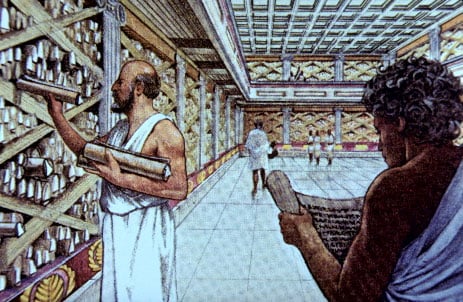
Library of Alexandria

An artists depiction of the Library of Alexandria. Image source.

Perhaps one of the most interesting accounts of its destruction comes from the accounts of the Roman writers. According to several authors, the Library of Alexandria was accidentally destroyed by Julius Caesar during the siege of Alexandria in 48 BC. Plutarch, for instance, provides this account:

when the enemy tried to cut off his (Julius Caesar) fleet, he was forced to repel the danger by using fire, and this spread from the dockyards and destroyed the great library.
(Plutarch, The Life of Julius Caesar, 49.6)

This account is dubious, however, as the Musaeum (or Mouseion) at Alexandria, which was right next to the library was unharmed, as it was mentioned by the geographer Strabo about 30 years after Caesar siege of Alexandria. Nevertheless, Strabo does not mention the Library of Alexandria itself, thereby supporting the claim that Caesar was responsible for burning it down. However, as the Library was attached to the Musaeum, and Strabo did mention the latter, it is possible that the library was still in existence during Strabo's time. The omission of the library can perhaps be attributed either to the possibility that Strabo felt no need to mention the library, as he had already mentioned the Musaeum, or that the library was no longer the centre of scholarship that it once was (the idea of ' budget cuts ' seems increasingly probable). In addition, it has been suggested that it was not the library, but the warehouses near the port, which stored manuscripts, that was destroyed by Caesar fire.

The second possible culprit would be the Christians of the 4th century AD. In 391 AD, the Emperor Theodosius issued a decree that officially outlawed pagan practices. Thus, the Serapeum or Temple of Serapis in Alexandria was destroyed. However, this was not the Library of Alexandria, or for that matter, a library of any sort. Furthermore, no ancient sources mention the destruction of any library at this time at all. Hence, there is no evidence that the Christians of the 4th century destroyed the Library of Alexandria.

The last possible perpetrator of this crime would be the Muslim Caliph, Omar. According to this story, a certain "John Grammaticus" (490–570) asks Amr, the victorious Muslim general, for the "books in the royal library.” Amr writes to the Omar for instructions and Omar replies: “If those books are in agreement with the Quran, we have no need of them; and if these are opposed to the Quran, destroy them. " There are at least two problems with this story. Firstly, there is no mention of any library, only books. Secondly, this was written by a Syrian Christian writer, and may have been invented to tarnish the image of Omar.

Unfortunately, archaeology has not been able to contribute much to this mystery. For a start, papyri have rarely been found in Alexandria, possibly due to the climatic condition, which is unfavourable for the preservation of organic material. Secondly, the remains of the Library of Alexandria itself have not been discovered. This is due to the fact that Alexandria is still inhabited by people today and only salvage excavations are allowed to be carried out by archaeologists.

While it may be convenient to blame one man or group of people for the destruction of what many consider to be the greatest library in the ancient world, it may be over-simplifying the matter. The library may not have gone up in flames at all, but rather could have been gradually abandoned over time. If the Library was created for the display of Ptolemaic wealth, then its decline could also have been linked to an economic decline. As Ptolemaic Egypt gradually declined over the centuries, this may have also had an effect on the state of the Library of Alexandria. If the Library did survive into the first few centuries AD, its golden days would have been in the past, as Rome became the new centre of the world.

Featured image: One of the theories suggests that Library of Alexandria was burned down. ' The Burning of the Library of Alexandria ', by Hermann Goll (1876).

By Ḏḥwty

References

Empereur, J.-Y., 2008. The Destruction of the Library of Alexandria: An Archaeological Viewpoint. In: M. El-Abbadi & O. M. Fathallah, eds. What Happened to the Ancient Library of Alexandria?. Leiden; Boston: Brill, pp. 75-88.

Haughton, B., 2011. What Happened to the Great Library at Alexandria. [Online] Available at: http://www.ancient.eu.com/article/207/
[Accessed 8 May 2014].

Newitz, A., 2013. The Great Library at Alexandria was Destroyed by Budget Cuts, Not Fire. [Online] Available at: http://io9. com/the-great-library-at-alexandria-was-destroyed-by-budget-1442659066
[Accessed 8 May 2014].

Plutarch, Life of Julius Caesar,
[Perrin, B. (trans.), 1919. Plutarch's Lives. London: William Heinemann.]

Wikipedia, 2014. Destruction of the Library of Alexandria. [Online] Available at: http://en.wikipedia.org/wiki/destruction_of_the_library_of_alexandria
[Accessed 8 May 2014].

– See more at: http://www.ancient-origins.net/ancient-places-africa-history-important-events/destruction-great-library-alexandria

About golden ratio

The Golden Ratio – a sacred number that links the past to the present

There is one thing that ancient Greeks, Renaissance artists, a 17th century astronomer and 21st century architects all have in common – they all used the Golden Mean, otherwise known as the Golden Ratio, Divine Proportion, or Golden Section. Precisely, this is the number 1.61803399, represented by the Greek letter Phi, and considered truly unique in its mathematical properties, its prevalence throughout nature, and its ability to achieve a perfect aesthetic composition.

According to astrophysicist Mario Livio:

Some of the greatest mathematical minds of all ages, from Pythagoras and Euclid in ancient Greece, through the medieval Italian mathematician Leonardo of Pisa and the Renaissance astronomer Johannes Kepler, to present-day scientific figures such as Oxford physicist Roger Penrose, have spent endless hours over this simple ratio and its properties. But the fascination with the Golden Ratio is not confined just to mathematicians. Biologists, artists, musicians, historians, architects, psychologists, and even mystics have pondered and debated the basis of its ubiquity and appeal. In fact, it is probably fair to say that the Golden Ratio has inspired thinkers of all disciplines like no other number in the history of mathematics.

In mathematics and the arts, two quantities are in the golden ratio if their ratio is the same as the ratio of their sum to the larger of the two quantities. When the Golden Mean is conceptualised in two dimensions it is typically presented as a regular spiral that is defined by a series of squares and arcs, each forming "Golden Rectangles".

This symbolic potential arises because of the way the means spiral shape resembles growth patterns observed in nature and its proportions are reminiscent of those in human bodies. Thus, these simple spirals and rectangles, which served to suggest the presence of a universal order underlying the world, were thereby dubbed "golden" or "divine".

The Golden Ratio in History

The golden ratio has fascinated Western intellectuals of diverse interests for at least 2,400 years. The earliest known monuments believed to have been built according to this alluring number are the statues of the Parthenon in Greece, dating back between 490 and 430 BC. However, there are many who have argued that it goes back much further than this and that the Egyptians were well versed in the properties of this unique number.

According to some historians, the Egyptians thought that the golden ratio was sacred. Therefore, it was very important in their religion. They used the golden ratio when building temples and places for the dead. In addition, the Egyptians found the golden ratio to be pleasing to the eye. They used it in their system of writing and in the arrangement of their temples. The Egyptians were aware that they were using the golden ratio, but they called it the “sacred ratio.”

The first recorded definition of the golden ratio dates back to the period when Greek mathematician, Euclid (c. 325–c. 265 BC), described what he called the “extreme and mean ratio”. However, the ratio's unique properties became popularised in the 15th century when aesthetics were a vital component of Renaissance art and geometry served both practical and symbolic purposes. As the famous mathematician, astronomer, and astrologer, Johannes Kepler (1571 – 1630) wrote:

Geometry has two great treasures: one is the Theorem of Pythagoras, and the other the division of a line into extreme and mean ratio; the first we may compare to a measure of gold, the second we may name a precious jewel.

The Golden Ratio in Architecture

Many artists and architects have proportioned their work to approximate the golden ratio, with the belief that the outcome will be more aesthetically pleasing. Using any of these ratios, an architect can design a door handle that has a complementary relationship to its door, which in turn has a similar relationship to its enclosing wall, and so on. But more than this, the golden ratio has been used for the façade of great buildings from the Parthenon to the Great Mosque of Kairouan and all the way through to modern landmarks such as the Sydney Opera House and the National Gallery in London.

The Golden Ratio in Nature

Perhaps what is most surprising about the Golden Ratio is that it can be seen as a naturally occurring phenomenon in nature. The golden ratio is expressed in the arrangement of branches along the stems of plants and the veins in leaves. It can be seen in the skeletons of animals and humans and the branching of their veins and nerves. It can even be seen in the proportions of chemical compounds and the geometry of crystals. Essentially, it is all around us and within us and for this reason, German psychologist Adolf Zeising (1810 – 1876) labelled it a ' universal law ':

in which is contained the ground-principle of all formative striving for beauty and completeness in the realms of both nature and art, and which permeates, as a paramount spiritual ideal, all structures, forms and proportions, whether cosmic or individual, organic or inorganic, acoustic or optical; which finds its fullest realization, however, in the human form.

As a result of the unique properties of this golden proportion, many view the ratio as sacred or divine and as a door to a deeper understanding of beauty and spirituality in life, unveiling a hidden harmony or connectedness in so much of what we see.

By April Holloway

– See more at: http://www.ancient-origins.net/unexplained-phenomena/golden-ratio-sacred-number-links-past-present-001091#sthash.we7t6pvy.dpuf

The scientific study of the findings of Amphipolis matures at time of


The excavation of Amphipolis is a separate archaeological field surveys that no scientist can not analyze it over a bit months as good and if it is.

Given the fact that they spent eight months from the discovery of a funerary monument on the Hill of Mesolakkias Kasta ,the persistence of those who insist to publish the final results of studies , verges of insanity.
In the space of the archaeologists considered unthinkable to occur in scientific Congress and Moreover in a section a few minutes, a thorough work that has not even completed the cycle of.
The absence of an interdisciplinary group of Katerina Peristeri from 28 scientific meeting of archaeologists 5 until 7 March will take place in UNIVERSITY, demonstrates the seriousness with which we treat studies of archaeological findings .
The update for the archaeological developments in tumulus Kasta from August, covered to the fullest extent all the audience who watched and the monitor, but now came the time of scientific study that requires much work and in-depth analysis. Something as a "torment" will say ,for those involved in this process.
It should not go unnoticed that there are cases where archaeologists excavated scholars do not meet the threshold of five years must publish their results. Some even have far surpass the limit. It is known through recurrent publications, is the case of Kalliope Lazaridi here and 31 years did not go to the scientific publication of Efibarchikoy law discovered in Amphipolis the 1984.
So if you compare two instances that refer to the same region should ask the reasons in a case, We insist so much on the other do not know absolutely nothing.
The Deputy Culture Minister Nikos Xydakis should perhaps be focused towards this data search after the introduction of the three-Member Committee will examine the topics of Amphipolis. The main task of this epitropias must be the effective promotion and documentation of the findings as a whole and not the comparative political posturing. Every other attempt kapelwsis of scientists who already participate in the excavation of the Tomb on the Hill will issue raises moral Kasta and discriminatory strategy something that the previous administration of YPPOA considered non-negotiable items.
The excavations in Amphipolis present peculiarities and great importance , Therefore, it would be preferable to serve as an educational scope object a broader scientific conference through an inclusive process that could occur under the auspices of the Aristotle University of Thessaloniki.
In this Conference can participate all researchers, by project partners of the late Dimitris Lazaridis, to the followers of, where everyone will show the unity of. At the same time can be given the opportunity on those scientists wish to submit queries, queries and complaints. This however requires the completion of a research project into the tumulus Kasta along with the continuation of the excavation will start in May and according to estimates, earmarks and other good news.

by George Rodakoglou

http://www.thousandnews.gr

THE TAFI OF M. ALEXANDROU AND THE ADVENTURE OF THE LEIPSANWN

Alexander the Invincible

As it known, Alexander died in Babylon the 323 e.g.. Εκεί οι νεκροί κατά τους Ηρόδοτο, Στράβωνα και Στοβαίο δεν μουμιοποιούνταν ούτε καίγονταν αλλά θάπτονταν τοποθετημένοι μέσα σε μέλι ή κερί. Το ίδιο έγινε, as for the bunch of Alexander who was destined to be buried in Macedonia led the x 321p.. from Damascus as violent by Ptolemy (a)’ in Egypt (Παυσανίας, Arrian, Αιλιανός). There in mainstream information was buried in the Holy City of Memfi “According to Macedonian law provided for cremation” (Παυσανίας, Πάριον Χρονικόν, Κούρτιος Ρούφος).

CONTINUE THE READING

White mummies of China and indications that the Greeks of Alexander the great, they arrived until the ancient China…

White mummies of China and indications that the Greeks of Alexander the great, they arrived until the ancient China
Due to the aridity of the desert, many features have not been altered completely
tarim-mummies08

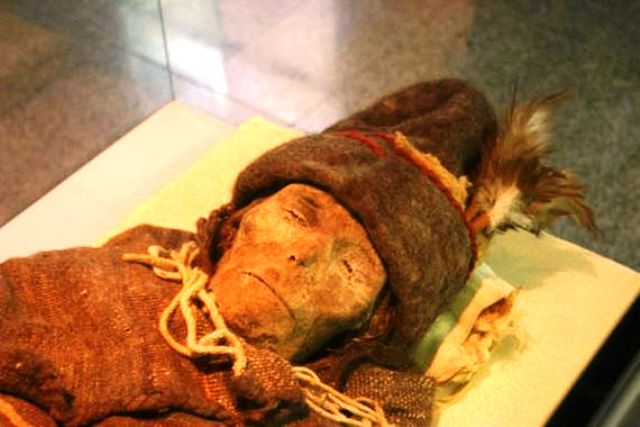
In the Tarim basin ", in the Xinjiang Province of China, Takla Makan desert lies, in which discovered mummies with eyrwpaϊkacharaktiristika.
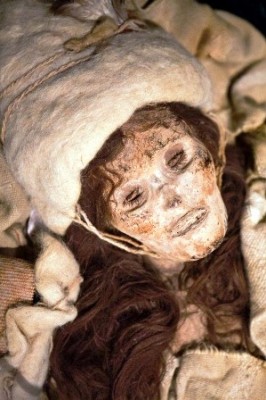
The mummies are almost 4000 years, After going back to 2000 e.g.. Because of their color, they have been named "white mummies». Because of the desert drought, many of the mummies retain their characteristics, While there are several garments. The results of scientific investigations are impressive, as proving the existence of immigrants from Europe in the wider region of Tarim.
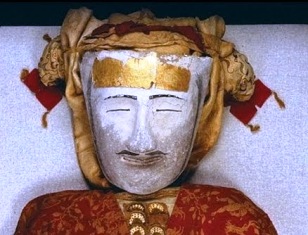
The mummies have no eyes and Chinese are taller than Asians. The color of their hair has mostly blonde and Auburn and the person bring «corners». The clothes that have not been tampered with, and some burial artifacts refer to European peoples. At times, has recorded the presence of Europeans in the region. The Roman Emperor Claudius had received some reports about the existence of human beings in the Tarim basin ", they had hair anoichtokitrina, blue eyes and a height much bigger than that of Asians. References are not historically substantiated and are not safe source, However reinforce the view of researchers.

*Lived Greeks in Tarim area;*

45a06d9cfc9d359f0654f1ab7875c086

The Chinese historian priest's wife Shima has recorded in the file of the story of the Emperor's Ambassador Wu, The Priest's Wife Zhang, who was sent to the West to search for allies against the Huns. During the trip, prisoner and when he managed to escape, Takla Makan desert found, where he met the
«Ntaϊoyan» (conjectured Greeks even when they bring). The described, White, with beard, no Chinese eyes and reported that they had in their possession horses, beautiful buildings and objects and statues. The area in which it is alleged was inhabited Alexandria eschate, one of the towns that had been founded by m. Alexander, so if the guesswork, the people who described the priest's wife Zhang, were Greeks. When the emissary returned, He talked about people who met the Emperor, which was mainly for horses. Thus began the contact and the exchange of.
Based on these data, It is possible the existence of Greeks in the region. The attire of the Mummy points to Europeans of the time the results of the investigations show that the mummies, have diverse
ancestry. This is justified by the "mixing" of peoples or by other tribes for commercial reasons. The mummies discovered, create a political issue in the city, Once in the past, the inhabitants of the region, they had asked their independence, arguing that there are Chinese.
The survey results indicate that they may have right.

The clothing of the mummy refers to Europeans of the time

mixanitouxronou