An Egyptian writing for the greekness of Macedonia

Written by Nikos Martis

The identity of the Macedonians as Greeks, other well-known adiapseystwn historical data (inscriptions, discoveries of archaeological sites, ancient Greek historical texts, Jews, Romans etc) confirmed by an inscription of 267 e.g.. (Photo of which I sent Mr. Stavros Hatzis, Retired Policeman, that tracks the theme of Macedonia) which is found in Egypt and refers to sports competitions, made in twelfths Royal birthday.

Athletes who reported that struggled, characterized by their place of origin (Thrax, Macedon, Samios etc.), i.e. from the single Greek geographic area. Therefore, only by the fact that listed among other Greek athletes and four Macedonians athletes, confirms that the Macedonians are Greeks.

George Robinson, to the issued the 1899 in New York his book written: The ancient Egyptian civilization galoychithike for three centuries of Greek culture and trade developed in the highest degree, but not altered by the Macedonian conqueror (Ptolemaeus) in religious and language elements of, that's why many inscriptions found, It is etched in the Egyptian (hieroglyphic or vulgar) language and in the language of the Macedonians» (i.e. the Greek).

Apart from the above items adiapseystwn, the identity of the Macedonians as Greek, confirmed and mentioned in my recent letter to the Syrian Ambassador in Athens, i.e.:

(a))From the old testament, stating that "the Hellen King will defeat the Persian King». In the book of Maccabees refers that: "The Alexander of Macedon Philip's son Darius enikise".

(b)) The Apostle Paul ((P) 9, 10) refers, that the 50 a.d. visited the cities FILIPPOYS, THESSALONIKI and VERIA, IE cities that had centuries before the 50 a.d., Since then and until today, these Greek names, confirming the identity of Macedon as Greek.

(c)) The Apostle Paul ((Q) 4, 12) in Thessaloniki and Veria met Greek and Greek women, that Christianity.

(d)) The Apostle Paul spoke and wrote letters to the inhabitants of Thessalonica and Philippi in Greek.

(e)) 356 University professors of American and other countries, co-signed a letter to President Obama and seeking to revoke the decision of his predecessor,. George Bush (son), who in the aftermath of the second election of, He named the Republic of Macedonia as "Republic of Macedonia" and overturned the established u.s. policy on Macedonia, as was outlined by the circular of the Minister of Foreign Affairs Stettinioys the u.s. 1944 and the Truman doctrine. Mr. Bush also reversed an earlier Declaration of, that the 1946-1947 the US helped the Berlin and Greece to maintain their freedom. The u.s. President k. Bush is neither historian, Neither archaeologist and like other leaders, but Governments,
been misled by advisers and named the Republic of Macedonia as "Republic of Macedonia".

(f)) End, the designated by the United Nations,. Nimitz, as mediator between Skopianwn and Greek, for the name of the FYROM, in meeting with the Pan-Macedonian Association of America, He admitted the historical truth and said that Skopianoi is of Slavic origin. The information is reported and the reporter (c). Fotiadis in "ADESMEYTO TYPO" the 20th April 2011.

The UN must announce all the historical truth, to cease the issue of Macedonia to reviled in the UN. Macedonia can name the State of wishes, provided that they do not involve the word "Macedonia". I suggest that the "Republic of PAIONIAS", because when came the Slavs in Macedonia, part of them settled in ancient Paeonia.

The English historian NGL HAMMOND, who wrote books about Macedonia, in his book "Alexander (a genius)"notes on page. 268, Ch 5: "The campaign of Illyria and the Macedonian forces»: "End of summer (335 e.g.) Alexander led his army into the country of Several (around present-day Sofia) and in the area that was inhabited from Paeonian (around today's Skopje». THE N.G.L. Hammond, in his book "history of Macedonia" (Volume 2, SLE. 126), reports: "The Paeonian were not Greeks».

The historical truth is that Lenin the 1923 at the 5th Congress of the Communist International, for the first time proclaimed the slogan "Independent Macedonia – Thraki». This policy followed and the KKE and the 3rd extraordinary Congress of Mrs e. (Newspaper RIZOSPASTIS, 14.2.1924) unanimously proclaimed "on an independent Macedonia – Thrace». The 6th plenary session of the 1934, the Pair underlined "The GREEK COMMUNIST PARTY supports the right of the aytodiathesews of the population of Macedonia and Thrace and their parting in a separate State.

Tito, in August 1944, with Stalin's assent, renamed South Yugoslavia (Vardarska) in Socialist Republic of Macedonia and its inhabitants Macedonians.

The Stettinioys, U.s. Secretary of State 1944, with the Encyclical of 8. 868014/24.12.1944 to the ambassadors and Consuls of USA reported: "The American State Department has marked ascending semi-formal statements and propaganda, on autonomy of Macedonia. The American Government considers any discussion of Macedonian ' Nation ', on "Macedonian homeland", on Macedonian ' conscience ' unjustified demagoguery, without national or political personality and resemble aggressive predisposition against Greece. The specific policy of our Government is to oppose any revival of the Macedonian, that implicates the Greece. The Greek region of Macedonia inhabited largely by Greek.

The Greeks they, have no intention of aytonomisews and are opposed to the creation of the Macedonian land. Our Government will hold responsible any Government or groups of States which tolerate or encourage threats or aggressive actions "Macedonian forces" against Greece. "
The Kiro Gkligkorwf, After the breakup of Yugoslavia in the UN Assembly, has achieved recognition as an independent State, the "Socialist Republic of Macedonia».

The historical truth, that Skopianoi have nothing to do with the Macedonians, confirmed the 15 leaders of the EEC in June 1992 at the Summit in Lisbon, where unanimously decided to recognise the Republic of Macedonia, If the name does not contain the word "Macedonia". The issue was raised by the then Macedonian President of the Hellenic Republic Konstantinos Karamanlis, who from 3.1.1992 his letter, where is stated that Macedonian, He wrote that: "The recognition of aytoapokaloymenis" Republic of Macedonia "has fundamental importance for Greece and I know better than anyone else since I myself am Macedon.

This Republic nor ethnically, Neither historically has the right to be called Macedonia», and added: "The Seychellois population of this country consists of Albanians, Turks, Gypsies and Slavs, which have nothing to do with Macedonians», and that: "It is inconceivable that with the end of the cold war to historical legitimacy given to Tito and Moscow, who named the Southern Yugoslavia in Macedonia, for output in the Aegean, detaching the Macedonia from Greece».

Pope John Paul, with the Encyclical 1981, proclaimed "The persons born in Thessaloniki Greek brothers Monks (Methodius and Cyril) Celestial patrons of Europe ".

http://master-lista.blogspot.gr

ELLINIKES GIZA


The pyramid of Amfionos is probably the most subversive modern archaeological discovery! The finding revealed a world forgotten, a culture that puts in a new theory of the pyramids, leading the Greeks to claim another major trophy. The wondrous world of Greek history confirms again the greatness of!

The literature on the pyramids and the pyramidal buildings in Greece is widening in recent years along with the monuments that disclosed or investigated anew, historical, morphological and functional. In particular the pyramidal monuments of Argolis, for which we'll talk para down, considered beacons (buildings in which they lit fire to impart a message off) or quartering areas and, However, the time the determination was, in’ all, with exogenous historical criteria, i.e. the arbitrary condition (Note that pyramids and pyramidal buildings schon Greece were unthinkable before the expedition of Alexander the great in Egypt, the "cradle" of pyramid construction!

THE DISCOVERY OF TWO IROON TAFOY TIS ELLINIKIS MYTHOLOGIAS
Morphological and chronological aspects of the pyramids of Greece even in tethi new basis in the investigation of the monuments of architectural space of Amfeioy, Thebes in Boeotia. Specific, with the excavations demonstrated that the Hill on which, According to the legend, they had buried the Thebans Dioskouri, the Zithos and Amphion, study on graded by had pyramidal monument!

For the topography and the naming of the hill that there were reasonable and safe recordings of ancient tradition. The tragic poets of Athens of the 5th and 4th century BC., who raised issues of dramaturgy from the so-called Theban Cycle, i.e. from the tragic fate of the House of Labdakidwn, by topografisan’ points of natural necessity and monumental environment of Thebes, in the context of which evolved the action heroes of their tragedies.

First Aeschylus, in his dramatic masterpiece Seven against Thebes, left us a brilliant description and a reference to the natural landmarks of the Acropolis-the Kadmeias thibaϊkis- but at the gates of the wall of the. In front of these walls were lined up the seven lochagoi of Peloponnesian campaign against Thebes, in order to install on the throne of the ekdiwchthenta Labdakidwn Polynices.

THE HUGE IMPORTANCE OF ANAKALYPSIS TIS ELLINIKIS PYRAMIDAS ' GREAT '
Our age is unquestionably the era that the Mesanatolikokentrikes God mesoyranoyn and impose the control effects and their parameters in too many areas of everyday public and silent.

But in today's obscurity Thiva, just at the point where the ancient tradition but also all written testimonies of the place, was about thirty years ago by the archaeologist Theodore Spyropoulos an important discovery kosmoϊstorikis, that however remains unknown and paragkwnismeni, Although you may change all the up to date historical-and not only- data: Found the ancient tomb of Dioskouroi, Zithoy and Amfionos, According to all sources were buried together!

But why this discovery is so important;
Not only because the visitor today can no longer touch the same national Memorandum where were two heroes of Greek mythology! Thing that means that these heroes actually lived and with them played out Ali thina events, some of us have become accustomed to consider as a omichlwdoys time events, in which place persons in situations virtually nonexistent or very much symbolic!

But beyond this shocking confirmation exists and something else, even more unsettling: The Tomb in which found the tomb of heroes, It is the last section-the top i.e.- a huge degree of pyramid midwtis, which is the whole current Hill of Amfeioy! And this Hill is traversed by endless-and unexplored- underground galleries of five metres, sculpted in the rock!
Maybe, However, the syntaraktikotero is that this large Greek Pyramid, can be dated securely around 2700 e.g.! Thing which means it is clearly older than the great pyramid of Khufu, but from the earliest Egyptian pyramid, that of Zozer!
In a nutshell, the pyramidal shape is a Greek invention and from here "exported" in Egypt, but throughout the rest of the world! Of course the topic has even greater ramifications, After this same pyramidal shape presupposes and implies pre-existing religious, policies, social and other similar structures!
We understand well how much stuff spilling the amazing quest of anakaly (I). Spyropoulos… Greek mythology becomes, with exhibits and artifacts, Greek history and even one and a half Millennium earlier than they want to exhibit some agony! One smiling now, When thinking how to officially dating another Greek pyramidi party construct, the famous pyramid of the Greek: Need, says, to build after the era of Alexander the great, Since then only the Greeks came in contact with Egypt to replicate the midiko pyramid shape! And it's called science…
At the same time, We understand and why the kosmoϊstorikis importance of Amfeioy archaeological revelation remains completely aposiwpimeni and let the indifference and ignorance (at the same time that the theories of m. Bernal l. x. yperproballontai…), to the point that today the place that can bring up and down world history is almost a dump…
Here of course it is not n’ develop the thorny problem of monumental topography thibaϊkis regarding the antiquity of the wall of the Kadmeias and the seven gates, to which even the seven igitores antistoichithi of infamous SC Secretariat staff should always ekstra, considered that took place before the Trojan.
Whether Aeschylus refers to the original gates of the Acropolis or kyklwpeioy wall and gates of the city wall of broader historical times, It is an issue that goes beyond the framework of this topic. Moreover, This is an issue exhaustively developed in studies of eminent researchers in the thibaϊkis monumental topography, as Fabricius, the Willamowitz and particularly Keramopoullos, Antony. The latter, in the monumental textbook of Thibaϊka, in Archaeological Bulletin 3 (1917), developed all relevant issues, without-fear- to always results in secure identifications.
In what,but in terms of topographic position of Amfeioy, all the scholars and the Theban line investi can agree that it is a hill that is located to the North of Kadmeias, from which separates a deeper initially-richoteros today due to silting- neck, Once in this position there is no other natural landmark point, that corresponds to the reports of the tragic. Especially Aeschylus writes (Seven against Thebes, 526):"And fifthly n t, I say / prostachthenta borraiais pylais pemptaisi / by tymbon’ This diogenoys Amfionos».
C ' Borraiai Pylai» Aeschylus did not supervise may be placed elsewhere, except at the north end of the oval Kadmeias, which narrows at the end this. However, endless nanti from these gates there is a natural and monumental milestone: The Hill and the tomb of Diogenous Amfionos, who bears the name Amfeion. Everywhere around the milestone that lies the fertile plain of Thebes, the Territory Aonion.
Aeschylus in addition record the Hill and the funerary monument of Thiva Dioscuri, as Meteor-i.e. high milestone- the tragedy and the Suppliants, 662, When he writes: "Tanks (d)’ vehicles (I) / Amfionos enerthe semnwn threads» (see. and: "Besides the Zithoy ' amfimnima / Evripidou The Phoenician Women, 145). This verse indicates the Hill and, on the top of the tomb of Zithoy, which bypassed the Parthenopeus to highlighted at the gates of Kadmeias, the so-called Borraiwn or Wgygiwn Portals, that in the works of all the Tragic are linked to the Hill of Amfeioy.
This well researched natural Hill at the beginning of the 20th century. Antony Keramopoullos,, thereby establishing the testimony of Pausanias 9,17,4: "Zithw and Amfioni in Earth soil is common th mega». In this way, the traveler of the 2nd century. a.d. on the other hand’ a rescued the tradition that they were buried in Dioskouri Thebans common gravesite, on the other hand’ then eyewitnesses described it as the Tumulus of mnimatos as "common Earth soil th mega».
Fri’ but the whole Keramopoullos, EPI assured with the research of the small height of the Mound in the top of the Hill (3 measures approximately over the Hill, It has a height of approximately 35 measures), failed to identify the common grave of the Dioscuri, which we have brought our systematics research during the period 1970-1973!
So, the "mythological" tradition of a Sima ntikoy and venerable monument of the prehistoric culture of Greece, was entirely accurate!
But our research has not stopped here. The Tumulus covered the common grave of the Zithoy and the Amfionos, It was seen that there was dirt simple, but colon shape Romanian construction cone with Adobes, in the northern part of which had become the great-of course common-CIST grave of two heroes. A monumental burial installation with IE kalyptiria huge plate and double door on the north side of close!
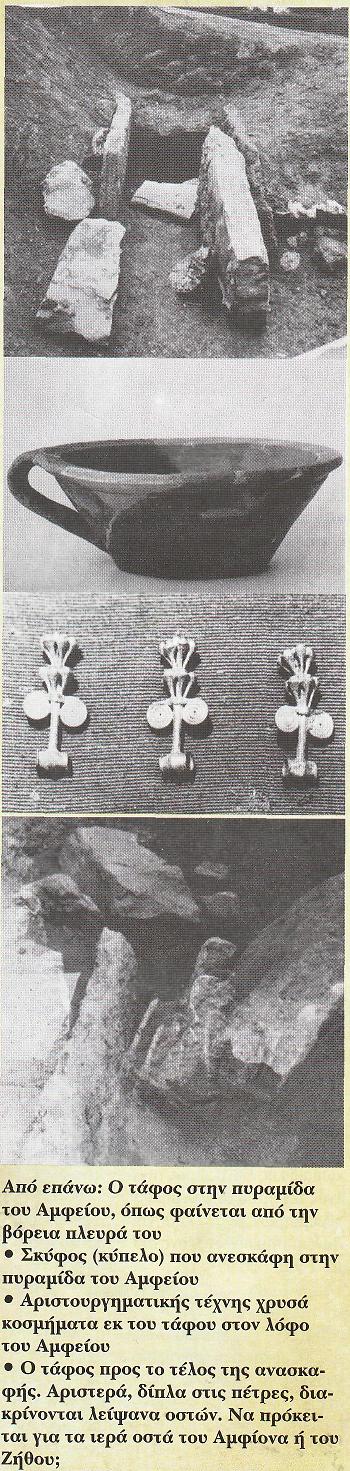
The sylimeno grave diataragme to found skeletal remains and three gold Orna Mata krinopapyrwn EUR 0,033 m. (33 mm), with double spiral on the basis of oppositional anthers and strain that resulted in mounting yoke. Of Course, There were a lot more members, one or possibly two necklaces, which anadeiknyan the I WOR and priestly Office of two Princes. (Something similar are the flowers of KRI mind-Papyrus, the bearing and the Prince of the "achaean" Knossos in the famous toicho PHY Prince with the lilies, strating that anadei, in general admission, the priestly office…)
The gold jewelry, the nicest of the Greek area and the findings of the Tomb (It, skyphos) date the pitchers of the tomb and the Mound that covers, in the Prwtoelladikoys II times, i.e. in the period 2700-2400 e.g.!
Despite the objections and the attempt by the scholars to taxes katabibastei hrono λογία and gold jewelry and the Mound to the next Elladiki Period (2000-1700 e.g.), our dating is generally accepted today and is the starting point for the dating and the spatial distribution of the shape of the mound in Greek, but the European space!
Briefly, the princely epitaph Tumulus of Amfeioy is not a known sample and process type Kurgan burial Mound, It is found in Central Europe, the Eurasian zone and South Balkan (Albania). The tumuli are Kurgan burial monuments multiple burials (multiple burials) and their offerings are different from those of the Amfeioy and other tumuli of Greece, in which I encouraged burial jars, bronze objects and pottery typical Greek-Mediterranean and not "European". This undoes the attempt to link the elladikoi tumuli with the bodies of their presumed use mound Kurgan and IndoeyrwpaIoys stakeholders that then, supposedly, for the first time (PEII / IP III period, 2200-2000 e.g.) entering Greek territory… However, Neither the archaeological, Neither the legal sense picture of the Greek area support such theories, as we will see below.
The Tomb is indigenous epitaph shape and signal, evolved from small-slip knots tym of Neolithic times and taking monumental dimensions and monumental form from the Middle Bronze age, proportional to IOS Office of igemonos-deceased. The latter apathanatizetai in memory of the nation and with the epitaph tymboeides bulge, that Homer describes as "Trade Mark" tilay, compatible with the nature of the Mound as commemorative of the glamour of the deceased ruler.

THE TYMBOS THRYLIKOS
But our research has not stopped here. The Tumulus at the top of the Hill stood at the end of a section of the Hill, which had koloyrokwniko shape (cone with two webs, up and down) and a height of approximately 4 m. from one surface to another.

On the basis of this part of the Hill was purely a perimeter zone, a stomach ache, they tried to interpret the Keramopoullos,. Of Course, He is right, of course-!- considered that it was artificial and not natural.

Hypothesized, well, that the stomach ache that was a processional Street ' rituals '. Such rituals suggest the Oracle of Bakidos, a seer from the Arcadia of the archaic times. According to the Oracle it, the Thebans had to guard the tomb of the inhabitants of Tithorea, who, When the Sun was in Taurus Star Agency (May), attempted to steal sub soil from the Amfeion and the post bear home. The soil it carried in tomb of fwkoy, who was the wife of Antiope, mother of Lioskoyrwn of Thebes.
Pausanias used the verb "yfai reisthai" to describe the action of the inhabitants of Tithorea: "YfafeIsthai (d)’ ethe loysin re’ This land in the Fwkidi Tithorean nots ".
The Keramopoullos, contemplates any factual meaning of the term and wondered if this was normal Hill format, ther. Fri’ all these, made the mistake to classify as Byzantine aqueducts some of tunnels in the Hill, which seemed when he visited the tarmac road Athinon-lamias…
” Eventually, our research showed that the "yfaireisthai" of Pausanias was one of the two parameters of the Amfeioy pyramidos, i.e. its internal tunnels!
” The other parameter is the same configuration of dwti Hill bathmi, with such carving, in order to get the tribathmo shape, on top of which built the Tomb and the tomb of Zithoy and Amfionos common, that gave the name of the Hill, «Amfeion» or «Amfion». (see. Xenofontos Greek, 5,48: "and for the Amfeion thesthai agagontes ekeley being weapons», Arrianoy 1,8,6,7 and Plutarch on the sprite Iwkratoy, 4: "The Arch'ias Theokriton and now the kalesas Lysanorida prosagagwn long time ekneysas own speaks of the road under the Micron Amfion»).
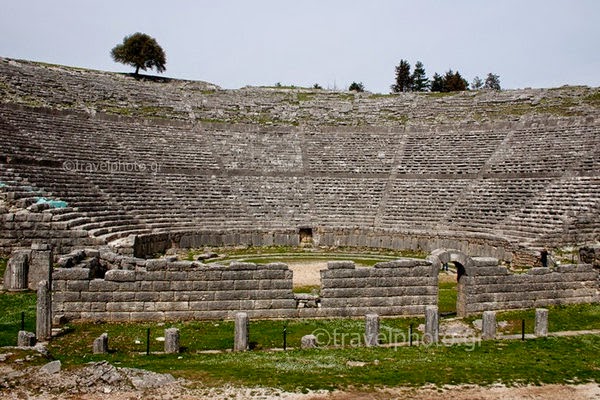
The discovery of the pyramid-shaped Hill experiences started from the finding that a few meters below the Peridromo, at the base of the upper cone of the Hill, There was also a second similar km/by stomach ache, who was fthe'i by pachytates katakaly form, trees and bushes, that made it invisible. The APO also revealed that peridromoy cover and even a koloyro Cone, While, as per our skafi, It seemed and still a third principle. The latter though, It is virtually katachwsmenos, In addition to the East side, where there was a bed of Chrysorroa. And even further East, There was the city of the historical Market, but not the Roman Empire railroad, times, the ending of which stipulated the ancient theatre.
The cones of the Hill were measured as follows (imputed value):
* the Tumulus 2,20 m.
* the first cone 4,40 m.
* the second Cone 8,80
* the third Cone 17,60 m.

ROUTE INSTRUMENTS in amazing tunnels of a hill
The Hill of Amfeioy has laxeyetai recommendation psammoli thiki and relatively easily, but the citizenship of epifa undergoes weathering the weather. However, This does not apply to the inside of, where the tunnels perfectly rithikan in-depth maintain your speed over 20 m. The main access to the Interior of the Hill made from vertical shaft, approximately one meter diameter, which was revealed at the perimeter of the plinthinoy mound, his large Tomb borei as the top of the Hill.
A second well on the western slope, slightly oblique, served the ventilation and lighting of the Interior, as is the case in the underground Egyptian monuments memorandum.
The tunnels inside the Amfeioy project is diligent and sophisticated. From the Central shaft leads, East one, in a trifylloschimi notch of the rock, West does not, in an ashlar scale, that puts the Po level of tunnels. These tunnels run throughout the Interior of the Hill in straight segments, right angles which form a maiandroeidi Grill around the Interior of the Hill! The height of tunnels is 5 measures and the creatures description 1,80 m., While the roof is arched!
At irregular intervals, bifacilal, opened in rock alcoves EUR 2,5 m., kamarwtes up, the largest amount of which has been wrapped by pieces of rock.
Our path inside of the Hill was an exciting transfer in the world of legend. The twenty meters depth of kata koryfoy our shaft brought daily with a Clipboard lifting mechanism in the bowels of Amfeioy and in the elaborate tunnels of, which run with individual guard and awe, tethered with cords in order not to perish in the unexplored daida Luce!
The scientific search stirred the human curiosity, the admiration for the amazing structures and our emotion, which was so deep, and the depth of shafts and tunnels that bring us to the mysterious world of the dead, trying to discover the eternal dwellings!
But unfortunately it has left us! Not even had time to run all the underground tunnels, to the design and the photo grafisoyme…
However, our experience, Although short, It is always shocking and magic” the Interior of commercial Amfeioy is the amazing underground monument of Greece that must be investigated and given to the public! And this is very easy from the lateral exits of the tunnel, located next to the existing roads! The legendary and the magic have taken monumental under stop inside the Amfeioy and from coverage of underground tombs is the vindication of our Tradition and our own-atelesforwn, Unfortunately- research efforts and.

THE OTHER GREEK AREA OF GIZA
For the remaining pyramids of capadocia indications are atelestates. In the author's book Word Axios and researcher Chris Lazou, Pyramids in Greece, ekdo tions Aeolus, recorded seven pyramids:

1. The pyramid of Hellinikon
2. The pyramid of Ligoyrioy
3. The pyramid of Dalamanaras Argolida
4. The pinnacle of Caterpillar, New Epidaurus in Argolis
5. The pyramid of Sicyon
6. The pyramid of Neapolis in Laconia (Biglafia)
7. The pyramid of Amfeioy in Thebes

The author briefly describes the dismal condition of most of the monuments are in his article "we pyrami view in Greece!» in Focus magazine, vo 35, January 2003, SLE. 98: "The pyramid of the Greek is the best preserved, with approximately nine masonry structures found style (6-7 measures).
Is she in Ligourio, flattened, of which there are very few saves only its lower stones, especially in the downhill. The pinnacle of Caterpillar survives on little ruins, mainly the front side with the entrance and the pyramidal angle of. The pyramids of Dalamanaras, of Sicyon and she in Biglafia had been destroyed, with the difference that the last saved only the moat that surrounded. End, the tiered pyramid of Amfeioy, Thebes, has undergone so many interventions and disasters, It is difficult to discern the shape of».
In the latter case, the author obviously refers to the installation of a system of Scouts on the pyramid with the permission of the State, Although he had already anakaly application have been referred and the Tomb in Thebes and the Dioscuri gradient formation of Hill.
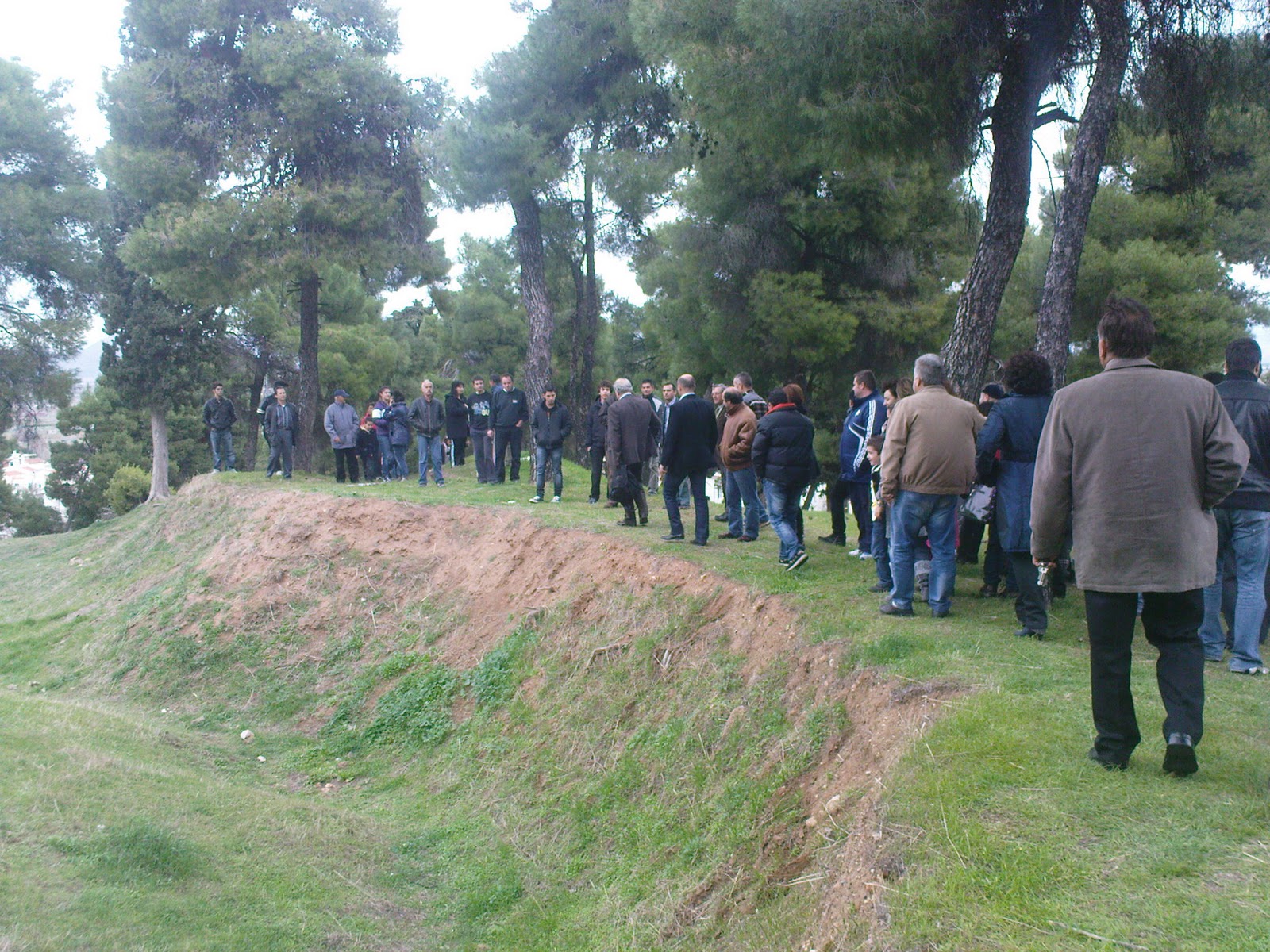
On the other hand the Hill meanwhile was Grove and was planted with pines, the roots of which cause damage to the surface of monuments th. Among the pines, Digger cleared a narrow area to discover the Hill gradient formation in pyramidal monument. Distinguished, from the bottom up, the rungs 1,2,3 and the two intermediate sections, While at the top of the Hill stands the-invisible in the photo- "tumulus" with the common grave of the Zithoy and the Amfionos.
Gradient shape has until now only the pyramid of Amfeioy, While the rest look Beauti encouraged to belong to the type of normal sided pyramidos, with smooth surfaces and construction of surfaces, epimelesteris or ypotypwdoys sculpt. The pyramid of the Greek has among large surfaces and smaller stones, a technique known in prehistoric buildings in Greece, not only in the cyclopean walls, but in oldest built apartments and construction, as the prwtoelladika ' mounds ' of Kwpaidas.
The u.s. study of the Irich Karstedt (Per Kopaissee im Altertum und die «i minyschen» Kanale, Arch. Anzeiger, 1937, SLE. 1 JV) grammisei that the Sub had walls of prehistoric structures in any way is not a presumption of their exact dating. Other researchers do not, have emphasised that, from the ancient walls, those who stand out for their manufacturing peculiarity are the walls of the buildings (mainly naϊkwn) of geometric times, distinguished with the "mikrolithiki" the structuring (steinekeinigkeit). Therefore, the chronology of the pyramids with only the criterion of their Builder is risky and futile.
Only the excavations and the application of modern methods of dating can determine the chronological horizon construction of these unique monuments, keeping the expectation to grow numerically with the progress of the investigation. However, Despite the possible survival of an original shape, It is obvious that the pyramids of Greece (but also of Egypt) expressions of culture and practical approach of an era, a cultural cycle that the «discovered», the structured and mopoiise used for his own needs and his own philosophy sees or worldview, fact essential for interpretation and their dating. The final use and sending more powered almost undisguised. For Pausanias the Greek Midas pyramid was burial polyandrio.
As written by Xr. Lazos (as above, SLE. 9: "Pausanias called the pyrami view polyandria (the Greek and Dalamanaras), meaning the tombs of many individuals and not a. The small forts were polyandria that hosted a limited number of soldiers. The Arvanitopoulos argues that this was the emblem of the Greek tomb and that beneath the hill there is a probability that is the grave of a prominent person. As a polyandria-forts consider the pyramids of the Lord, Wiegand, Fracchia-he believes that defence towers were some of Andalusian-while Leake, Ross, Vischermi Clark agree with Pausanias, that was a funerary monuments. However, no bones were found in the pyramids… Most likely, or equally likely is the view that considers buildings beacons, broadcasters Pty fwtei messages with the method of pyrseias, which support the Cirtius, Donaldson, Tsountas and Manatt. End, the team of the Academy of Athens supports the very terms that promote thimeni likely to be astronomical observatories).
It is obvious that it is full sygchy point! The Xr. Lazos writes that pyramid in Biglafia of lakonia "had become an obsession for me and I tried to locate ten times. Eventually I found the 1995. All that survives from this is the moat that surrounded ". But nobody has explained to us what serves a moat around one pyrami da, for which the Lazos suggests "different architecture" and notes: «located on a rectangular base, surrounded by a wide moat and saves only its lower stones must be rectangular stones, as we distinguish the various stones that come from’ This and have used the surrounding folds» (as above, SLE. 9.
Pausanias, as we all know, considered this Midas pyramid tomb of Kinadwnos, Master of Menelaos. For the wide moat that surrounds the pyramid of Biglafiwn and memory pitha restore original shape will syggrapsoyme special study. It is obvious of course that each Monument requires its own research and interpretation, and certainly the exact dating.
So will only prove their potential diachronic, the possible survival of shape and any destination or the initial integration of all in a cultural and’ contains chronological horizon, that for us is the most likely version. We believe such a horizon, the early and middle age of hull technical, the period of the minyakoy culture of Greece, the Millennium of burgeoning culture tion of Minywn in Greece and beyond (2700-1700 e.g.). This State, the cultural agency that has, for us, invent and promote the pyramidal shape not only in Greece, but the wider area.
But what is the purpose, What is the starting point and the operation of these buildings; The tomb was clearly Amfeion. On top of the grave of Rulers, the Dioskouroi of Thebes, Zithoy and Amfionos. The Tomb he probably was the center of worship of heroes, institutions of the city of Thebes. In anereynito unfortunately, the Interior of the Hill are presumed to be arguably others tombs. There it refers and the reference of Pausanias for tymbw rychwn attempts inside the Hill («yfaireisthai»), and the grave yard of Hill-Monument, as well as pyres of Niobidwn despite the lofon.
So, the Hill and the pyramid of Office like as not only landfills of rulers the Dioscuri of Thebes, and their families, functioned as "polyandrion" and at the same time as their opsimoys irwolatreias space until times of antiquity! From this point of view, the pyramidal shape was not only utilitarian ierarchoyse the graves in which the Office of the dead, but capturing and sanctity of eternal dwelling of Rulers, of heroes.
The pyramid of Amfeioy, gradient Exo inside and poaching internally, It is the most important, After Lacedaemon, our national Memorandum of minyakoy culture.
Unfortunately, the elaborate this grid has not been investigated, because the signer Digger was transferred from the headquarters of the year 1973…
We underline once again the monumental construction, the complicated route of tunnels, the excellent preservation of laxeysewn… Of Course, the Interior of the miatafiki economy Amfeioy served and practice, which reinforces the similarity with the Egyptian funerary monuments of ancient and Middle Kingdom, in which there are also tunnels, scales and niches, as in Amfeio. The elaborate structure of tunnel route correctly interpreted as a ploy to mislead the tymbwrychwn!
This grid of tunnels in the commercial Amfeioy Interior, which of course was known in antiquity, commented-unbeknownst to IOS, probably- Pausanias, with the ' yfafeisthai d conservation parati’ etheloysi re’ This land in the Fwkidi Tithorean nots ", hinting, apparently, action tymbwry tests inside of the monument.
Fri’ the investigation of Amfeioy stayed imite lis and the shaft was closed with cement after removal of the signer excavator, the findings and survey data have been enough to tekmiriw Soun interpretation as a funerary monument of bathmidw of Early bronze age (2600-2400 e.g.. that is the oldest of the great pyramid!)!

THE THRYLIKOI MINYES AND TECHNOLOGIKA KATORTHWMATA SOOOO TOUS.
The Amfeio well, necessarily put us in an important reflection: There was indeed another important culture in Greece before the Mycenaean Culture and, If Yes, What was the starting point, the duration and characteristics of; The research of Amfeioy led the excavator in the dating of the epanektimi colossal project of Kwpaidos from straggistikoy, that tradition was connected with the Minyans of Orchomenus Boetian. The Orchomenos 77(1) already in Homer referred as Minyeios, While slow cially Pindar reiterated the connection with the Minyans in expression: «Bishops ' Minywn Palaifatwn.
Dienergisa excavations, so in mounds of drainage canals of kwpaϊdikis basin, and in ther parties of "great Ponor»,, that is the main water artery of the diverter kwpaϊdikis Lake to Larymna via an artificial tunnel length 2,5 km, with Professor S. Lauffer, University of Munich, witnessed that the huge drainage work had all paid and work in the Sun of the Millennium b.c..
This was another indication that before the Mycenaean era, Greece became experienced a high technological culture, which in turn presupposed proportional administrative organization. These items, however, were very disturbing to scholars those, He promoted the theory that the mycenaeans founded the oldest culture in Greece and faced with prejudice or even contemptuous indifference, but they can cancel, Since these are based on archaeological data!
Buildings ' palatial ' character of the early Bronze age front, i.e. of the third millennium b.c., revealed in Greece, Thebes (arched building) lerna (State of residence), in Akkobitika of Messinia… Last even, apokaly dismissing Thebes, the "seat" of Amfeioy, palatial building and relic wall of Kadmeias, as well as great "tumulus" from mud bricks-bricks. All the above assessed in prwtoelladikoys times chronolo, so it finds contemporary GE of Amfeioy pyrami. The conclusion is self noito: the Greece enjoyed before the naϊko and one of myki’ just as thriving and, I believe, akmaiotero culture, the duration of which covered the third and the beginning of the second Millennium b.c., virtually an entire MI CADE (2700 until 1700 e.g.)!
The culture he had administrative palatial organization and monumental burial architecture and high technology, hydraulic start and not only! Not particularly brilliant, During this period there was the metallurgical technology, as shown by our own per skafes in the village of Agioritika and the Strait of Tegea, two spaces which currently represent the most important and archaiote RI metallurgy, not only in Greek, but throughout the Mediterranean and the euro ence at national, European space!
We we featured this culture "Minyako» and the period of time of development" ("Minyan") period "of proϊstori technical culture of Greece, covering the Millennium 2700-1700 e.g.. This is included in the Millennium and the so-called early Helladic Era (2700 until 2100 e.g.) and the first two subdivisions of Μεσοελλαδικής era awaren legome (With I and II), After the third tier of, the ME III, There is archaeological and historical "», but lying or rather is the borderline between two cultural circles: Of the minyakoy and of the Mycenaean civilization.
Now it is worth researching and jobs the minyako meleti Millennium culture 2700-1700 e.g., as a substantive high culture istic circle, in all aspects and ekfan tions of.
Follows, will distinguish from both the long neolithic culture of Greece (7000 until 3000 e.g.), and shall the x, the Mycenaean civilization (1700/1600 until 1100 e.g.), by the end of which consistent sympi and end the so-called prehistory of Greece. Why the minyakos account of Greece culture emerges as the standard by which our culture was the Mycenaean, in terms of political organisation, Tomb architecture mnimeiwdoys, technology, worship, but literary oyrgias standar, as we develop our other Mele timata.

THE PROBLEM OF CHRONOLOGISIS
The dating of the pyramid of Amfeioy in the third millennium b.c.. several issues anekinise Mata, Although scholars aren't recorded the starting point of the new da kypse reflection after the announcements and our dimosiey ments… The investigation centered on the reaction of the well-known pyramidos chronolo in Greek of Argolis, which was considered Hellenistic times, According to the dating proposed by the American archaeologist Lord (Hesperia 1938,481-527).

The new date was based on a new excavation investigation of the monument and in application of the method of thermoluminescence. Researchers of the monument, teachers Theoharis and Lyritzis, witnessed that the pyramid of the Greek dating to the early third millennium b.c.. With this survey was the ancient chronological setting of the pyramids of capadocia, as was shown by the excavation and study of the Amfeioy of Thebes stepping pyramidos. So, the pyramids of Greece – at least two of the most important, both the step, and the schema tetrapleyroy- is not of Hellenistic site, but the prwtoelladikwn years! There were works of the third century but of the third millennium b.c.!

The discoveries and these findings defeat all the mainstream of our time, but it was compatible with ancient Tradition, which usually describe as "mythological", aplopoiitika and generalizing. The "mythology" of these two monuments rescued much later touring ' literature ' of Pausanias. The pyramid and the tomb of the Amfeioy tradition of Thebes, He was rescued by Pausanias, the link with the common grave of Thiva Dioscuri, which compound contained in Homer as the first built wall in Kadmeia (Odyssey, (l) 260).

"The first Thibis edos built eptapyloio
pyrgwsan t ', Although th apyrgwton epe'i c’ nanto edy
spacious Thibin naiemen, kraterw CA’ eonte»

Recently discovered relics of promikynaϊkoy (kyklwpeioy) This wall in Kadmeia, near Amfeio, and he has headed the chronolo prwtoelladikoys times, that is the same time as the formation of Amfeioy in gradient pyramid!
And not only found the wall that, that is mentioned in the Odyssey as the eyrima of Kadmeias archai otato, but a specific add-on, palatial, contemporary menu in the adjacent wall and building, a real citadel house, as announced by archaeologists of the Inspectorate of Antiquities Thebes in recent Conference organised by the competent Committee in Thiva!
And the former Pausanias and the Keramopoullos, I noticed the shape of the Hill of Amfeioy in gradient pyramid, but the first two and left a verbal comment and a reference to attempts by observing tymbwrychias, "Shin d'etheloy yfafeisthai re’ This land in the Fwk'idi Tithorean nots ". The Keramopoullos,, with education and acumen of wondered: "That “yfafeisthai” dynomai not to noisw or as otherwise seeking unto the whole principle of the mound, unto him that is the natural lofon… ignoei Pausanias or fine bws says neither Hill nor nature eswterikin the whole thereof pistin» (Arc. Deltion 3,1917, SLE. 387-.
The research of Amfeio opened a new reflection on the use, sending and dating of railroad buildings pyramidi capadocia, but the research of hydraulic works, which we first chronologisame in the third millennium b.c.. and we felt works of minyakoy culture of Greece. It is now certain that the progress of the investigation will be constantly knyei him anadei culture, the Golden Millennium of our prehistoric past and prosgrapsei all of the katakti ments and achievements, which yfirpase the Mycenaean civilization. This well I’ the new component effec brilliant chapter of archaeology and science…
The pyramid of Amfeioy arose as a memorandum he meiwdis construction, which proϋpe thete analogue and modern administrative health Union, an administrative system, which s he oyrgise a monumental architecture before the middle of the 3rd millennium b.c.. This upset the established theory that in Greece there were no monumental burial constructions and monumental administrative-palatial buildings before the Mycenaean Times (1550-1200 E.G.).
The bodies of the Mycenaean Culture were considered-and still considered- the descendants of Indoeyrwpaiwn, who-allegedly-entered in Greece at the end of the 3rd millennium BC., of course, there is no archaeological or linguistic support of relative theory. Besides, nor is the movement of Kurgan tumuli solved the issue, because elladikoi tumuli evolve independently and are not offered as a presumption of tribal movements from the European or Eurasian space in Greece.

THE PYRAMIDWN AND ARCHETYPIKO OF THE FACTORS DETERMINING THE
In what,What concerns the morphogenesis of pyramid structures and spatial that the afe, things are competitive and exciting. Who ' anakaly ' took the shape of pyramidos; The alleged "cradle" of, Egypt, or Greece ("minyan"); The great antiquity of English pyramids would be indefensible as a single phenomenon and product, If you couldn't make with a modern, multi-faceted cultural infrastructure and State Organization, that ekfra he elsewhere and here with high-grade products and technology.
Without the existence of State and minyakoy culture minyakoy, Greek pyramids would stay more curious construction (curiosities) and metakinoyntochronologika from the "prehistoric" until the Greek Natur compliance with its times, sometimes with RIA research tekmi, sometimes in’ Yours sincerely. But despite gwga, works and monuments of a particular culture and a particular time duration and this determines, indirectly but imputed, the dating of Greek pyramids, the Greek creation of architectural culture of minya Golden Millennium (2700-1700 e.g.,)!
The Egyptian pyramids are the true thesteres polypli, but, now, not the oldest! Greek pyramids short numeric residues, but this probably is symptomatic (subject to the "chance of discoveryw/probability of discovery), but already claiming not simply taytochronia, but greater antiquity than the oldest Egyptian, dating on the 2700/2600 e.g..
However, the archetypal of the pyramids is determined not only by the culture that produced, but from the mission and their use. The pyramids are not only burial monuments, which are mainly the Egyptian pyramids. Modern research has yielded another character and using in the great pyramid of Cheopos, which investigates as astronomical station or legal proceedings projects, with convincing arguments! Of returns is not accurate gaiwdesia and "beneficial" effect on the maintenance of organic substances covered by the ' shell ' of!
Instead, the remaining, as far as I know, and the "classic" gradient pyramid of Zozer (2600 e.g.. about) they had burial progress higher, as the ypogei s polydaidales or adjacent burial and their respective facilities devotional. The premises where you were intended to ensure the body-snatchers and parapla serving the multiplicity of ethimotypiwn faith and practices developed in the main trait of Egyptian priestly Hierarchy and every stwtikis.
Burial destination had clearly and the pyramids of Amfeioy and Greek of Argolis, as shown by the findings and the inner tunnels of Amfeioy, but the tradition that he wanted and the one and the other pyramid to have hosted the graves branded heroes of both regions (Zithos and Amphion, Proetus and Acrisius respectively).

http://aneksigita-fainomena.blogspot.gr

At Least 350 the tumuli in Thrace

THE HONORARY HEAD OF ARCHAIOTITON D. TRIANTAFILOS APOKALYPTEI
Until the 1980 they were discovered 269 tumuli in Thrace, from whom 70 In Rodopi. The most important is that of Small Doxipara Evros, While so far only 35 have been explored to some extent in the Rhodope region and specifically breast, There were lathroanaskafwn cases and so I started from the 1992 the excavation of tumuli Interview Dimos Mpakirtzakis / Tribute: Archaeological / Tumulus Breast area monuments speak for themselves and reveal moments of history.
So I made with the tumulus of Amphipolis. So would become if the excavation on the tarmac about 350 tumuli of Thrace who keep buried secrets. Most of them have visited the archaiokapiloi, long before the archaeologists, have brought about major disasters and have removed interesting facts. The fact is that their raids the confirming, the Honorary Curator Diamantis Triantafyllos. The man who brought to the surface, a unique archaeological find. Five Roman carriages and important objects found in the tomb of 6-7 m. with a diameter of 55-60 m. It was the most impressive of the findings uncovered in Small Doxipara – The Evros area. The excavation began in September 2002 and brought to light valuable findings that still await the special Spotlight and their residence permit Mr. Triantafillos spoke in the "x" for the tumuli of Thrace during a very in-depth interview. Revealed that until 1980 they were discovered 269 tumuli in Thrace. Total 70 In Rodopi, 54 in Xanthi and others 145 in Evros. The most important is that of Small Doxipara, While so far only 35 have been explored as a degree. Excavations in Amphipolis have sparked their interest and tumuli of the Rhodopes and Thrace wider. There is evidence for our area; -We can say that we have two categories of funerary tumuli: those located on the outskirts of the ancient Greek cities, such as Abdera and Maronia in ancient Peninsula of Molivoti peninsula. And there is a second category of tumuli, is free in room tumuli, IE does not have a direct relationship with a settlement, is at greater distances, and such we have many mainly in the Northern Evros. Why this site has more tumuli; -Why were there at the time of the Roman Empire – most dating to the 1st and 2nd century. a.d.. There were many landowners, who at one time had acquired wealth from agriculture, from livestock and were able to build such memorials, who needed a big expense. It was namely for ordinary people, who in all seasons were buried in simple pits, in cemeteries. There Are 350 tumuli only in Thrace; -Yes, and above.
About 150 they were the ones who had counted in the Prefecture of Evros only. There are also in Puebla in the region of Eastern Macedonia and the Parent at Xanthi near the Abdera. The archaeological hoe with these tumuli, What has made this whole time; -Start of the Ebro. There was a tomb excavation program, because we had many cases of lathroanaskafwn. Went with hoeing machines and were trying to find their graves. Others find them with drills. We find such residues in tumuli. So, though, identified only box-shaped, they say that is constructed with stone slabs or carnivorous, When pounding the arida on the stone. If it is a burning dead, It is difficult to diagnose. We Started, well, a program in the Ebro, every year to dig into one or two tumuli, Depending on the time you take the excavation. Most of them are Imperial Roman times, but it also found very few of the 4th and 5th century. e.g.. Unfortunately most sylimenoi found, but interesting pottery and we've recovered many cremations found apeiraktes. So, We have many funeral gifts, vessels, glass, stoneware, iron, copper objects. In this category belong and the tumulus of Mikri Doxipara Zone, where of course the rich found these findings, the carriages, horses etc. In the area of Rodopi, in the area of breast, We had lathroanaskafwn cases and so we start from the 1992 the excavation of tumuli. Found and stone sarcophagi and tombs with box-shaped plates that denontan each other with iron links, but of course this was sylimenoi. We've Recovered, though, interesting pieces of ceramics and pottery sygkollisame, as the only white lekythoi, that is in the Museum of Komotini, the skyfoi of Ag. Valentine and other interesting findings not interested treasure hunters or looters. Namely the archaiokapiloi interested in what, What is in gold; -More interested in gold and metal objects, but undamaged. The way, though, intervening, usually causes destruction in sensitive ones, even from metals, objects. It not only needs, of course, are gold and thither directed their interest. In ancient Maronia had done the excavation. From there found and finds at the Archaeological Museum of Komotini; -Yes coming from the mound where I had done excavations.
In the ancient city continued the d. Terzopoulou and now continues the excavation program in collaboration with Princeton University. Implemented this year for the second year and will continue on Tuesday and of course can be renewed and the license and for more years. It is fortunate that started this excavation with expenses mainly Americans and is big issue of identification of the city there, because there are many opinions. We continue to believe that this is the ancient Maronia, but of course you have to prove with facts and findings, mainly with inscriptions that can give us such items. There are even tumuli has not entered any archaeologists; -Yes of course, most. Why is this, It's so big the cost; -It costs too much, because one such excavation can keep to a common tumulus, not very big, and two and three months, and depending on the findings may hold and above, as he kept the excavation of Doxipara. Need and money and people, to say that such a program will continue excavation of tumuli. The expenditure is large enough and of course now in these days we need to be very impressive find, to have similar interest of the State. The tumulus of Paradimi presents some interesting; -Differs from the burial mound. There is the term, better to say tuba, It's prehistoric settlement, that with the continuous habitation-after the disaster that is this happen often with a village fire- Why was again set in the same place, so over the centuries created this artificial An. These are the prehistoric mounds, have no connection with the funerary tumuli.

Source: http://www.xronos.gr/detail.php?ID=94411

Macedonia and pre-Hellenes known

THE PROELLINES
(GENOMENI IN THE AITHOYSI DIALEXIS TIS ETAIREIAS MAKEDONIKON SPOUDON)


379223_526111607423677_481530022_n

Ein OL’ these things are very old, o the pre-Hellenes known and their culture and their language, but not deprived for’ this out of interest.
In science the old and the new are equivalent and equally.
Because the old is the Foundation of the new, and the new relies on old and identified by this unequivocally and perennially.
That is why I am not, speaking of the pre-Hellenes known in front of cultured public, to say things alien to his interest.

The Caucasians, that part is the Greek race, It was as the 5th Millennium b.c.. X. one of the many linguistic tribes inhabiting in Europe.

But this race seems to have been endowed with a possessive and assimilate capacity, that the results could be spectacular qualifier.

When after the 5th Millennium b.c.. X. began to break and their individual Indoeyrwpaikoys schimatizi folks, i.e.. the Greeks, Indoiranoys, Thrakoillyrioys, Italokeltes, Teutons, Baltoslaboys k. a., and it spreads to all geographic directions, the other language tribes of Europe and Asia found in steps of, other late and other fast, have not been able to avoid subjugation and linguistic assimilation by the indoeyrwpaioys.

Tyrsinoi, Tomba dei Tyrrinoi Leopardi, Tarquinia

So Asia Indian they took the moggolikoys peoples who inhabited the vast country of Indian pentapotamoy.

The Chettites, the peoples of palaioteroys m. Asia. In Europe the Teutonic assimilated peoples of Northern Europe palaioteroys, the Celts of Gaul and the Ligyes the Pritu, i.e.. old British of England,
the Italians the etroyskoys etc..

The Greeks, After the proto-Greek, as the saying, period in the plains of Hungary and Serbia, plithynontas numerical and geographical spread to such an extent that n ° archisi their language differentiated into dialects, appeared around the 20 ° century b.c.. X. in the present northern border of the country that was destined to famous re’ These should Greece and the definitive historical cradle on 4 000 years incessantly, from then until today.
The entrance in Greece was not made at once, but in three waves, with three successive conquests.

First came the Ionians 1 then, around the 17 ° century b.c.. CH., the achaeans, and last, around the 12th century b.c.. CH., the dorians.

The new and final home found the Greeks not uninhabited.

The countries bordering the Mediterranean is, as we all know, archaiotatwn peoples residences and birthplaces of ancient civilizations.

And of course you couldn't otherwise with the symbi country more Center and most favored by the nature and climatic conditions, the Greece.

First dark Mediterranean peoples 2 with skin grilled over millennia by the Sun and the salty kayton of waves, racially and linguistically irrelevant with xanthogalanoys Indoeyrwpaioys, putting arts, maritime trade and piracy in the seas that connect the three old continents, kosmogyrismenoi thalassokratores, It was already established by the Millennium 47p p. X. on the shores and Islands of the Aegean Sea peribrechontai, the Libyan and the Ionian Sea, i.e.. in the West of Mongolia. Asia, in Greece and in Italy.

Were the carriers of culture in archaeology is called the Minoan aigaios. Of culture with the huge and rich Royal palaces, the painted with lilies and garden of leiria and with the yolks of the mountains, with the new psilolignoys and yperkompses ladies.

The angiography with marine plants, animals and shells, that creates more dull shade of bythwn4.

When the centuries went out from the memory of Greeks every remembrance of the descent from the North, o simple Greek people thought anymore that has always been indigenous to this country, and coined the embezzled from them as hellenized now predecessors, locals "big bang" myths, they were natural born and bred in the land of.

The pre-Hellenes known for the people is just the ancient ancestors, and the perception of this place once and finds in poetry that reflects Street beliefs, as λ. x. in Hesiod and Aeschylus's Suppliants, and the simplistic Historiography of Herodotus (1,56), that identifies the Ionians with pelasgous, i.e.. with the pre-Hellenes known 5.

Other Greek writers, and especially historians, It was not re’ those who could escape their attention to such an important event, even though they had passed so many centuries from the time of the first descent. Nor was it possible to avoid the barrel impression that as their season saved here and there between the remnants of alloglwsswn Pregreeks. Already the poet of ' Odyssey telling about Crete :

Has arithmitoys residents and ninety countries.
Kabe people and the language of.
Live at Achaioi, zoϋne Islanders Cretans, pallikarias sparrow hawks, and Kydwnes and Doric, and Pelasgians lebentes 6.

Herodotus says that the Greek nation was originally but then grew thin, because coalesced together of the Pelasgians and many other barbaric fyla7. He saith to the attic that was formerly the pelasgic, that language was barbari8, that then also changed glwssa9 in Greek, the Imbros and Lemnos was inhabited by Pelasgians 10, and that the entire Greece formerly called Pelasgia 11.

Thucydides testifies that on the peninsula of Athos in the years of, Besides the Greeks colonists from the “Andros and chalcis, was and other towns that were inhabited by a mixed population of bilingual barbarians, that was largely pelasgian and descended from the same Tyrsinoys who inhabited those older and Lemnos and Athens 12.

Strabo writes that the oldest of hecataeus of Miletus mentioned that in the Peloponnese before the Greeks inhabited by barbarians, and adds o Strabo that the whole of Greece has long been a dwelling barbarians 13.
The commentator of Apollonius of rhodium (I 608) He says that the older inhabitants of Lemnos was pirates Tyrsinoi, i.e.. Proellines14 thing that agrees with that Homer calls her residents Sintias agriofwnoys 15.

And the other islands of the Aegean old residents Greeks stood out from their own ethnic group.
And the Islanders, written by Thucydides, It was pirates, Kares and Finikes because those inhabiting most nisia16.
And Strabo adds:

"From what has been eipwthi for kares, that they receive the most is that the Carians….was then Leleges and inhabited the Islands» 17.

The ancient Greeks distinguished writers pre-Hellenes known from the real Greek, sometimes with the name Pelasgians 18, and Tyrsinoi the Tyrrinoi, sometimes with the names Carians and Leleges and sometimes with local national names, complex with the epithet eteos (= alithinos, native): Eteokrites, Eteokarpathioi.

But what,What was considered very old in Greece the pelasgic characterised. Ancient walls, the built in ogkolithoys, the thought "pelasgian".
Larissa in Thessaly called Pelasgikon Argos. The very old temples, as of Zeus at Dodona in Epirus and Hera in Thessaly, but in the era of the Pelasgians :

Oh Zeus of Dodona, Pelasgike, that you are resident off us! 19

Additional presumption for the ethnological distinction Greeks and Pregreeks, that was the time when composed the Homeric epics still felt, is that in’ the Pelasgians, those still in extreme places swzontan then anafomoiwtoi, presented as allies of the Trojans, together with other non-Greek peoples of course m. Asia and Thrace.

These I mentioned merely to Fani :

1) How the Greek authors were assured for’ what science today with its own archaeological and linguistic evidence testified, that i.e.. before’ those resided in Greece another, stranger to them, and alloglwssi clan, and

2) That the ethnological and linguistic absorption of Pregreeks by the Greeks took much to symplirwthi in all regions of the country, After the time of Herodotus and Thucydides, i.e.. as the 5 ° w. X. century, There were remnants of Pregreeks which had not yet afomoiwthi, even though they had spent fifteen centuries since the time of the first descent of the Greeks.

The culture that brought the first Greek breed in Greece was incomparably lower than the culture of Pregreeks.
And as usually happens when a people uncivilized conquest a civilized people, Greeks face the prehellenic culture.

But not lost a culture entirely with the looting and burning of palaces and shrines.

The Department of simantikwtero, the animate material, that was o alive body of cultural goods, not burned, but he stayed with all of spiritual cultivation, triangulated racially, religious, even linguistically with the Conqueror, and from this junction, that in hindsight it seems that stood one of the biologically most favorable associations peoples, took two superb scores :

The first was a new, organic renewed, robust and beautiful breed, endowed with exquisite spiritual gifts, combination of physical vigour and freshness of the conquerors with the aesthetic and spiritual refinement of a people exhausted organic of a long-standing advanced life form.

The second was the beginning of a new culture, that is not starting from scratch, other new power continues, transforms and epoikodomei a ready, finished culture religion, legends, traditions and art, and gives the robust form of, with whatever is presented to us in the full bloom of the first Greek civilization in the buildings and artifacts of the Mycenaean and late Minoan times and in the Homeric epics.
This intersection of the spiritual stands for better ap'dla the Greek pantheon, where the male gods of Greek indoeyrwpaiwn presented zeygarwmenoi with female deities, that almost all are proellinikes.

There are in the history of the Nations many examples of conquerors that are ethnically and linguistically assimilated by the nation that enslaved, especially when, as usually happens, The Conquerors is numerically and culturally inferior by the conquered.

So e.g.. their Norse origin was with Rws(s), that ekslabistikan from the Slaboys vassals of.

The same was with the German Franks (Frangais), When speaking of the Gaul ekgallistikan kyriepsan.

The same was with the Mongolian race and language Prwtoboylgaroys toyrkotatarikis, that ekslabistikan from between the Danube and the Slavs Aimo vassals of.

The same was with the Scandinavian katagwgis Normans, When he conquered the b. Ekgallistikan France, and when England conquered exagglistikan ap'ekei.
The same end was with the Romans occupiers of the Greek East, i.e.. of Byzantium.

So no strange thatan not although the Greeks were digested by the numerically and culturally superior of pre-Hellenes known, and even after I went to Greece together, but when three waves that divided the centuries. And yet this was not.

The first Greek tribe that found among pre-Hellenes known, the Ionians, not assimilated, but they took a large part of the Pregreeks, so that, When after three centuries, downloaded the achaeans, they found a largely Greek-speaking country, and even more, When following other five centuries came the dorians 20.

But eplirwsan otherwise the Ionians groundbreaking glory for localisation of the country:

Not only spent the their possessive Alki from uneven mixing them with their pre-Hellenes known, so when downloaded the achaeans were no longer the Ionians as tribe exoflimenoi conquerors, and for’ This easily another succumbed and repulsed by the achaeans on the East Coast and in the Aegean Islands, but their language was stronger and deeper effect of an ancient”, While the language of the achaeans and Dorians stayed katharwtera Greek.

When the 17 ° century b.c.. X. Greece descended into the second Greek wave, the achaeans, the political leadership of the country immediately passed into their hands.

The Ionians were, the pre-Hellenes known as, civilians merchants, artisans and professionals, limited i.e.. in a totally small projects for heroic age, for’ This and the Homeric epics, where is the glory of Achaeans, the Ionians nor even mentioned as contributors of the Trojan war, If luck should be for’ These reason, featured with antiirwika adjectives.

Not eyknimides, chalkoknimides, chalkochitwnes, ariifiloi, filoptolemoi, megathymoi, as the achaeans, but elkechitwnes, i.e.. people with long dresses, frequenting the fairs, of course as traders and craftsmen, occupations that will give them again later, in historical times, along with economic and colonial superiority,
and the spiritual leadership of the Greeks, but certainly keep them on the sidelines of the epic story.

The effect that were Greeks from the pre-Hellenes known extends to all forms of life and is quantitative incalculable.

And this is why, When merging the two peoples had gone a long way, Greeks were no longer only genuine, nor only two or more races, but the sheer pre-Hellenes known, that no exellinismenoi as to the language, There are ethnologically from genuine, and incorporated into their character Formation keeping, the special way of life, the old legends and traditions, and many elements of their old religion, These built-in piano dla at a Greek life, language and art.

And because they mirror the life of the past is always the language and art, This resort today to know what AP’ those who are for us today the archaio Greeks are genuine Greek and what comes from the pre-Hellenes known.

Archaeology is today able to broadly inform us what elements of the residence, tools and utensils and decorative in ancient Greece is fermena from the North with the descent of the Greeks conquerors, and what are the elements of culture proellinikoy.

My Commission will, as a non-specialist, not to speak for them and to focus on those elements that the Linguistics acknowledges in the ancient Greek language as the pre elements.

Although the Archaeology and Linguistics are cooperating in this field of research, and very often their findings coincide, the Linguistics, as you might need, is that the light illuminates with zaiirotero aspects of ancient life, where the two ethnic groups met.

So I will tell you a few things about the pre elements of ancient Greek language.
How these help to distinguish through the words and the cultural elements that are pre, You'll find yourself.

But before we get to the individual teacher you query, is it able to xechwrisi Science today
What of the ancient Greek language is purely Greek and what prehellenic ;
And with what can research method petychi ;
The answer to this question is Yes, anepifylachta.
And the method of research is as follows :
Today, Thanks to the tremendous work done by linguists around the world in the area of Comparative Linguistics, It is known in General what words every Indo-European language keeps them from the time when the indoeyrwpaioi was
yet a people and which borrowed later from other non-Indoeyrwpaikes languages, on the other hand’ until every nation stood out from the trunk of indoeyrwpaiwn and lived in another geographical environment.

So and especially for the ancient Greek language, linguists have made the separation of the material with the following method.

Any word and any grammar element is found in all other Indo-european languages, or in most or many of these, the previously adistachta and sometimes considers with great degree of probability as genuine Greek, carried in Greece by the Indo-european homeland.

But any word any grammar element has no corresponding to the other sisters languages, This, If mporesi to exigisi as newest creature Greek, go well. “But if you don't mporesi, then seek to 2000 the origins of one of the non-Indoeyrwpaikes languages of peoples with whom the Greeks came in commercial intermixed and general historical contact.

As for the method is negative.

Is not indoeyrwpaϊko, It is so from another language. But the positive verification of what language is that you must complete the presumption and arming with peithanagki and here two things can happen :

“The brethi will be the source of any non-Greek word in one of the neighboring languages that have written delivery earlier in Greek, as are the Semitic languages of Western Asia (Assyrobabylwniaki, The Hebrew) and the chamitikes of North Africa (ancient Egyptian) and then longer problem solved,

the brethi will not be nothing relevant in these languages, and then you need to the following syllogismos should :

Greek is not, Semitic is not, chamitiko is not, It should therefore be the tongue of Pregreeks.

But here too we have on hand only the negative presumption of an ancient origin. The positive, that would be to find the word you are looking at written in the pre-texts, This does not exist, why the proellinikes inscriptions, In addition to minimum, It is written in an unknown alphabet far and, with all the efforts that have been made and are made, We found a way to read.

Us stays well for Greek words proellinikes only the negative presumption, that is not entirely without merit, near this though and a few other auxiliary items that gives us the sense above all, but the Geography and the Story.
Let's look at some :

To be entirely coincidental that the words of the ancient ellinikis, that is not indoeyrwpaikes, express things and concepts that were certainly not known in the cradle of indoeyrwpaiwn, and you need so the Greeks to the met for the first time here in Greece ;

All the plants that do not grow their own further north from Greece, are not in the Greek language onomataindoeyrwpaika.

Consistency requires to accept that they first saw the Greeks here and their pre-Hellenes known asked how are these plants.
The pre-Hellenes known told them the name they had in their own language, and Greeks together with the new thing they got in their language and the new Word.

All fish names, birds and other animals, that is not Indoeyrwpaika, It is those who live just around the Mediterranean and southern Europe.

So it was very natural to not have Greeks, When I came here, words for such fish, birds and other animals, and knowing for the first time here. to learn their names had given the pre-Hellenes known.
Because it would be really strange thought that neither their own Greek name but had to give in such animals, Neither the prehellenic only but see fit to get, but expect to spend centuries, to get to know the ancient Egyptians the Palm trees and ask them how to name these animals.

Ancient Greek words that express objects and concepts somewhat advanced for the era that civilization is not indoeyrwpaikes. A few of these are the aigyptiakes23 foinikikes22, and entered the Greek when the commercial communication began with the Phoenicians and Aigyptioys.

But other than that derived; It is reasonable to accept our here that came from the language of Pregreeks, afoy archaeological findings showing that the culture of the past were much more advanced than the Greek. May is supposedly completely by chance that Greeks, people who always excelled for the overly developed sense of form, but never about the music of feeling, had musicians conditions is not Indoeyrwpaikoi;

The ancient Greeks their karikoys ethaymazan hymns and lydika members, i.e.. music origins. It is therefore extremely strange droi musicians of ancient Greek to be proellinikoi.

The toponyms of ancient Greece, i.e.. the city names, Islands, mountains, rivers etc., It is in the 9/10 inexplicably with the help of Greek vocabulary 24.

No IE. no importance in Greek. Many of these are older, and just what the ancient Greeks the pelasgic characterised. What the logikwtero well than to accept that the toponyms found these Greeks ready in the language of Pregreeks and have not felt the need to change kammian.
The preservation of place names of prokatochoy people from the occupier is phenomenon General on ethnologikes changes of all peoples.
And the Italians (l). x. retained proitalika, the etroyskika places of their country, and the Turks the Greek toponyms of m. Asia, with minor grammatical adjustments in their language:
The City did unto Istanbul, the EIS Amison, Samsun, the in Kos, Istanköy, the Izmir, Izmir, the Adrianoy(polis), Edirne, the ikonion, Konia, the Proϋsa, Bursa, the Sivas, Sivas, the “Ankara, Ankara, the Trapezoϋs, Trabzon, the Kerasoys, Giresun etc.. So always.
What strange well although the ancient Greeks did the same for pre toponyms ;

The pre-Hellenic toponym origin of these becomes physically bebaioteri, When we find the same and comes in pre-Hellenic endoteri m. '' Asia in the era that had not yet egkatastathi there Greeks.
Larisa here, Larisa and ekei.
Pidaaos here, Pidaaos and there.
Parnassus here, Parnassus and ekei.
Pindos here, Pindasos and ekei.
Mykallisos here, Mykalisaos, Mycale and ekei.
Ten olympoi here, others so olympoi and ekei.

The same thing happens, When we meet in Greece and in pre-Hellenic m. ' Asia toponyms inexplicably and etymologikws morphology rather than Greek, in-ACE, -SGP, -nthos, -rna, -Mina, as Parnassus, Knossos here, Alikarnassos, Telmissos ekei, Laria(s.)(a) here, Mylassa, Bargaoaa ekei, Korinthos, Nϋos Tiryns, Zakynϋos here, Layrandos, Lnkandos, Soandos ekei, “Arna, Alasarna, Falasarna here, “Yparna, “Abarnos, Aiarni, Pasarni in m. ' Asia, Rethymna in Crete, Mithymna, Changed to kalymna in Islands of m. ' Asia.

Nor of course is without importance for the origin of such place names that the endings-s(s.)ND-nthos and the encounter and in prosigorikes words proellinikes definitely,
as kyparissos, Narcissus, asaminthos, apsinthos, erebinthos, lebinthos, olynthos, yakinthos.

Mycenaeans, the first Greeks in Italy

Positive presumption for the pre-Hellenic origin English words have when words of ancient Greek, not explained as Indoeyrwpaikes, the encounter and in the language of the proindoeyrwpaikwn inhabitants of the Italian peninsula, i.e.. of etroyskwn, that was language relatives of Proellinwn25.

The Etruscan we have about 7.000 inscriptions and a book, written in a variant of the Greek alphabet, i.e.. material not only quantitative incomparably ploysiwtero from the prehellenic, but easy-to-read, in order to be able to boithisi in our study of Proellinikis26.

So e.g.. for the Rector to find corresponding Greek Etruscan epuruni, for the tyrant, the etroysk. turan, about opyiw -(I am espoused with), the etroysk. puia (= woman), for the ieros (' iaros (Isaros), the etroysk. aiseras, about Tyndaridai (= the sons of Tyndareus), the Castor and Pollux, the Tina etroyskika (= Zeus) and tur (= son), about trytani (= scales), the etroysk. trutnut etc..
Also the testimony of the ancients that the old prehellenic Tetrapolis of Attica but only was Yttinia, i.e.. with the ancient pronunciation Huttenia, He finds wonderful explanation to the fact that the number four in Etruscan was called huth.

This is in short the method, with which linguists, sometimes by chance, sometimes with certainty, divide the ancient Greek words in genuine Greek and proellinikes.

It is the same method, setting and other brothers of Greek language proindoeyrwpaika elements, i.e.. the proindika of the Indian, the Italian proitalika etc..
With the implementation of this method we have longer today resolved an important amount of ancient Greek words with pre-Hellenic origin. The overview is in many respects interesting and’ a wider audience of non-eidikwn, Why

1) It teaches us the historical origin of a significant part of ancient Greek vocabulary,
2) gives us a, faint even, Idea of arthrwtikis and sound format that had the language of Pregreeks,
3) It shows us how many and what the pre-Hellenes known concepts and things there were masters of the Greeks, and
4) He teaches in’ those who feel AWE and disgust at foreign words of modern Greek, that owe him some understanding to the historical fortunes of our language, seeing how much the foreign Word is the fate of kaite history language people, the inevitable outcome of cultural communication and cross-fertilization of cultures on Earth.

I present here a selection of proellinikes words of ancient Greek, reclaimed from various regions of ziois, where they give a general impression for the chapter of our linguistic history:

(A) '. NAMES

CR-nthos : Amarynthos, ‘ Arakynthos, Wormwood, Erymaniyos, Zakynthos, Zyrinthos, Cerinthus, Korinthos, Koskinthos, Maze, Aebinthos, Probalinthos, Pyranthos, Saminthos, Syrinthos, Tiryns Yen. Tirynthos.

CR-p(s.)ING, ttos and the(the)(a) : Amnisos, Dirfwssos, Ilja(s.)ING, Kifis(s.)ING, Knwasos, Mnkalissos, Parnassus, Praiaos, Termissos,— Ardittos, Brilittos, Gargittos, Lycabettus, Sykalittos, Sfittos,— Laris(s.)(a), Marpissa.

CR-mnos and-Mina: Kalymnos, Rethymnos, Sedamnos, Larymna, Míthimna.

With symphonic cluster PN: ' Alasarna, “Arna, Falasarna, Parnis, Harlots ", Parnassus.

Cr ·Ana: Athana, Mykanai, Pirana
.
Miscellaneous: Gaϋdos, Thassos, Thira, Gokceada, Karpathos, Crete,Kos, Leros, Lesvos, Limnos, Milos, Naxos, Iti, Olympus, Paros, Samos, Skiathos, Skϋros, Symi, Tenedos, Tinos, Chios.

(B) '. PLANT NAMES

“Apsinthos, erebinthos, kalaminthos, koloknnthi, minthi, dlynthos, Pistacia terebinthus, terminbos, hyacinth, akalifi, amygdala, anithon, arakos, asfodelos, afaki, brabyla, Laurel, ELEA, ϋymbra, ϋymos, Cactus, kapparis, kegchoos, Cedar, kerasos, kinara, kri and barley, kyminon, kipárissos, leioion, malachi, Narcissus, onwnis, origanon, orobos, rice, palioyros, pisos, rafanis, rodon, roia, selinon, sisamon, the Romans (= Willow), sikyos (= cucumber), sinapi, sirfi, wheat, sogchos, sykea, Maple, sfoggos, lentil.

(C) '. NAMES ANIMALS AND FISH

Atherini, bolinthos (= Wild ox), galeos, eledwni, thrissa, ixalos, sheath, kwbios, laros, membras, nebros (= neonate lafioy), drfws, perki, pilamys, salpi, sargo, sialos (= choiros), siserinos, skaros, skolopendra, skombros, smaris, smnraina, annular sea-bream, aynagris, sfix, teythis, trigli, fagros, channi.

(D) '. NAMES FROM NATURE

Sea, Zephyr.

(E) '. NAMES OBJECTS AND TERMS OF CULTURE

Abyrtaki (= kind of sauce),anax, arbyli, asaminthos (= bathtub), Scutum, barbiton, King, baϋnos (= Kamini blacksmith), vetch, brabeys (— judge struggle), brattimis (= type of bread), bysaos, geison, depas, dithyramb, slave, peace, booth, God, troupe, thriggos, IAMB, clean, kalws, Tin, Guitar, risk, people, lebis, pycnometer, Megaron, mirinthos, sword, pessary, plinth, trumpet, Sambuca, aandalon, iron, sicinnus (= Dance Satyrwn), sisyra, tube, friend, copper, chrysos28.

T '. NAMES OF GODS

' Athens, Apollo, Artemis, Venus, Ermis, Hephaestus.

(G) '. NAMES IMITHEWN

Giant, Hercules, Pegasus.

But clearer impression for the external form of an ancient language can be read proellinikwn submit us or inscriptions, written by Pregreeks residues in historical times, When they had gotten longer than laboring Greeks the Greek (Phoenician) alphabet, and so their inscriptions read numbers today with the same ease where read and s ancient Greek, even if, as in the content is incomprehensible. I quote well and some phrases from the pre-Hellenic inscription of Lemnos, and then a few sentences from inscriptions of etroyskwn of Italy, two things to watch out for:

1) They have nothing the Greek, nor are reminiscent of kammian other Indo-European language, or in the words eϊte in joint, and

2) How look like sound amid the Pre-hellenic or with the Etruscan. Rich and soft in two bodies, continued in accordance and poor in rugged and stigmika. And at two absent after as b, g, d.
Are two languages with numbers and apalotita, one might say, Womens.

Someplace somewhere are common or similar words, e.g.. proell. aFiz — etroysk. avils, proell. sialchFiz — etroysk. sialxus, k. s.

(A) '. from the inscription of Lemnos, the 6th BC. century.

Or correct reading is facilitated by volume that s words in inscription divided or one of the other.
Their intonation is unknown to us.

Or inscription begins so:

NAFOTH ZIAZI ZIFAI EFISTHO IOLAIEZ ZERONAITH SIALXFEIZ MAFANASIAL ZERONAI MORINAIL MARAZ AVIZ AKER TAFAPZIO
and so ends: SIAXFIZ MARAZM AFIZ AFIZ AOMAI.

(B) '. from etroyskikes Tomb inscriptions. (To x is observing. x):

LARTH ARNTHAL XURXLES THANXVILUSC XURXLES CRACIAL CIEMZARTHMS LUPU AVILS CLAN.

Alli : SETHRE LARTHAL TUTES CLAM PUMPLIALX ZILACHNUNCE ZILC XI PURTSVAVC VELAS XI MAXS AVILS GATHRUMS LUPU.

But let's turn to the Greeks.

Their life after installing them in Greece, come abruptly to an entirely new phase :
New country, with lush mountains and seas switching, so different from the joined with the horizon Plains of Europe, different, mild climate, unknown plants and animals, new housing styles with unknown far amenities, frequently working with lifestyles and dominant position of shipping, strange customs with dominance of the woman inside the House, new spicy Mediterranean blood in their veins than racial interbreeding with indigenous, new vocabulary for so many new things and concepts unknown far, strange and akatalipta sites names to their every step.
And because for us today mirror of this profound change of things is mainly the language, It is perhaps an exaggeration what it says

The French linguist a.. Meillet, that passing do the Indoeyrwpaiki in the Greek language appears that ushered in’ a kainoyrgion world 30.

Apart from foreign proellinikes words for accepting this the Greek language, There was need and from pure Greek to dismantle some, Why pretend not semantic sight, and other adapted semantically and to take on new importance.

I will confine myself to a few examples :

The word fratir Indoeyrwpaiki for omopatrio brother was not longer sufficient in new family hierarchy, where, from the mitriarchias effect of Pregreeks, the ierioteros sisterly bond was the one that existed between the omomitrioys and not in omopatrioys.

Therefore found need to articulate a new Greek word from the cumulative and delfys = uterus, i.e.. a delfos. Another example : Pontus esimaine originally in Greek. language «passage» and «way», importance of the maintained the corresponding India panthas, the Latin. ponspontis, the slab. roii etc..

Epeidi in Greece the most frequent passage and o most straight road was the sea, the point took the meaning "sea".

The methy was a drink of honey and water, importance that maintained the corresponding India. Madhu and slab. med.
When the Greeks were here another afthonwtero and best sweet drink, wine, the named Ki aytomethy, and because, Unlike the old, the new zalize methy, coined and verb methyskomai.

These, in General, It was a few years ago as our knowledge of the pre-Hellenes known and Greek relations with them. It was a scientific faith dekaetiridwn, that was for the Gospel of the famous book of r. Kretschmer, Introduction to the history of Greek glwssas31.

But suddenly the problem of Pregreeks created a fuss, the opoia, from a phase that will be one called epic, threw in a phase of dramatic.

Archaeology, the opoias the findings are valuable for all historical sciences, did a very interesting finding, the Linguistics couldn't agnoisi.
With systematic excavations testified that in Greece there are below the first Greek cultural layer, the mykinaiko, not one, but two successive pre layers culture, distinctly different among them in terms of style in the decoration of vessels, as well as the anthropological form skeletons of anthrwpwn:

The ENA, the deeper in the ground, and more old so, only in Greece and extends to m. Asia, and Eastern, Asia minor origin.
Called it a n a t o l j k what (Anatolisch).

The other, that stretches up to the previous, It is therefore younger than’ This, covers Greece, the whole of the Balkans and the Danube basin as the Hungary, passes and in n. Italy, but absent from the m. ' Asia, and has meseyrwpaiki origins.
The style of the vessels is the so-called Bandkeramik.

This layer named Doynabiko (Donauländisch).

The first Greek cultural layer, the mykinaiko, crashing down, as we said, and these two cultural layers,
the Greeks thus had predecessors in Greece as two different peoples.

What is going well;
Which of these two proellinikoys them peoples and cultures is the real proellinikos, where gave i.e.. to the Greeks the blood and the cultural and language elements where we saw; the mikrasiatikos or the meseyrwpaϊkos, or two and, one inside the other;

The problem where it was born so it was inseparably bound with the question of the origin and character of an ancient language of.

THE R. Kretschmer, that has always been the biggest pundit in the pre-issues, leaned back onto the new problem, and from the 1925 He wrote various treatises 32, their findings are summarized in 1939 in a large work titled : "The pre-linguistically and ethnologically layers» 33.

Minoans in Thira.

In this treatise he tried to symbibasi the findings of archaeology with Linguistics, admitting that the two met proellinikes Greece ethnicities:

1) A palaiotati Mediterranean, starting from the m. ' Asia, that was the last vestige of the Carians and Leleges the coast of Asia minor and of our islands, and

2) a newer European ethnicity, but not the indoeyrwpaikis language family, with some perhaps distant affinity to indoeyrwpaioys numbers, analogous to the distant kinship with the Semitic language family with the chamitiki.

As pithanwteros stroke of descent in Greece set o 25th Century BC. CH., i.e.. 500 some years ago the Greeks descend.

These are the p e l a s c o t u r n o r I, the direct, the real pre-Hellenes known.

' Re’ These stems and the pre-Hellenic linguistic heritage we saw, combined with elements of the predecessor Eastern language layer.

Aytoi maintained and forwarded to the Greeks and the ancient toponyms that had left the previous ethnological layer, adding and some their own.

They wake from Greece and Italy have passed and formed the Proitaloys, i.e.. the etroyskoys.

This stopped the r. Kretschmer, considering any other finding as early, before an ancient key brethi writing and read the proellinikes inscriptions, that would certainly solve the problem permanently.

But immediately they sprang the impatient and adventurous, the adventurers of science. Because what else but tychodiwktismos is in science, When Len frontizi research to go by pressing on solid ground, but it is in the air ;

The Bulgarian linguist Vladimir Georgief, disciple of Kretschmer and Professor of Linguistics at the Sofia IIanepistimio, immediately rested on accreditation of teacher, that direct European origin is pre-Hellenes known, and added:
Not only European origin, But language is the pre-Hellenes known indoeyrwpaikis, and during, nothing less, Thrakoillyrioi.
It is known that the Bulgarians consider themselves as their bodies of blood thrakoillyrikoy itself in the Balkans, because their ethnicity slaboboylgariki spread onto substrate thrakoillyriko.
Localisation of the Thracian and the ancient colonial Greeks of Thrace did not acknowledge him.
The same loipon thrakoillyriko guise, with which struggled to assert their ancient Macedonians are ethnically, without to achieve, because it turned out that the ancient Macedonians were linguistically and ethnologically irrelevant with the Thrakoillyrioys, Although met territorial with them, the strefoyn now in rear of Greek history, trying to represent the presence of the Greek race sii n. Balkan as a parenthesis within a thrakoillyriki eternity, It begins long before the Greeks come here and continues from the current Thrakoillyrioys ekslabismenoys.

"From ancient times, written by V. Georgief, the Thrakoillyrioi lived in the Aegean region. '' Here created a splendid culture, that culminated in Crete, at Mycenae and Troy, until, folks barbarians (the Greeks) raided by the North and subjugated them» 34.

Anyone who knows how the Bulgarians obsessed inferiority complex of ethnological and how the looting of foreign History stood rule in thought and in action, will not be affected for the new ekplagi.

But certainly I will ekplagi and lost his temper, When the Government has the following claims of V. Georgief:

Because the historical case of Hellenism from the Thrakoillyrioys with the Pregreeks and Thrakoillyriwn recruiters can leave very long historical presence of the Greeks from the 20 ° century b.c.. X. as the 20 ° m. CH., i.e.. 4.000 years, The pincers of history should be systeili more.

THE V. Dimosiepse in Georgief 1937 in Sofia a work in German with the title : The bodies of krito mykinaikoy culture, their origins and their language " 35.

In this work tries to support that not only is pre-Hellenes known Thrakoillyrioi, but all earlier in Greece Greek tribes except the dorians.
Only the dorians were Greeks.

The first and only Greek descent is the Doric.
Earlier Greek tribes, Achaeans and Ionians, was Thrakoillyrioi.
Not well from the 20 ° century b.c.. CH., rather than just from the 12 ° starts the presence of Greeks in southern Balkans.
In Troy Thrakoillyrioi besieging Thrakoillyrioys. And the katapliktikwtero: ' In prwtoillyriki language originally poiithikan and Homeric epics " 36.
That has experienced the world only in Greek language means nothing.
Is a translation made by the Greeks from the Illyrika originals, to praising the klei they of their predecessors.

Of Course, to be consistent with o V. Georgief, I had the etroyskoys of Italy, as relatives of the Pregreeks language, to the bgali them Thrakoillyrioys.

And he did it in three successive treatises adistachta toy37, published in Sofia in German 1938, 1941 and 1943. The arguments of the, written o r. Kretschmer38, It is largely so arbitrarily and deprived of probative force, dso and their pre-Hellenes known about.

Feature is that among linguists dloy of VMS code only three were found to agree with the opinions of V. The pre-Hellenes known Georgief.

One is the Bulgarian D. Detschef, the other is o Jugo m. Budimir (Arcades ambo!), and third o Austrian W. Brandenstein, He just with unbridled imagination and boldness had argued in 1937, periodiko39 in Turkish, that etroyskoi was pre-Hellenes known and Turks, and they had come and then in the Mediterranean, like the younger Turks back to the middle ages, from Central Asia.

But science does not have any importance the good the bad, the selfish the selfless intentions.
The truth is, and this, as luck, blind, and indifferent to what is harmful and what beneficial. Let us therefore in essence erthoyme.
The insurmountable obstacles, You should not allow it to accept the theory of V. Georgief, that is pre-Hellenes known Thrakoillyrioi, is:
1) That nothing at all from the linguistic residues of Pregreeks we saw above cannot be apodeichti as thrakoillyriko. The proellinikes sign-boards, as read, they do not have a Word to be found in any thrakoillyriki inscription.
In order to counteract the basic obstacle o V. Georgief what does; The outlaws are simply.

In a recent work 40 claims, without any argument, that the inscriptions were not written by the pre-Hellenes known, but once in Wales were transferred from place unknown of a non-indoeyrwpaikis area, the, says, graftikan by people unknown, non-indoeyrwpaioys, from unknown

part migrated to ancient Greece in an unknown era, and agnoista cause, and for whom no ancient author doesn't make it anywhere reason. The unknown well by unknown. Id est ignotum per ignotius explicare, they say Latinos.

The indoeyrwpaioi and is pre-Hellenes known for another reason, saith o V. Georgief 41, because none of the ancient Greek authors who speak for them not saying that is not indoeyrwpaioi.
As if it was possible the ancient Greeks, I didn't even know that there is even indoeyro)paiki language family, nor that they belonged s'ayti, nor that the language is related to another language kammian, to find out what language the language resembles that of Pregreeks.
Argumentum ex silentio "could never be chrisimopoiithi with worst way.
Then what do you think o paradoxical and unbelievable claim of V. Georgief, that the Greeks to descend on their crossed Thrakoillyrioys in Greece’ the entire Balkan ;
We know that all peoples spread into territories Indoeyrwpaikoi language-non indoeyrwpaika.

So the Greeks only stamp the bad luck, Once they move in the South, to find the entire Balkans caught by Thrakoillyrioys ; but whether or not, Suppose this was, Although nothing supports.

But then what would be fysikwtero by the Greeks to remain in place in Central Europe, to subdue, If they could of course, some of their neighbors Thrakoillyrioys, with the opoioys first came into contact in the plains of the Philhellene;

And what the most unnatural and most odd and most unlikely to accept, so apla, with absolutely no presumption, that once appeared on the horizon the Greeks, the vast world of Balkan eskistike thrakoillyrikos by magic like Red Sea in two, to perasi unhindered o Hellenic Moses marching towards the unknown and transito impasse South, and immediately closed again behind the steps of ;

What precedents were the Greeks with its southern, down from Olympus Thrakoillyrioys, so paratrechontas dloys others, rushed up to show only in’ those on their Mania possessive;
And one more thing:

If pre-Hellenes known was a simple extension of Thrakoillyriwn of Balkanikis, why only aytoi supposedly developed culture, art, writing and what,What other show us their archaeological remains, own people while the Kuroshio current and their Thrakoillyrioi nothing omoglwssoi than’ not gnwririsan, nor in the same season, or later ;

Where are the palaces of Kings like the like the Minoan mykinaika, that their treasures, the murals, the pots, their inscriptions;
It was never possible to partition an Olympus so unequal in terms of culture a large omoglwsso nation ;
How such asystata, bizarre and strange things, He was certified and would cause consternation, to accept when presented astirichta and anapodeichta ; 42.

And if all this House of cards on the Thrakoillyriwn Pregreeks was assembled just to dikaiologithi voice oddity a few words of ancient Greek, that, While it is indoeyrwpaikes, are supposedly not purely Greek, but thrakoillyriki morfi43, Why not accept that those words were broadcast in Greek during the Greek geitoneias and Thrakoillyriwn meseyrwpaikis;

The "panillyrismos" he, as the ironically named the Kretschmer, It is also historically slim, Why, as himself, impute in numerical strength and geiografiki Thrakoillyrioys area of colossal onto the Balkan, the Italian peninsula, and Mongolia. ' Asia, that in such an ancient time kommia ethnicity could not have.
Them for their recruiters can of Pregreeks with Thrakoillyrioys. For the other, the despicable Allegation, that and the first Greek tribes, i.e.. the Ionians and the achaeans, were these thrakoillyrikes, and the first great Greek civilization, the mykinaikos, and the Trojan war, Thrakoillyriwn projects, the Homeric epics, thrakoillyrika creations, that the Greeks supposedly translated and hijacked, one can kagchasi the to PI along with a judge of the Georgief claims that courtesy requires that silent (die Höflichkeit gebietet zu schweigen), the agreed upon with the r. Kretschmer that V. Georgief allegations of them bumped into such an fantasiwdi despotism, that prevents us to take him seriously but the history and the logic is more eyglwttes than the kagchasmo, the polite silence and contempt.

And here's why:

How ever could alone be the dorians Greeks, that prwtoirthan in Greece on the 1100 e.g., afoy and others, the older, the Dorians Greeks had preserved the memory of the late Doric descent, I called descent of Herakleidai;
And the main :
The Greek Ionian colonies and overseas of the achaeans outside Greece starting on 14 ° century b.c.. CH., and to involve these long-standing tribal stay in Greece and overpopulation.

The Greeks they are verified that brought colonists to their new homelands language Greek, opios p. x. the achaeans in Cyprus. But how could we ever so early Greek language from Greece in the overseas colonies, If the Greeks in Greece just prwtokatebikan around the 1100 p. X ;
Finally, the claim that the Homeric epics were translated in English by prototypes thrakoillyrika testifies to astonishing ignorance of the problems that presents the gradual genesis of poems of the Homeric and generally of epikoϋ circle.
For’ What and who is involved with the Homeric question is not considered his opinion Boylgaroy linguist worthy of even mention oyie revise.

It could only be one rwtisi:

The Greeks, I so much respected the pre-names, that happened by dragging in their language the epic glories of Thrakoillyriwn not to maintain in the Homeric epics, nor a thrakoillyriko only but the Greek hero ;

The last secret of the ethnic origin of the Pregreeks is inscribed with an unknown alphabet and in an unknown language on thousands of proellinikwn epigrafwn45.

The difficulties to read once the inscriptions these are during the. Evans forever insurmountable, When r. Kretschmer and others, very large.

We want to solve a problem with two unknown coefficients, the language and writing.

In order to know the language, You must first find out what the symbols represent the letters of the inscriptions.

But also to find what pronunciation has the letters, We need to know the language. From the vicious circle that just finding a bilingual inscription, as was done for the hieroglyphics on the Rosetta stone inscription, could bgali us.

The difficulties these prosiethike last another :

The latest excavations at Pylos, at Mycenae, etc.. bring to light more and more signs with prehellenic alphabet, belonging to 14 ° and 13 ° century b.c.. CH., i.e.. at a time when the these citadels possess Greek tribes, so it is very likely that these inscriptions to depict language Greek *.

In this case those experimenting with hypothetical readings of these inscriptions, Greeks and foreigners, do not know which language to support the hypothetical readings.

When, as was done for other unknown writings, the sfinoeidis of Assyrobabylwniwn kaiiws and the hieroglyphic of the Egyptians, brethi the key and an ancient writing and katanoithi of the language of the inscriptions, the nationality of the Pregreeks — whatever it is — I should a detail • potty inside the exquisite spectacle of an unknown, ancient and exotic world, that overdrawn will glow in our eyes and our milisi himself will be in the language of.

*. Nb. Before my speech above typwthi got welcome news, whereas in Sweden and in England at the same time found the key to an ancient writing, that began to diabazwntai the inscriptions of Mycenae and Pylos that are undoubtedly Greek language! It is the language of the achaeans of the 14th and 13th aiwna p. CH., long before the dorians in Greece descend (the first and only Greeks in xöv V. Georgief), those IE. just that the Bulgarian linguist struggled to the presentation as Thrakoillyrioys.

NOTES


1. That s Ionians went first in Greece and not s Achaeans, as they thought ol e. Meyer and Busolt, see. R. Kretschmer Glotta validate 1, 11.
2. For the dark color of the Pregreeks see. R. Kretschmer in Glotta25, 5.
3. That s was blonde and galanoi indoeyrwpaioi see. W. Sieglinq, Die blonden Haare der indogermanischen Völker des Altertums. Eine Sammlung der antiken Zeugnisse als Beitrag zur Indogerinanenfrage. (München 1935). Gp. R. Kretschmer Glotta validate 27, 4 kex.
4.See. R. Uussand, Les civilisations prehelleniques dans le bassin de la ruer d'Egee. (Paris 1914), S.. N. Sunrise, the ancient Cretan culture. (' In Athens 1927).
5. Irod. 1,56. «(Croesus] No Lacedaemonians and ‘ Athinaions proechontas, some toy Doric genus, and of them iwnichoϋ. Not the prochechrimena γάρ Taϋta, eonta volume archaϊon the Pelasgichon, the "ethnos" newspaper "is not ellinichon. Gp. and DPS saith for laboring Ionians s Islands 7, 95 «and tonto "ethnos" newspaper Pelasgichon, iwnichon eklithi * not ysteron.
6. So when tou translation tion s. Eftaliwti. The ancient text (Odyss. T 174) is:
a d’ people a lot, apeiresioi, enenichonta and polies. “Alli d'allwn memigmeni ýí although Achaeans language, a d’ Eteochrites megalitores, a de Kydwnes Dwriees Te dϊoi Te trichaiches Pelasgians.
7. Irod. 1, 58. "The ellinichon of michrou telecommunications Hat’ all pliuos ethnewn ormeomenon iyzeto s, Fact proschechwrichotwn aytf user pelasgon other frequent eunewn barbarians ". Gp. Thoykyd. 1, 3, 1.
8. Irod. 1, 57. «”Diplomat iesan de Intina s atrecheois I eipai ouch Pelasgians’ We were eati techmairomenon debt is not… regulations were Pelasgians diplomat ientes barbaron».
9. Irod. 2, 57. "Volume" ethnos "newspaper Attichon, the Pelasgikon, If the change in the Greek and the language is changed» .
10. Irod. 5, 20 «What otanis… GF Limnon user imbron eile, even then under the Pelasgians ampsoteras oicheomenas *.
11. Irod. 2 56 "of nϋn ellados, erstwhile de Pelasgiis chaleymenis *.
12. Thoykyd. 4, 109 «oichyϋntai xnmmeichtois ethnesi ai barbarians bilingual, and what short Chalchidikon EMI, the tree mostly Pelasgikon, s and Limnon never Tyrsinwn oikisantwn user ' Athens *.
13. Strab. 7, 321 "Hecataeus of Miletus on hand s of Peloponnese psiain, that pre s pschisan this Greek barbarians. Almost the whole of what de or Hellas was the new barbarians residence *.
14. N.. ' Apoll. Rod. I 608. "Wchisan blaptichwtatoi Tyrsinoi γάρ this being * .
15. ' Odyss. Θ 294 «(“Ifaistos) oichetai s agriofwnoys Limnon after Sintias *. And the commentator of Hellanicus of Mytilene odysseias interpreting the same verse characterizes residents of Limnos € mixellinas».
16. thoykyd. 1, 8 "Oych ioson And robbers were s nisiwtai, Carians being and palm trees” Tash pleistos of outoi already wkisan Islands.
17. Strab. 14, 661 "Many reasons eirimenwn on Karwn de o malisth’ BIOS omologonmenos Ochi, that s Kares…, then known as Leleges, Tash Islands have».
18. The name Pelasgians interpreted today by volume * Pelagsgoi, and toϋto by the sea, where originally meant omali surface», (GP. Alos ýí pelageasi, alion Beach, poniion sea) and "plain". They were named by Pelasgians Greeks initially the indigenous kampisioi, s pre-Hellenes known where possessed and cultivated the Plains.

19. Ltte. P. 233 «Zen per, Dwdwnaie, Pelasgike, chilothi naiwn,Medewn dyscheimeron IDwdwnis» .
20. From the multitude of related tasks see. C. Schuchhardt, Die Indogermanisierung Griechenlands. Die Antike 9, 303 kex., 4. Debrunner, Die Besiedlung des alten Griechenland im Licht der Sprachwissenschaft. Neues Jahrbuchfür kl. Altertum 21, 433 kex.
21. Pre-Hellenic effect in the iioniki dialekio believe some turn in the makrou (a) tou, the turn tou t< in SI (Poseidon Potidawn, eikoii twenty, ichonti echoysi) k. s. 22. See. (E). Ries, Quae res et qua vocabula a gentibus seruiticis in Graeciam pervenerint. (Breslau 1890), MussArnold, Semitic words in Greek and Latin. Trans, of the Ann. Philol. Ass. 23,35156, A. Müller, Semitische Lehnworte im älteren Griechisch. Bezz. Beitr. 1, 273, where and earlier literature. 23. W. Spiegelberg, Aegyptische Lehnwörter in der älteren griechischen Sprache. Kuhn's Zeitschr. 41, 127 kex. 24. R. Kretschmer, in Glotta 28, 252. 25. R. Kretschmer, Pelasger und Etrusker, in Glotta 11, 276 kex. 26. Or study of Etruscan got strong growth especially in Italy from the 1928, with the establishment of Etroyskikwn Studies Committee», where publishes the magazine «Studi Etrusci». New material for the Etruscan gathers the e. Vetter in Glotta 28, 117231. 29, 205219. 27. See. R. Kretschmer, Einleitung in die Geschichte der griechischen Sprache. (Göttingen 1896), A. Fick, Vorgriechische Ortsnamen als Quelle für die Vorgeschichte Griechenlands. (Göttingen 1905). 28. ΒΛ ΠΕΡΙΣΣΌΤΕΡΑ ΠΑΡΑΔΕΊΓΜΑΤΑ. G. Glotz, La civilisation egeenne, o. 441, (C). N. ΧΑΤΖΙΔΆΚΗ ΣΤΉΝ “ΑΘΗΝΆ 42, 83 kex. Gp. //. FRISK, Grekiskan och det egeiska substratet. Apophoreta Gotoburg V. Lundstrom oblata, s.. 171185. 29. See. C. Pauli, A Greek inscription of Lemnos. 2 ΤΌΜΟΙ (Leipzig 188694), A. Torp, The pre-Greek inscription of Lemnos. (Christiania 1903), E. Nachmanson, The Greek inscriptions of Lemnos. ATH. Mitt. 1908,47 kex., S. P. Cortsen, The lemnische inscription. Glotta 18, 101 kex., P.Kretschmer,The Tyrrhenian inscriptions of the stele of Lemnos. Glotta 29,89 98. 30. A. Avoids, Apergu d 'une histoire de la lanque grecque', s.. 32 «en passant de l ' indoeuropeen au grec commun»., on entre un monde nouveau dans».. 31. P. Kretschmer, Introduction to the history of the Greek language. (Göttingen 1896). 32. P. Kretschmer, The protindogermanische layer. Glotta 14, 302 kex., ΤΟΰ ΊΔΙΟΥ, The oldest levels on Crete, Glotta 31, 120. 33. P. Kretschmer, The pre-Hellenic spoke and grass-roots classes. Glotta 28, 234 278, 30, 84 218, 244 246. 34. V. Georgief, The winners of the design Mycenaean culture, their origin and their language, I (Sofia 1937). Summary. Gp. ΤΟΎ ΊΔΙΟΥ, Before Greek Linguistics. (Sofia 1941). 35. ΣΤΌ ΊΔΙΟ. 36. ΣΤΌ ΊΔΙΟ. «In urillyrischer language also the Homeric epics were first drawn up.. 37. Georgief, The language of the Etruscans.(Sofia 1938),-The fate of the idg. Ο declination in Etruscan. (Sofia 1941),-The linguistic affiliation of the Etruscans. (Sofia 1943). 38. Kretschmer, in Glotta 27, 3 «his etymologies are largely so arbitrarily and without probative value., as in the I. Part».. 39. Brandenstein, Linguistic to the prehistory of the Etruscan and Tyrrhenians. Bulletin, Istanbul 1937, s.. 745 kex. 40. Georgief, État actuel prehellenique of the études de linguistique. Studia linguistica 2 (1948), 71. 41. Georgief, at the same, the. 71. 42. For the story and only needs being simeioithi here that as things argued and the Thomopoulos, "Pelasgian", i.e. on the language of the Pelasgians (Athens 1912), where is trying to exigisi the pre with the help of Albanian, and the n. ' Eleftheriadis, Pelasgian Greece, s pre-Hellenes known (Athens 1931), where does pre-Hellenes known Semitic them, and the Homeric epics epwn proellinikwn Semitic translation. but two bodies and had the ayioi mitigating that neither linguists, nor do philologists were, were occupied i.e.. with the issues as amateurs, so irresponsibly and asynorista. (See. crisis of c. N. Hatzidakis in Athina 43, 41 kex.). Nowadays other amateur fan of n. Eleftheriadis, Mr. (D). THE. Tziortzogloy, through unique supply volume dictionary of Turkish tou o Fresh, publishes a series of pamphlets, with the title "pelasgikis etymologiai and explanations of the origin of Greek words»(Miitilini 1949 kex.),where he explains everything the prehellenic to Arabic ! 43. As a sample of the neurosis which method works the V. Georgief ii for having supporting his theory that it is pre-Hellenes known Thrakoϊllyrioi numbers, because supposedly a few Indo-European words of Greek form thrakoϊllyriki show, mention the following : The word asaminthos — bathroom bathtub ii associates with the HELLEN. edged = stone and accepts that a virus caused in turn by tou in the, satem languages where is, as in Indian, where the edges became asman. but the bathtub, like certifying or Archaeology has always been from clay, of metal or wood, but never from stone. Stone, however, and that was, It is not thinkable because I had being called stone or stone. MR A. Mayer in Glotta 32, 58 produces the aoaminthos from volume assyr. neroϋ container = assammu. Most etymologies tou oi V. Georgief», written by Kretschmer Glotta validate 27, 2, "it is so arbitrary and obscure, ΏΣΤΕ ΠΕΡΙΣΣΌΤΕΡΟ ΕΞΑΣΘΕΝΟΎΝ ΠΑΡΆ ΕΝΙΣΧΎΟΥΝ ΤΉ ΘΡΑΚΟΪΛΛΥΡΙΚΉ ΘΕΩΡΊΑ ΤΟΥ».. 44. R. Kretschmer Glotta validate 27, 2. «It is me but incomprehensible»., like Galbano the aiolischen dialect of Illyria, the Homeric epic for the folk epic of Urillyrier, the Achaeans and hence the carrier which may explain raykenischen culture for lllyrier. Here he versteigt himself to a fantastic will cure, that no longer be can taken seriously».. ΠΑΡΆ ΤΙΣ ΚΡΊΣΕΙΣ ΑΥΤΈΣ, Ο V. Georgief reverts to his theory through perseverance in a recent work with the title D actuel des etudes de linguistique prehellenique, Studia linguistica magazine in Swedish (Lund) 2 (1948) 6992. 45. From the great number of relative dissertations see. (F). Xanthoudidou, Prehistoric writing a Crete. AOina 18, 560581, (A). Evans, Scripta Minoa I (Oxford 1909), G. Ipsen, Der Diskus von Phaistos. Ein Versuch zur Entzifferung. Indog. Forsch. 47, 141, (C). (E). Miller, the enepigrafos amforeys of eleysinos and eterostomos or Greek writing. Arch. Efim. 1936, s.. 61 100, G. Puqliese Carratelli, (C),e preelleniche di Haghia Triada inscrizioni in Creta Peninsulare e della Greeia (1945), B. Hrozny', Kretas und Vorgriechenlands Inschriften, Geschichte und Kultur. Ein Entzifferungsversuch. Archive Orientalny'14 (1943), ΤΟΰ ΊΔΙΟΥ, Les inscriptions cretoises II. Archive Orientalny’ 15 (1946), P. Kretschmer, The inscriptions of Praisos and eteokretische language (1946). ΠΕΡΙΣΣΌΤΕΡΑ: http://www.Schizas.com/ site3/index.php?option = com_content&view = article&ID = 57091% 3Amakedonia-kai-proellines&CATID = 32% 3Amacedonia-i-elliniki&Itemid = 211&lang = el #ixzz3SYk3enXt

http://master-lista.blogspot.gr

Beauties of Pageos – Old Mesolakkia

Dissakia Cave, old Mesolakkia, Serres

The cave is tucked away near the half-deserted village of Mesolakkias, at the foot of Mt. paggeo. Has form entry, 3m around and need bracing or rope. Then becomes horizontal with some decoration and many gramena in rich spilaiothemata.. Marble in which opened up the cave belongs to the geotectonic mass of Rodopi and in particular in section of Paggaio. Striking the diaklasi on a piece of the cave. The cave visited Proteus in the context of the 5th Seminar.

Beautiful spot with plenty of decoration
The entrance of the cave

The diaklasi
Fairly narrow point (Foto. G. Sotiriadis)
Point opy moved seed and created plant, where It takes energy from the kotylydones of
The team
Old Mesolakkia

The ancient myths of the Serres Prefecture, Greece

This here place, hiding a big secret. It happened at times of high past, then you and the gods were still kids and toyed.
In a meadow that precedent in beauty can't be seen today human eye, play nymphs and goddesses. The Nysio field called, like “desired” I would describe myself Hostage and grandfather will tell us the names of young girls who were playing amerimna there. It was the Electra, the Fainw and Leucippe and Rodeia, the Ianthe, the Kalliroi, the Iachi and the fate, the Ianira, the Meliti, the Chrysiis, the Akasti and Milobasis, the rodochroi and Wkyroi Admiti, the Plouto, the Styx and the Rhodope Mountains, the ravishing Calypso, the Urania and the Galaxayra the welcome and the egersimacha Palace and the toxotria Artemis!
The wind caressed their rich hair, the Sun did shine, anakateyontan of the Meadow scents with the voices and the laughter of little girls. As that among the beautiful and fragrant flowers that have been collecting the girls, singled out one like this ever not made the Earth. Daffodil said later. From the root of xefytrwnan stalks one hundred, and so eywdiaze, who agalliazan the gods, people, up the deep sea theoskoteini.
First “the daughter”, the only one not you I named before and Helene Persephone, He bent down to pick it up and put it in the basket of. But all of a sudden started a rumbling chilling, all prairie began to tremble, the Earth opened and long beach emerged a chariot with terrible noise. Was he the King of the underworld. Hades and his name means he who does not seem. She grabbed her daughter and went to his basilio, to make her his wife. The daughter turned out great voice and tears, but no one listened.
Is the myth of Persephone. The Mpoyrkert, the Nilsson and Kerenyi, of the greatest researchers of Greek religion and mythology would write unequivocally, that he see the myth is the most ancient of human thought. Probably dates back to the Neolithic era. The Mpoyrkert in his book “Ancient Greek Religion”, We write that Mannhardt and Frazer gathered a huge amount of world mythology, in cases of fruit cycle. Nowhere could find something to connect with the mother and daughter relationship.
Why I write all this; But why this beautiful world that was suddenly and scary, It is somewhere in the plain of Serres. The NysiAN00069818_001_lthe field, where was the abduction of her daughter is somewhere North of Paggaio as we write the Appian. In this place the Greeks had the oldest maybe legend. Why does; Does and it's that ancient King Pelasgus of Argos, Aeschylus described to us and that we wrote in an article on the history of our country;
But it's not the only legend that connects the mythic thought, of the ancient world with the Valley of the Struma. God Strymon River as we write in the Theogony Hesiod, the chaste Struma as we write Aeschylus, flowing side on guitars pangeo, in igatheon Nysiion, in the Nysio field, the Territory Sylews… God Strymon River which is the father of one of the nymphs that were playing along with Persephone that terrible day. He is the father of Rodopi. Oh and all the “lower Struma” called “Dance of the nymphs”. The Rhodope Mountains the acquired smigontas with the Muse Euterpe, with the Muse of music. Rodopi has two brothers. Two basilopoyla of Thrace. The Olynthos and Riso. And if we don't know the Riso, It is because we have not sufficiently Greek religious tradition. The religious tradition of our nation, had the hero at a level between gods and humans. Each city had the hero's protector, each Guild also, but the neighborhoods, families, There was the teichofylakas Hero who protected the city walls, the policeman who protected the boundaries etc… The heroes of the Greeks had been affect so much the barbarians, the Persians as they come to Greece, they made libations to the heroes of Troy. There was but a single hero who was a hero of all Greeks. There was no tomb. He found him everywhere. The worshipped in all cities of Greece. Shrines and temples are scattered, wherever you set foot in Greek. The cult of surpassed and Greece. Romans, Etruscans, but in the East yet, his name and worship of traveled beyond this empire still m. Alexandrou. The Greeks the hoisted on Olympus. They did two libations for him, one like God and one as a hero! He was the Hercules.
Such was the hero for the Rhesus of Thrace Thracians. The sophist Philostratus the younger, passed from Thrace, the third or fourth century, He wondered with prices etychaine from the Thracians the Rhesus afirwismenos anymore, and timwntan as doctor, God of the hunt, of horses, soldiers and like alexikakos generally. But the Athenians and after the Spartans in Amphipolis had the Riso for prostate Hero. The mythical Riso, through the Greek poetry first encountered him in the Iliad. From the plain of Serres travels to Troy to fight on the side of the Trojans but cannot keep up. Evening arrives and falls to sleep. In the camp of Trojans, pass secretly Odysseus with Diomedes and the second kills him while sleeping. More will learn from the swmeni tragedy which attributed to Euripides and which has named Rhesus.
First of all also clarified the origin of:
“Re’ the winds dernomenos
the pageroys of Thrace, Paionia and”
“Around the Pangeo
and the Paionioys Plains”
But through the tragedy that takes us the myth of the hero, Learn interesting aspects of both the myth, and worship that obtained at the place of. Muse's mother speaks and says:
“After, When I gave birth to my sisters I was ashamed that I was without a husband and I got and let the dancing waters of your father. And not in the Struma gave human hands to grow but to anathrepsan the daughters of sources. And become King of Thrace, first among all men, my child.”
I stress that the Struma gave the Riso on Pupae to raise and to revert to the lower Strymon is dancing Nymphs, The nymphs who play along with Persephone in Nysio field (that is called Nysio of Nysiidwn, which are the nymphs who raised Dionysus). Filled with Grubs (with several names like for example in the Darnakochwria call kalotkes) is the modern folk tradition in this place.
Diomedes destroy
the Riso in his sleep.
But after the tragedy, gives us some weird religious cult of details Risos. The companions of the bring to his homeland to bury him, but his mother will ask for pardon from Persephone for her son:
“He won't get on the all-black earth soil,
This request will make the bride of katou world,
the daughter of the goddess Demeter who gives all the fruits,
Let my soul to this here…”
And below will tell us, What will be the position of the Risos within eternity:
“Hidden in the bowels of the Earth asimoflebis
like anthrwpodaimwn It lies and will be alive, like
Prophet of Bacchus left the cliffs of Pageos,
kalodiathetos God for those people will know him well.”
The translation of the text is from the Zitros and anthrwpodaimwn versions translate as “anthrwpotheos”. But the Greek tragic in our prototype the Group clearly teaches:
“…kryptos (d)’ chthonos ypargyroy in antrois of
anthrwpodaimwn keisetai Gazer faos,
Bacchus Prophet so Paggaio rock…”
As anthrwpodaimwn well cherished the Rhesus in place and across from the sanctuary of, There is the sanctuary of the mother of the Muse, in another version is the Cleo. There are three other versions of the mother of Risos. Three Muses. The Calliope (EC of the: good + wps = this with beautiful eyes), the Muse of Epic poetry, the Euterpe (EC of the: EV + terpw, Welcome to terpw, Thanks), the Muse of music and Lyric poetry, and Terpsichore (EC of the: terpw + dance, the dance by terpoysa), the Muse of dance and Orchisews. The Shrine of Clio which has been found in Amphipolis, as has been found outside the walls, near the Struma, a shrine of the nymphs, with a jar at the Center, of which has removed the bottom and which has sunk to the rim of the, in the Holy Land. And in Pangeo know that there was an Oracle of Bacchus.
We turn again to the beginning of the myth that we began, in thanks that makes Persephone to the hero of the land from which he was kidnapped. But the strimon Valley has inspired the mythical man, and around the Meander forming, We have to tell many wonderful, bizarre and sometimes grotesque stories, for which you will write soon.
Just before I close this text, I would like to write to you and something I have not noticed many researchers, but certainly knew very well the Greeks and maybe the great interest and the cult in Riso. The Rhesus you say, According to Homer as a human rather than divine origin (divine origin of his father Struma), He was the son of Iionea, who was the son of Thessalian Magnes. And here is our secret. Magnis is one of the six children of Aeolus and Enaretis. Not of Aeolus, the God of the winds, but the Aioloy of Thessaly, the son of Greek! His grandfather Risos, He was the grandson of Greek!
The Rhesus is the Greek triseggono, the progenitor of the Greeks!
The sanctuary “the nymph” located
outside the northern wall of Amphipolis, a few meters
by the North Gate.
In the Center we distinguish
the submerged jar.

“… and now you raise Paggaiw as botani, Guitar called, the aitian in lifelong: Orpheus Diasparaxasai, members of the proeirimenoy at the ebalon River ebron, and the head of man, When pronoian gods, at the Dragon changed the form of the body, the Lyra katestiristhi, When Apollo proairesin, EC no blood enefani botani reystantos, Guitar called, the Rule is not performed, without this guitar anadidwsin, the d’ Home peribeblimenoi thyrsoys ktratoyntes nebridas, adoysin ' hymns, and then froniseis, When average fronwn, as full time c Kleitwnymos’ the tragic”.

Plutarch “On Rivers”
Onto our Pageo says Plutarch grow a herb called guitar. It is a result of basting of the mountain from the blood of Orpheus, When this dismembered the Maenads. This woman turns out guitar sounds, when committed the Dionysia mysteries and then the locals are wearing animal skins, and keeping thyrsoys chant hymns.

Priestess of Bacchus in painting
in the 19th century, dressed with
and keeping thyrso pelt.

It is the birth after death, It is the eternal circle of life, as he saw the Greek national tradition. The guitar and music, made from the blood of the dead Orpheus.
But the same pageOn so named from a mythical hero who looks on Oedipus. Is another ancient myth. And I will explain, After the recount.
THE Paggaios was the son of the God Mars and Kritoboylis, and unwittingly became a tragic aimomiktis, not with his mother as Oedipus, but with the daughter of. To punish himself, instead for voluntary blindness chose death. Suicide mpigontas the sword in his insides, on the condition that until then was called Karmanio and from there and after she got his name.

“The first thygatri’ edramen s Karmanion syggenomenos agnoian term spasamenos and exceedingly regrets the sword itself aneilen…”
Plutarch “On Rivers”
This myth is ancient, because it is a myth prwtosyneidisis. Is the man who understands the affinity. While the animals, from where comes and our species, mated once adults between them. so the Paggaios, didn't kill himself, But kill the animal inside him, When acknowledged paternal relationship with daughter.
This term well, pangeo, They both praised, We know that had an Oracle of Dionysus. This worked and in historical times. It was under the supervision of the Thracian sheet name “Satres”, While according to Herodotus were famous Satres Bissoi, his priestly sex God Dionysus. The relationship of Dionysus in our place we know that was a special. We know that the gods they worshipped particularly in our area were four. Aris, Dionysus, Artemis and their Royal houses of Hermes. For Dionysus now the Manti and our place, We read a story of Homer from g’ Rhapsody of Iliad:
“…What neither the Lycurgus was able, Dryanta son of anchovies,
happy birthday to live, as the ' Vale with the gods in the celestial.
The holy mountain of Nysas Once they put the Dionysos,
bakcheyti of God, kynigise᾿ and eytys these all
cast their thyrsoys toys᾿ underfoot and Lykourgos antrofonias
with the goad of the stirred, and Dionysus fobithi
and in shore boytaei᾿ and Thetis in dechti in agali
skiagmeno᾿ what the voices were shaken in excess of Lykourgou.
With this triseytychoi gods were angry but then,
and the son of Saturn the etyflwse᾿ happy birthday again.
But not lived, what the immortals in all ochtreytikan.”

Of course mount Nysa, (Igatheon Nysiion, Nysio field) We know that it is in our County, but he swmenos from apollodoros myth won't leave us in no doubt:
“Lykourgos de Pais Dryantos, Hedoni King, the Strymon River paroikoysi, first exelaben this ybrisas. Whilst at sea and Dionysus to Thetin…”
The legend who is saved from many sources, It is a classic myth disrespect towards the gods, which leads naturally to crash the mortal, in tragedy. Besides this legend inspired the great tragwdo Aeschylus to write a trilogy with the tragedies Edoni – Bassarides – Neaniskoi Ki a satirical drama named Lycurgus.
Lykourgos well, Our region's typically Thracian King, It showed disrespect trying to banish worship of God from his Kingdom (in some versions of the myth, means to kill him). God left momentarily from place of terrified and found protection from Thetis. But Lykourgos with this Act aroused the wrath of the gods who echthreythikan. In conclusion the Lykourgos blinded, While most tragic narratives, Mad God and like another Ajax, thinking that cuts klimatsides, kills his relatives, his own child, and came to the logical when they started to beat with the axe and his own foot. When he saw what he did then was blinded. A third variant wants God to dry the land and this not giving fruits. He sued through his Oracle, that will not xanaginotan fertile land, If not punished with death Lykourgos. Then they took the King of the Edoni and imposed to horrible death in Paggaio, where “katasparachtike from horses“.
But if the oldest myths we have the perpetual cycle of nature, the consciousness, in the myths of mortals, the fate of standing there and lurks with tragedy. No one can be quiet and only one should be sure, that any joy in life, is obligated to pay with equal regret. And as a great pleasure, so greater and the regret. Such story will tell you in next post. A tragedy that happened in these soils bask and don't know, If it inspired someone big or smaller tragwdo, to be taught at the theatre of Amphipolis.
The attic is the tragedy have been more considerate product
that saved to create man on the planet,
throughout its history...
(D). Liantinis
The Attica tragedy created through myths, like him that took place in the land of pure Struma. A legend that you relate immediately now.
“Why est᾽ ἀrchaios ἀnthrwpwn apparent hand,
as if aIwn᾽ ekmathois brotwn oyk, If before
thani the, christos oyt᾽ eI eI oyt᾽ tw bad;”
Thus begins the Sophocles tragedy of women of Trachis, you go to tell the new performance, How
“There's a reason why ancient Greeks,
that of people living, before anyone dies,
good if it was poor, you know you can't.”
And our story begins inside the belly of the Trojan horse. There along with Diomedes, Odysseus and Menelaus, It was crammed and the most brave lads of the achaeans. One of them was the Demophon of Athens, son of the hero Theseus and Faidras. His name means Dimofown = Demophon of Athens municipality (place, people) + fows (light, Flash), “the light of the people, He illuminates his people”. The Demophon had on the side of his brother the Akamas. In Troy led them a shared secret. When the evening opened the hatch and antrokardoi the Achaeans came out from the wooden horse, ran at the gate of Ilion, the opened and poured inside the army of Agamemnon. Screams and fires and looting, but the two brothers were not taking anything, I wanted something to their left hands, had the eyes nailed in women, until in the bonfires and the crowd, They recognized the person who longed. Aethra was, their grandmother. Had kidnap the Paris, When kleftike with Helen. The Aethra had gone in Helen's Palace the Castor and Pollux. The two lads didn't get any loot from Troy. Only their Grandma. Such agreement made.
The brothers Demophon and Acamas
liberate their Grandma Aethra.
So the Demophon took the road of returning to Athens. On the way back from the land of Odomantwn, who exoysiazan the plain East of the Strymon. There the College hosted Fyllis, daughter of their King of Sithonia. Was fulminating love of basilopoylwn. They say how did two guys together and that means in the fertile plain, ruled by the foothills of Pageos, until those conditions Menoikioy.
As that one day came a news on dimofonta, how the throne in Athens emptied and that we should hold sway. Cold sweat washed beautiful Fyllis, as the Demophon gave oath, that will turn into a month that and if you qualify. We take care to be given safely to his homeland the throne elsewhere and he will turn to reigned together with his beautiful wife, in this place. Fyllis gave him to have with him a box, I asked though to open only if you decide not to turn back. It was the same Rhea strange this gift.
But on the street caught Gale, than the angry Poseidon after the Trojan sent in all the achaeans, with first Ulysses. So his ship arrived in Cyprus Demophon. The days went by and the Sun had set 29 times on Mount Dyswron, forming those rough and majestic Sun dyseis. Such that make the pain of NOSTOS, to become heavier in the breasts of lovers. The thirtieth day which was the last of the deadline he gave himself the Demophon in himself, the Princess, got the Strymon and reached up to the sea. Vainly waited as I caught the nychtia. Any ship not seemed Strymon Gulf. Took the road of returning, dianyktereyontas in the first city of the Kingdom of the sea. Nine streets called the city and gave nine fyllis curses to the Athenians, within the infinite sadness. But the bore in love not news to turn the Palace of. They found the morning, throughout an arid one almond tree. Others said he died of grief, other how hung in this almond. However, the gods transformed itself in almond. From the top of the nine streets, to gaze from the sea, did and turned her beloved, on the other hand believes the Kingdom left.
The Demophon does not ever forgot the promise to his beloved. So although it was returned to their Kingdom. In the nine streets though the sued the bad news. Then ran and embraced with such momentum dry almond tree that she pulled out again leaves. Amid the sadness of the Demophon wanted to see what was the box that gave him the beloved, Although she told him to open it, only if you decide not to turn back. Just opened the box, While he was riding on his horse proud Thrakiotiko, that afionistike and threw him onto his own sword.
The Odomantes in honor of their Queen, They called around that place East of their Prefecture, Phillis, and even today that the State province name province Fyllidos.
They say that the first of the nine Fyllidas curses the Princess was suicide, just found out about the death of her grandson. But historians in the future, the saw clean. The one place that say Nine streets, the Athenians settled him after centuries and named Amphipolis. Nine times the Athenians were defeated in war. From the Peltasts of Drabiskoy with ten thousand dead, until the crash and the death of Cleon and as they gave the Amphipolis victory of Sparta in the Peloponnesian War, driving the great Athens in decline.
The Demophon gave oath to the gods, for something I did not know that he will be able to perform, instead of giving a nice reply and ask the beautiful woman of patience and faith, on measures of mortals. So as closes the Sophocles ' tragedy Antigone, will close and I this myth that I narrated:
Wisdom in happiness is the most important.
Have the gods not to show disrespect.
Always great words of mortals
with great misfortunes will be paid,
so that the passage of time
will teach the wisdom.
  • The myth has many variations. For example – the suicide, about his brother Demophon, the Adamas and indeed in Cyprus. My own choice is to tell him so with excerpts of versions, instead of dry academic presentations of these scenarios. The myth is mainly what: Narrative.
http://emmanouilpapas.blogspot.gr
http://amphipolis.gr

…the Trojans together with Cretans are the settlers of Great Britain

British and Scots are looking forward to their origin, through the emineia of the picts. Let's say someone that Trojans and Cretans were the first inhabitants of their land and that the word is Greek picts. Note that the Romans never stepped foot in Scotland and therefore is not onomatisan the sites with ellinoprepi names.

Taking a look at the map of Scotland, We can clearly see Greek names:

Clipboard12 Clipboard01 Clipboard02 Clipboard03 Clipboard04 Clipboard05 Clipboard06 Clipboard07 Clipboard08 Clipboard09 Clipboard10 Clipboard11

and of course the island just as the Stroma because it resembles a mattress

Clipboard13

THE MYTHS THAT OMILOYN KELTIKOI FOR HELLENIC ORIGIN OF KELTWN;

Written historical sources of the Greek and Roman world are minimal. As originally reported by the people Ekataio the Milisio in his work "Geography", the 5th century BC.

Julius Caesar in his book "on War" the ancient Gauls, a book in the form of memoirs gives us the following information : that religious ceremoniesthe Celts and Gauls were identical to the Greek, While in the language where the Dryides was also epselnan the Greek. But officers of the synenooynto with the priests of the Celts, the Dryides, Greek speakers. Like the gods had same or paraftharmenes names Greek, as That Pater – Deys [Zeus] Father.

Greek mythology States that when Hercules was campaigning in the West, Orion Galatea, a nymph where with her had two sons the Celt and Galati. Where these two kids came the Celts and Gauls.

First in Ireland and after Britain.

The capital's Celtic traditions in Ireland and never echathisan not ellinikotites. Where this is shown by the Celtic mythology, and first were the Danaoi onwards Milisioi.

Reports : "After the second battle of Toyred Magk [etymology of English words], the Danaoi [the Danaoi mentioned in Homeric epics, where is the other name of Achaeans Greeks] ekybernisan to Ireland until the coming of the Milisiwn, sons of Miletus [The Athenian colony Miletus Ito]».

The Irish legend says that this breed ancestors from uncles katigeto.

Continues : Ito Thursday, Mayday and 17th day of the Moon [Lunar calendar], When the Milisioi arrived in Ireland. May day apobibasthikan and Parthalwn on the Islands.

The Irish legend says that King Parthalwn, He came to Ireland three centuries after the great cataclysm. It is said that started from Macedonia or Middle Greece accompanied by a small group of people. Among them were 3 Dryides from Dodona, that Fios onomazonto, Aeolus and Fomoris.

An ancient Irish poem of Amerginoy saith :

' Append the land of Ireland.
Serene is the fertile sea
fertile is the mountains with fruit trees,
filled with fruit trees are the cool forests,
cool are the waters of waterfalls,
by waterfalls formed deep pools,
deep lakes are the sources of slopes.
A tribal source is the great meeting,
the meeting of the Kings of Taras.
The Tara is the Acropolis of the tribes,
descendants of tribal Militoy,
the Militoy with its many boats and dinghies.
A magnificent boat is Ireland,
the magnificent Ireland, the polytragoydismeni.
An appeal to a great art
Append the land of Ireland».
There is still a number of Irish myths mentioned in the Greek tribes who colonized.

Even today the Irish pride themselves for their Greek ancestry, where the dominant war song of the Irish revolutionary army [I. R. A.], titled "a nation United, Once again», among his lyrics, their hymns 300 of Leonidas who ethysiasthikan for freedom and urges Irish to remember their ancestors and to imitate them.

Today there is also the city with the name Ireland Salonica, i.e. Thessaloniki, in the square where there is a statue of Alexander the great.

Secondly in Britain, the myths and traditions are and here too many.

The Aeneas after the fall of Troy, escaped to Italy. His grandson Brutus, at the age of 15 years, He was forced to leave the country where she was born, and Abbot with 3.000 young Trojans, started to find his luck. In his campaign that followed him and the Greeks of the Cretan colony of Calabria [region of South Italy], led by Tefkros.

After many adventures he decided to colonized the Great White North Sea Island, as onomazeto then Britain.

They arrived there after exiting the Hercules traveled West, synantwntes 4 trwϊkes colonies which ruled the Tranios.

They arrived on the White Isle, They called Broytania, by the name of Brutus, where they founded a town and named it New Troy, which is the current London.

In accordance with what Homer mentions in Iliad, the Trojans together with Cretans are the settlers of Great Britain [corruption of Broytania ;], but the founders of the first civilization on the White Isle.

[Romance, Chapter 5 – the Celts have Greek ancestry, pages 51-58, Stefanos Mytilianios, Releases New Position 2000]

SOURCE = taken from his book author Homer Ermeidi titled "Greeks or Ellinizontes

Christians»
Amphipolis.gr
eleysis-ellinwn.gr

Poem: Alexander the Great By Christa Wehner Radeburg

article-2401057-0D5D720400000578-514_306x423

It was as if the dawn broke forth in song

as Alexander lay concealed in Olympias’ womb.

The forests of Macedonia rustled in accord,

surrounding Pella's grove at Phillip's castle.

The young prince saddled his horse and rode

toward the East,

transforming the world.

Bucephalus strained,

Bucephalus stamped,

Bucephalus struggled

against the youth's strength.

The Iliad ran through his dreams,

engrossed … soon he stood upon the hill of Troy …

Achilles was near.

We remember Issus Battle, Darius’ death,

the battlefield at Gaugamela,

Persepolis reduced to ruins…

Still Susa's fountains add their melodious melody

to the joyous sound of strings and wedding dance,

as Orient's splendor with the legion was entwined.

The young mans path led on to the heights of Hindu Kush

where battle he did win, but lost Bucephalus.

Babylon, Babylon, Babylon cries silently

for a young son of Greece,

the friend of his youth, Hephaestion,

Iskander even…

A kings golden throne is shattered,

scattering stardust through the night for light.

For centuries the desert sands remain aglow,

borne within a mind as old as time.

Twilight falls, spreading its glow over the Euphrates,

from whose depths Hellas’ legacy emerges,

harbored in the dawn as it breaks forth in song..