




Municipal crews Amphipolis start placing concrete cylinders for gathering of water, which will be channeled into distance 400 meters from the monument.
With the method of mapping and electricity of electrical resonance in the first phase, «aktinografithike» just one piece of the Hill, identified above and around the impressive funerary monument, which brought to light after an intensive excavation the excavation team last quarter of Katerina Peristeri.
The political leadership of the Ministry of culture and sport, with the active role of Minister Costas Tasoula and Lina Mendoni General Secretary and in collaboration with the Chief Archaeologist Katerina Peristeri, has already identified broadly the stages that will follow from here and beyond both the excavation project in Kasta Hill and around him, and in the study of funerary monument and of the findings of and concerning the study of anthropology material, i.e.. the human skeleton found nearly complete in the Tomb in the background of the third Chamber.
Within walking distance
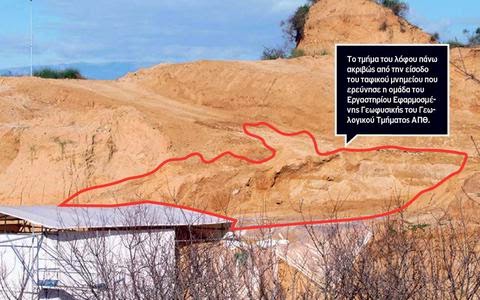
The "Sunday" ethnos "newspaper" found in a short distance from the site of the excavation in Kasta Hill of Amphipolis and recorded with the photographic lens of all phases of work, After completing the month-long phase of excavation, that was the revelation of the funerary monument. In a portion of the Hill, directly over the last, configured the space in order to proceed with the investigation
Already in this section until the middle of the week and despite the heavy rain last Wednesday, completed the first phase of prospecting, that started a 10-day period. Inside 7 until 10 days from the day of commencement of the work scientists of the University will be able to have with the method of electrical electrical tomography mapping-tangible results, as was stated in "" ethnos "newspaper" Professor Gregory Tsokas.
Will follow in the first phase of excavation incisions without unquantifiable time since there is always the factor of weather conditions of winter. Based on these incisions will be scheduled from spring, as estimated, the new archaeological excavation. At the same time Professor Gregory Tsokas and colleagues at the Laboratory of applied Geophysics will "scan" and a large part of the remaining 17 Hill's acres.

Excavator performs earthworks in the tumulus Kasta.
To note that the past decades starting from the excavations of the late archaeologist Dimitris Lazaridis 50 years have found a number of tombs. The period from the 1971 until the 1985 excavated in Northern, the Western and the eastern part of the tomb-the Tomb brought to light by the k. Peristeri is situated on the South side- and asylitoi discovered Iron Age graves. Also the 1982 found 10 kibotioschimoi or lakkoeideis tombs of late archaic era, eight of whom were in the northern part of the mound and two in East.
In addition found edifice with dimensions 10×10 m., with 5 m. height, that from the d. Lazaridis was considered burial mark, though Katerina Peristeri, based on the findings of the overall claims that this is the Foundation of the pedestal on which was placed the sculpture of Lion of Amphipolis.

The drainage project is in full swing around the mound peritoichio, as the presence of the truck in the back.
Under the pressure of the oncoming winter on the hill there is external Kasta orgasm, as she recorded the "Sunday" ethnos "newspaper". Transferring soils with big trucks and the help of a backhoe, While the trench was formed after the discovery of large perimeter wall with a total length of close to 500 measures, that was revealed in previous years, becomes a big drainage project to protect the monument.
The work is done at the expense of the municipality of Amphipolis under the constant supervision of the Mayor Costas Melitoy, and civil engineer. He, Speaking at the "Sunday" ethnos "newspaper", He talked about a project urgency, they undertook to implement the municipal authority in consultation with the archaeologist k. Peristeri. "The water collected in the trench are many and can endanger even the perimeter wall of statics" as said and for this reason created a wide drainage network-without concrete- they will gather the waters of the trench at various points and channels at a distance 400 measures, as reported.

Concrete cylinders remain piled up to be placed at points selected by the municipality's engineers.
DIASKOPISI
The "eyes" of special underground
This method of geophysical prospecting in General provides for the… partially ground wiring and the power input to the Earth with the help of electrodes. Then becomes a measurement of potential difference and the distribution of resistance with a fairly complex and developed algorithm, they have devised by scientists of the laboratory of applied Geophysics and these elements help for 3D visualization of subsoil. The method of electrical resonance, Complementing this mapping of electric, has far greater penetration and in addition is able to visualize three-dimensional subsoil. OSO is the largest ancient architectural remains (e.g.. a massive Macedonian Tomb) in the subsoil, the better the results of imaging, as the notes G. Tsokas.
X SELECT TELIDIS
ethnos.gr


