




THE ALEXANDROS STOUS THRYLOYS TIS GLOBAL MYTHISTORIAS
The unique character of Alexander, heroic, dreamy and determined to leave its mark in the world, managed to bring both deeply influence on parts of which passed and their peoples that conquered so 2.300 years after the legend remains alive, integrated or embedded in their myths, as an extreme example of courage and wisdom that surpasses human and touching the divine.
The many legends that follow the only really Big history, Start long before his birth..
Alexander, Divine seeding
The Pseudo-Callisthenes tells that the Olympiad was very embittered because he could not have children and therefore feared that he would leave Philip, who, According to the narrative of Pseudo-Kallistheni, demanded by this to find a way to make a child, otherwise do not like to seen.
The Olympiad takes refuge in Ektenaboy help, an Egyptian magician/astronomer who was a King in Egypt but was forced to leave the Kingdom and fled to Macedonia when he was attacked by the Persians, Iberians and other intruders. He convinces her that he would call the Amun-Zeus with the magic of art, from whom will acquire a male child. The Sands appear at night as a scapegoat and syneyrisketai with megalokeratos. None other than the Ektenabo, metamorphic, who manages this way and after numerous nocturnal visits to the bed of the Olympiad to leave her pregnant.. the child naturally, According to the narrative of Pseudo-Kallistheni, none other than Alexander.
According to another version, which prevailed because of the historical data contained in, the Olympiad was founded in Samothrace Mysteries school and said it was especially dedicated to Amun-Zeus, the Egyptian IE equivalent of Greek God. The destiny of both Philip and the entire world, sealed with the visit of Samothrace, where he met Olympiad, which became a wife and mother of Alexander. The night before their wedding is complete, the Olympiad saw her sleeping like a thunderbolt fell onto her body.
Philip himself is not, dreamed of before the birth of Alexander that sealed the body of his wife with a seal, whose footprint was that of a lion. The Aristandros from Telmesso, thinking how strange it was to endorse something that was empty, assured him that the dream meant that the Queen was pregnant with a boy who one day would prove to be so strong and brave like a lion. Some time after their marriage Philip found a reptile to sleeping on the side of the Olympiad.
The fact it's called How did Philip to stop the wishes, either because the address as giteytria or because it considered that has relationships with a God. Like to have things though, throughout his life, centuries after his death, Alexander was the son of Amun, something that he himself accepted as fact and therefore it wished from the years of his youth to visit the Temple of the "father" of the oasis of Siwa, in Egypt.
It was this desire that led him to Egypt and visit the city of Alexandria owes the existence of. Alexander was born at 6 of the month Ekatombaiwna, which Macedonians called Lwϊo, on the same day that burned the Temple of Artemis at Ephesus. The Leadership of the Magnesia tells us that the Church took fire and burned because the goddess of lacked, having gone to assist in the birth of Alexander. All seers on East looking at the ruins of the Temple had prophesized that this day would prove to be fatal and destructive for the whole Asia..
The oasis of Siwa
Arrian gives us a very short summary of what exactly happened when Alexander finally arrived in Siva. Reports a strange source in OASIS: The spring water is warm during the night and cold during the day. Then simply States that Alexander visited the Oracle of Sivas and got the answers I wanted his heart. Diodorus's story is perhaps the most lively and entertaining reference to Alexander's visit to Siva. Diodorus speaks of sudden storms, which anakoyfisan the companions of Alexander by great thirst and argues that this happened from Divine Providence. After this we have Ravens to lead the army deeper into the hinterland as well as a description of the source itself as stated by Arriano.
But what is the most fun in the narration of Diodorus is the direct transfer of speech between Alexander and priests of Siva. Diodorus tells us that God is represented as a form of emeralds and precious stones, which was mounted in a gold vessel carrying 80 priests. The vessel is said to be moving by itself and not driven by the movement of priests, but in fact it was this that led the priests. Sounds like "speech" from the boat, but it is not clear if this is for real words or an interpretation of moves made by the object.
Alexander acknowledges the temple as his father and then asking if really a day will rule all the Earth. The Soothsayer confirms. After Alexander asks if all his father's killers are punished and the priests, they interpret the answers of God say that the real father cannot be damaged by any, But if refers to the mortal called Philip, You should stay quiet as all those involved in his death have already punished. After that Alexander honors God with great gifts and returns to Egypt.

Alexander and Amazons
' Another legend for Alexander has to do with the appointment of a Greek Commander and the.. zeygarwma with the Queen of the Amazons.
The legend tells of Diodorus Siculus who narrates that the exceptional beauty and strength, Queen of the Amazons, Thalestris, passed in Hyrcania, accompanied by 300 the fellow, to meet the King of Macedon. Alexander's reputation after the perifaneis victories over the Persians had arrived as the Amazons who dominated in the land between the rivers Thermodwn and Fasi, as a result of being born to the Queen of the Amazons, the idea of this "mating" eygonikoy, so the fruit to be a child who would exceed in greatness everyone else.
Alexander, as a genuine Greek man, kolakeytike by the thought of Amazonas (and not just..) and not only ... succumbed to the desire for 13 days(!), but the farewell with beautiful gifts – it will say main .. Unfortunately, though, This meeting did not yield fruits, as the Thalestris was killed shortly afterwards in conflicts with neighboring tribes. An entertaining narrative of this legend is found in the trilogy of Valerio Massimo Manfrenti for Alexander.
The land of darkness and the Unclean tribes
The anthrwpofagoi Kynokefaloi was one of the 17 Unclean Tribes who inhabited the Land of darkness, from which, According to the Arabian legend, Alexander spent searching for water that would give him immortality.
The Pseudo-Callisthenes mentions the names of 17 Miarwn Breeds in Greek (Goths, Maggothoi, Anages, Agwkoi, Exaytheisi, Anthrwpofagoi, Kynokefaloi, Fardeioi, Aleneoi, Fysonikaioi, Asineoi, Draraioi, Defareis, Fytinaioi, Thelmataioi, Marmythai, Agrimantheoi), and speaks of a bronze Portal ordered Alexander to construct and the aleipsoyn with Siakinthi (a material so strong that neither iron nor destroys the fire) so getting stuck forever and 17 unclean tribes inside the cave in which they fled to escape from him. The Pseudo-Methodius again, a similar version of the legend, talks about confinement of Maltsech by Alexander Kynokefalwn in Tartarus.
The well of life
In the Arabian romance, Alexander starts his journey to the land of darkness, immediately after his marriage with the Queen of the Amazons in Al-Antaloys, in order to find the well of life, as it is called in Arabic, because he learned that the thread of his life is almost over and wants to live longer. In some versions, accompanied by his Cook, called Andreas in Syriac version, Intris in Arabic, – or from a mysterious figure called Al-Qadir. Al-Qadir means "evergreen".
Comrade of Alexander finds the well of life random, When a dried fish which soaks in this suddenly comes alive and swims away. Bathe in the fountain and then runs to tell the owner what has happened. And the two men return but fail to find the magical source again. The Cook is immortal and Alexander must die.. This episode from the long Arabic romance was and still is notorious throughout the Islamic world. There are versions in languages as diverse as the Mogkoliki and the Iabaϊki. European versions of the legend was equally popular during the European middle ages – but only the Oriental versions contain the episode with the well of life.

The Mermaid
However the legend he with whom Greeks are more familiar – grown up they will argue with him – is the one of the mermaid that stops ships and asks with pain if he lives the King Alexander and, whenever you get a negative answer, causes Tempest and sink the boat. When, though, get the answer (now there should not be a Greek sailor who don't know): "He lives and reigns and the world overwhelms" Feel jubilation and leaves the ship to leave. Is the sister of Alexander the great who in folk tradition, When her brother found the water of immortality, him and drank that, leading Alexander to the curse.
Or when another version of Alexander commissioned to find the water of immortality and she found. But, as the go to brother, fell, spreading all the water. Then from the sadness of her brother lost because of immortality, He tried to commit suicide, tumbling overboard. The gods, though, the regretted and transformed into a mermaid, half woman, half fish – and since then trying to allay the pangs of, asking from passing ships to learn, If brother lives of ... But the legends are not limited only to the sister of Alexander the great.
So, According to legends that ferried the Marco Polo, the Bucephalus, the magnificent Alexander's horse was a mythical Unicorn . Indeed, in Badakshan were the descendants of Alexandria Bucephalous, horses who all had a horn on their forehead. Their owner, though, refused to cede some of the horses to the King and he killed him. Then his wife, to avenge the King, kill all horses. So the unicorns disappeared. The magnificent Alexander's personality is not left untouched nor Muslims, Since many scholars argue that Alexander's presence is felt even in the Koran. Specific, many researchers believe that the hero of Koranioy, Dhul-Qarnayn(ذو القرنين),whose story covers 16 Koranioy lyrics, is Alexander the great.
Indeed, He is considered a hero by Muslims Prophet, While some researchers believe that Dhul-Qarnayn is an ancient epithet that attributed to Alexander and means "he who has two horns» (in some depictions of, Alexander appears with two horns). According to the narration of Koranioy, Jewish rabbis caused Muhammad to prove that he was a prophet, answering three questions. One of them asking him to talk about a man of ancient times who traveled much and reached the East and the West of the world.
After 15 days, Muhammad responded that the man he was the Dhul-Qarnayn, According to Muslim historians, is Alexander the great, who because he was King and Persia and Greece, called «dikeratos»(the two ends of the world). Indeed, the narrative for Dhul-Qarnayn legend which mentioned surrounding Alexander tradition and other peoples, as Jews and Syrians. One such legend is that of the Caspian Gates, where according to a legend of Syrians Alexander, as recounts to his mother, begged God to bring together the two mountains, among which built a wall of iron, to prevent the Gog and Magog hordes of (Scythians) than to invade Earth.
The death of Alexander the great
Legends wrap and the death of Alexander. So, According to the Byzantine legend played by Spanish, Serbian and English legends of the middle ages, When Alexander returned to Babylon, one infant was born half alive, half dead: the human track was dead, While the live piece took the form of a monster. The soothsayers of Alexander the ermineyoyn that Alexander will die and the epigonoi will dominate.

Alexander orders to cremate the monster. Meanwhile in Macedonia, the rebels and the Olympiad Antipater notifies Alexander. The Antipater fearing the reaction of Alexander sends in Babylon a poison so powerful, that, to be transferred should be placed in a leather box and this in iron. Alexander Iolas brainwashed from welcomes and time psychomachei, fog covers the sky and a star falls into the sea, followed by an eagle. The statue of Zeus in Babylon minced as soil. Then the star that had bogged down in sea pops up along with the Eagle. Alexander dies.
The remaining medieval legends follow the Byzantine style template for the death of Alexander, poikillontas to persons who reside around the bed of death (including the Olympiad, Aristotle, even bucephalus(!) that melts with the hooves of the murderer of his master) and in natural phenomena accompanying the Macedon's King charopalema: a violent storm hits Babylon, escorted by an earthquake and a total solar eclipse! But the most trabigmenos legend for Alexander's death written by a Danish monk Jacob van Maerlant the 1260 a.d.
In accordance with this, Alexander announces that this world isn't enough for conquests and wants to conquer other worlds. So he organized a plan his assassination not on Earth, but in hell(!!). The creatures of hell prepare a poison capable to bring the end of Alexander's life and deliver on Antipatro.
In between, Alexander, along with the new ally, King Porus, in India the idea in places not visited neither man nor God. There they find two trees: the tree of the Sun and the Moon tree, that whisper the message of oncoming death. After this, Returns to Babylon, where accepts the embassies from the Gaul, the Spain, the British Isles, the Italy, the Norway and Denmark.
The next morning , the day hesitates to start. Alexander drinks poisoned wine. In
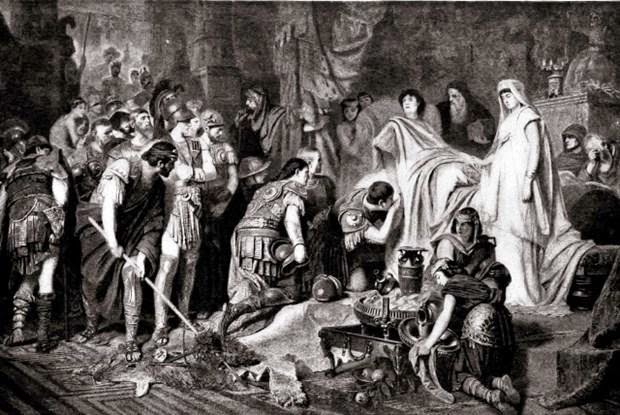
his deathbed says to his soldiers that now has a most important mission: four giants intend to conquer heaven and depose his father Zeus. That's why the gods invited to come to his father's help. Giving the ring to the Perdikka and dies.
See, well, how Alexander's personality was both catalyst, in order to master in the folk tradition not only of people who experienced the passage, but those learned later about the great Greek. Indeed, Judging from the number of books, Scientific and novels, still be written even nowadays for Alexander, the form of the young King will continue to keep you captivated and enchants people's imaginations and in the future. Maybe, eventually, This is what made Alexander Mega.
Spyridoy Gifts, Bright C. Giapoytzidoy
www.macedoniahellenicland.eu
Sources: Anabasis Alexandrou, Arrian, Historical Library,
Diodorus Siculus Anonymus Alexandros of Makedonos, Pseudo-Callisthenes
The age of Alexander: nine Greek lives, Plutarch, Ian Scott-Kilvert,
Lives, Πλούταρχος Ηγεσίας ο Μαγνήσιος Ψευδο-Μεθόδιος,
Οι Αποκαλύψεις Myths of the dog-man ,
David Gordon White Ponce de Leon and an Arab Legend, Paul Lunde Pothos.org Wikipedia, "Alexander the Great in the Qur'an"


