



Despite the fact that the excavations are still in progress and the final conclusions will be longer to go, the monument of Amphipolis managed to grab global attention and, as expected, it captured the imagination of conspiracy theorists spin it everywhere.

In an era where the Internet «kyriachei» and social media have become "chariot" to transfer ideas and theories, He was expected to see hundreds (Perhaps most) "experts" who know the ' absolute truth ' for the tumulus Kasta.
While the moderate non-experts rely on assumptions about the identity of the manufacturers of the Tomb or investigating possible correlations with Alexander the great, the family and descendants of, countless versions circulating on the Internet much more imaginative scenarios.
As stated in the "daily" If someone hits on a machine anazitiseis words like "Amphipolis, the truth ' will appear in front of hundreds of thousands of results, the majority of which has little to do with reality.
By far the most popular among users of the Internet proves the theory according to which the most important findings of the excavation have deliberately hidden from archaeologists and the Government, probably at the behest of the troika, Germany or… lobby anthellinikoy international "». And how else to explain the "disappearance" of mobile finds-among them, gold coins, jewelry and marble inscriptions, that may already reside abroad- but the strict security measures in the area of the excavation-rumors speak even for the presence of paratroopers and bracket of EII- as the cut the hands of Karyatidwn-what does holding;- or the August date in sketches of Sphinxes, whose heads were discovered in August;
What is the goal of plektanis; Of course the further weakening the morale of ' Greek ', who, in the diaforetioki case would find their lost prestige "», a way out of the crisis or a trigger to revolt against "foreign occupiers", Depending on the angle. At The Same Time, the revelation of the secret of the grave I was standing obstacle to Macedonia's concession plans-as name or geographical area, This does not clarify- in FYROM with the blessings of the USA. On The Contrary, If the monument was the tomb of Alexander, the "Skopje will be awarding dissolved within 15 days».
Of Course, conspiracy theorists can always to intersperse their opinions with crowd "revealing" information linking Amphipolis with unrelated, seemingly events, as Aman Alamoyntin's visit to the archaeological site of Dodona and the investigation in the Antikythera wreck.
And as always you must "close" such a text, the afterwords are full of allusions and unanswered questions that encourage the reader to fill in the gaps by using the "logic" of.
In a different version of the previous theory, archaeologists knew from the outset that the excavation of the mound would not lead to breakthroughs, but I followed the instructions of the political leadership, I wanted to create a "distraction", Turning the public's attention away from the prowthoymenes laws.
At the same time, the inhabitants of Amphipolis it seems that sell off their land to foreign investors, Having realized the potential of tourism exploitation of the mound and arrive in the area carrying suitcases with money.
Source: iefimerida.gr
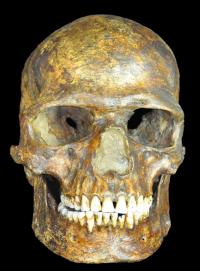 COPENHAGEN, DENMARK—DNA from the ulna of a modern human skeleton discovered in 1954 at an archaeological site at Kostenki-Borshchevo, located in southwest Russia, has been mapped by a team of scientists led by evolutionary biologist East Wilerslev of the Natural History Museum at the University of Copenhagen. The skeleton has been dated to between 36,200 and 38,700 years old, making the genome the second oldest to be sequenced. This new data suggests that this man, who had dark skin and dark eyes, had DNA from European indigenous hunter-gatherers, people from the Middle East who later became early farmers, and western Asians. It had been thought that these three groups only mixed in the past 5,000 years. "What is surprising is this guy represents one of the earliest Europeans, but at the same time he basically contains all the genetic components that you find in contemporary Europeans—at 37,000 years ago,"Willerslev told

