Oops! It appears that you have disabled your Javascript. In order for you to see this page as it is meant to appear, we ask that you please re-enable your Javascript!

"100 years of excavations at Philippi" – A unique exhibition in Switzerland

The exhibition will consist of ancient documents and material from the photo archive of Paul Collart

To mark the 100th anniversary of the start of excavations in the city founded by King Philip II’ of Macedonia, father of Alexander the great, the 356 e.g.. in northern Greece, the French school at Athens organizing exhibition in Switzerland in collaboration with the universities of Lausanne and Geneva.

The exhibition will consist of ancient documents and material from the photo archive of Paul Collart (1902-1981, Professor at the universities of Geneva and Lausanne).

The ancient documents will be presented in the form of large panels that will include archival photographs and reviews, While two videos will animate the presentation. At The Same Time, many conferences and events in Switzerland will accompany the report, which started yesterday, at 19 February and ending on 6 May.

Archaeologists of the French school of Athens began exploring the area in ancient Philippi, close to Kavala, the 1914, the year of the start of the first world war. The work continued after the war and held until today.

Swiss Teacher team has guided much of the scientific research being done at Philippi and has published fundamental works on the history and archaeology of the region. Modern excavations at the archaeological site of Philippi, made largely from Switzerland and members of the University of Lausanne.

The site of Philippi is a candidate on the list of world heritage of UNESCO.

www.patrasevents.gr

To such burial gold plate Ippwnioy

EImi and pais Oyranou Gis ἀsteroentos:

By Mnamosynas tode • epei if melliisi thaneisthai
eyireas εἰς Ἀidao surfaces, of d est '<(e)>xiἀ krina,
Despite aytan estikua d ' kyparis light<s.>ND •
psychai katerchomenai nekywn cooled within.
tas kranas taytas eggythen elthiis schedon mide.
tas Mnamosynas prosthen he eyriseis from limnas
ydwr proreon psychron • epyperthen easi he guards.
ἐν eIrisontai oI o in<i> frasi peykalimaisi
ot<t> I Ἄidos di exereeis murk orf<n>ientos.
• Gis pai eIpon<ò> eImi and ἀsteroentos • Oyranou
eIm ' dipsai d ' ἀpollymai and • ἀl ayos<(l)>a dot ' wka
ydwr pienai psychron of Mnemosyne by Lake.
and partner di ereoysin {(j)}ypochthoniwi Kingdom to life!<century>•
and {partner di} piein tas Mnamosynas ἀp dwsoysin[o] limnas
and di and piwn odon erchea sy<(j)> Te ἅn and ἄlloi

bakchoi and Ieran steichoysi mystai lock<(e)>inoi.

Calabria, Ippwnio [I]

This is the work of Mnemosyne.[ii] When is to die
(and to go) to well-made lofts of Hades,[iii] on the right there is a fountain[iv] and the side of the white Cypress stands.[v] Here like descend of dead souls are cooled.[vi] This fountain or even to approach!
Further you will find water cool rolls
by Mnemosyne's Lake.[vii] Security guards stand in front of.
I ask with sagacity spirit
What are you looking for in the bleak darkness of Hades.[viii] To say: "I am the son of the Earth and the starry sky.[ix] Stegnwsa of thirst and perish. But give me
quickly drink cool water of the pool of Mnemosyne ". And will ask the Queen of the underworld[xi] and I will give to drink from the pool of Mnemosyne.
Like drink, and the sanctuary will take the road [xii]

marching and other mystics and glorious bakchoi.[xiii] [I] From gold foil rectangle found in Tomb woman (around 400 e.g.), at the top of the breast. Perhaps it was fastened at the neck with a thin chain. Together with another group of similar findings by the Sicilian entella, the Petilia and Farsala constitute a relatively coherent description of the arrival of the soul of the deceased to the underworld. Someone (a priest, the Mnemosyne, the text itself;) addressed to the dead in second person and gives him instructions on what to see and what to do, When found in hell. Shortcut similar texts we have from Thessaly and Crete.

[ii] Mnemosyne is the mother of the muses, the deity of memory. Mnemosyne is associated with Orpheus pedigree through her daughter Kaliopis, which is the mother of the great musical. For the expression "the Mnemosyne project» GP. the beginning of the Homeric hymn to Aphrodite, where the poet invokes the Muse to sing the works of Venus, i.e. the sphere of influence of the goddess and aspects of its action (Mousa polychrysoy Ἀfroditis μοι ennepe projects / Kypridos…). Here the ' work ' of Mnemosyne is the swtiries instructions and words you need to memorize the dead man's soul, i.e. the text itself, like the inspired or dictated the goddess of memory. The text is in verse, just to facilitate the memorization. The guidelines apparently were given for the first time as the dead was alive, in some initiation ceremony. The man entrusts the goddess of memory, order to the underworld to remember what she learned during the myisis of the upper World [GP. orfikoi hymns (= TH) 77.9-10): makaira thea͵ mystais ἀlla͵ memory epegeire / eyieroy teletis͵ twnd΄ ἀpopempe by lithin IV].So the Mnemosyne becomes patron of the soul and the posthumous journey Guide. In philosophical circles the memory considered organ of human salvation. The Pythagoreans, closely connected with the Orpheus, gave great importance to memory and took care to practice with different techniques. Pythagoras remembered a lot from previous incarnations of. The same and Empedocles. The remembrance of past lives was necessary, for anyone to know his true self. The recollection is a cleansing of the soul. The unnamed deity who speaks in Parmenides and reveals the truth (Re. (B) 1 D-K) Perhaps it is the Mnemosyne. For Plato the drink from the water of oblivion (Oblivion) means to lose the memory of perennial truths. In the Greek ἀ-litheia is literally the absence of amnesia, therefore to remember means to know. Oblivion is the water of death, Mnemosyne is the water of immortality. The memory ensures the dead soul the ability to remember the divine origin of the, to depart from the circle of time and life and not reincarnate again.

[iii] One who dies is the adept (or the ' Hero ' to other sheets). Death is perceived as a passage for the soul, that is why the corresponding rimathaneisthai is written as if it were a verb of motion (εἰς Ἀidao surfaces). The text must be written at the precise moment of death, to avoid the terrors of Hades soul. At this critical moment the soul faced with options, other desirable and others do not. The texts do not explain why the soul must make a choice and not another, or why should I say certain words and not others: knowledge of the causes for the specific options suggested for the initiated and you don't need to be developed in detail by the authors of the texts. This lack makes it difficult for our interpretation of laminates.
The Palace of Hades described as well-built (Earth eyireas Ἀidao). The designation reminds us of the shows with the dead to the underworld to standing in front of a building with columns.

[iv] This is the fountain of oblivion. Here is placed on the right, While the fountain of memory is not left, But beyond the same (right) direction. The same pattern exists and in sheets from the entella and Farsala. In the foil from the fountain of oblivion Petilia is located on the left, While the fountain of Mnemosyne is located on the other side, that is to the right. In sheets from Crete Mnemosyne water is to the right. One of the signs of Thourion the soul must move to the right, to be saved. Generally the soul must follow a course to the right, When found in the Underworld. It is known that the Pythagoreans regarded the left as something bad. In Plato (State 614C) the souls of the righteous after the crisis the right path, which leads to the Macaronesian Islands (Gorgias 524A).
In the basement of Oracle Trofonios the priest takes the visitor to the sources of the river. There must drink first from the water of oblivion and after the Memory of water (Παυσανίας 9.39.7), a representation of the treaties of the underworld.

[v] Cypress from the most ancient times associated with Hades and death in many cultures. Cypress here is white, without explained why. Several interpretations have been proposed:
(a)) In various cults of the dead were buried with white attire [e.g.. Kea (Sokolowksi 97 A, sacred law of the 5th century BC), Lebadeia (Sokolowski 77 C 6, 5century BC), Messinia (Pays. 4.13.3), Orphic burial in Thoyrioys (Timpone Grande)].
(b)) The Mystics wore white clothes (see. l. x. Eur., Cretans re. 472, 16 Kannicht).
(c)) Cypress shines in the darkness of the underworld, attracting like beacon the souls of uninitiated dead in the water of oblivion.
(d)) Maybe the white here has the meaning of "spectral", After the color is associated with ghosts. In The Odyssey (Oh 11) the souls of suitors Lefkada petrin encounter on their way to hell.
(e)) Maybe Hades to be arrested here as the inverse of the upper World, where the Cypress is dark.
(f)) The orfiko-Pythagoreans wore white garments, When attending funerals, While it was forbidden to make coffins from kyparissoxylo, because of this wood was made the scepter of Zeus (Iamblichus, Vios Bottom Shell Area. 155, Hermippus re. 23 Wehrli – the Cretans of Euripides the Holy Temple of Jupiter is made out of Cypress, Re. 472, 4 k. on. Kannicht).

[vi] The dead man's thirst is global pattern. So I made in honor of the fallen wet offers or tipped vessels with water on the graves. Without a friend or relative to remember, the dead suffered from hunger and thirst, as we mention Lucian (Concerning mourning 9). In The State (621AB) Plato describes the road that leads to the plain of oblivion as barren, pnigiro and very hot. The Tantalus suffers from eternal thirst in hell for his crimes. Thirst can lead the soul to do wrong and drink from the water of oblivion. This is bound to make the uninitiated souls: cooled, but so forget and trapped in a new incarnation. The verb in the original is cooled (cooled). In ancient Greek language "psychw" also meant "blow", but "give life" (GP. soul = the breath that gives life to the body). There maybe etymologiko game: the souls who drink from the water of oblivion do not only cooled, but literally get life for a new incarnation, anything negative about the optics of Orphic.

[vii] In Homer the souls of the dead are ordinary shadows who don't remember anything. The soul of the Seer Tiresias in Odyssey 11 references (Rhapsody (l)) be able to remember and prophesied only when drinking the blood of carcasses. Odysseus tries to keep other thirsty souls away. In Orpheus blood shall be replaced by the Memory of water, with score to cut so any bond with the bloody carnal Over World.

[viii] The image of deities-guardians that protect a sacred and secret place is common and in antiquity and in the Judeo-Christian tradition. To the Gnostics the Lords, Junior Centuries, have negative role, After trying to prevent the rise of soul fylagontas the planets. The soul passes, only if you know the appropriate password. Similar ideas found in hermetically texts, the neoplatwnikoys, the mithraϊsmo, the Zoroastrian, esoteric Judaic and Christian texts, etc..
The keepers here make a question and waiting for a password ID., an image derived from guarding the camps or portals. The slogan that needs to know the soul also refers to covert or synwmotikes groups, whose members are recognized between them with special gestures or words. The Orphic texts don't tell us if some punishment awaits the soul who doesn't know the slogan, but from corresponding Platonic pictures (State 363C, Gorgias493B) We can assume that the disciplined soul. At amphora from Italy (42nd-3rd century b.c.. -Vulci), which unfortunately has now lost, was depicted a prosperous Prairie, which was separated from the place of the damned with trees full of birds. A hill stemmed a fountain and before her stood two young crowned with Ivy and keeping thyrso, Dionysian symbols. An Archer was depicted on hand to throw DART. The two young people are obviously Mystics, While the Archer-keeper is not leaving them to spend, If you don't say the right password. On the other side of the vase a demon tormenting with torch a woman, type of ypochthonias of punishment. The lack of reference to the Orphic laminates in punishments may be because that would be inelegant to recall something to a dead adept who hopes to salvation. Moreover the lamina with the instructions accompanying the dead, but the initiation that has received during his lifetime, Maybe considered capable weapons, to avoid forgetting the password and soul be punished.

[ix] The soul recalls the divine origin of the (Since Hesiod the Earth and the sky is the primordial divine pair, While gods and people have common origin-GP. Pind., Transmission New Projects Department. 6.1-2, Eur. Re. 1004 Kannicht), Hence the kindred with the guards, Hades and Persephone and the other gods. This shows the guards that remembers the origin of, but and that is entitled to share in divine State primary. However the weight seems to falls on the descent from heaven. In other similar texts the body belongs to the Earth (Titanic element in such legend of Zagrea) and the soul in heaven (Dionysiac element). The adept must renounce the earthly element of, even his personal name, to enter the world of the gods. The starry sky is the place of heavenly fatherland for the Pythagoreioys, While for Plato the redeemed soul returns to the star that corresponds (Timaeus of locri 42B). In another such sheet the dead calls himself Asterios, probably a secret name for the initiated and not his real name. A series of parallel passages in different traditions highlight that the recollection of celestial origin of some is necessary for salvation: see. l. x. Fr. Oh 1-2, Emped. Re. (B) 119 D-K, Ippol., Against all sects 5.7.30, Gospel of Mary (P. Berol. 8502, I 16). However we are not sure if the Orfikoi who wrote the Golden plates considered that the final outcome of the lytrwmenis soul is in heaven or in some part of Hades especially guarded about her, something like the Champs-Elysées or the Macaronesian Islands, where you will live in an eternal happiness. The redeemed soul refers simply to follow the road that got the other Mystics or bakchoi or heroes, without specifying where this road leads.

The dead indicates indirectly that the guards be versed, After the thirst of due to the fact that his soul drank from the fountain of Oblivion, as the souls of the uninitiated: as adept already knew from the myisi to the World that it is forbidden to drink from this, the remembered posthumously (with the assistance of laminae) and even managed to beat temptation, When passed from there. In many ways, well, is a capable fighter who deserves to be rewarded by the gods of the underworld. Thus the thirst here is a key part of ID as password and the reference to the celestial origin, but the call for xedipsasma from the source of memory (also a sign mystical knowledge held by the dead, Since he knows the importance of, but also that there is such a source to hell and even immediately after the source of oblivion).

[xi] The keepers must consult the Persephone, After ultimately aren't they, who will judge if the soul is entitled to drink water, but the Queen of the underworld.

[xii] The sacred way which leads to eternal happiness. The image is of Iera Odos to the underworld can be inspired by the operational path of terrestrial initiation or from the sacred processions of initiates l. x. the eleusinian Mysteries, where the course was long and difficult, but the adept does not feel fatigue with intervention of the gods (Eur., Bak. 194, Aristof., Gourmet Frog Wants To. 402 Mr. SEM.). Plato notes the similarity between the ritual practices and the journey of the soul (Faidros 108a). But we also have fabulous and philosophically in tandem: in Pindar, the road of Jupiter leads the godly souls in the Macaronesian Islands under Rhadamanthys (Ol. 2.68 k. on. -GP. Pal. Anth. 7.545). The Parmenides travels the path of wisdom ((B) 1.2-3, 27 D-K), to find the redeeming truth.

[xiii] The adept who arrived in perfection is identified with the God of, Dionysus-Bakcho and therefore rightly calls himself this title. But while those involved in simple Dionysian rites of ekstatikes cities are satisfied with a temporary identification with God that lasts as long as the ecstatic ceremony, the Association of orfikoy with the divine is permanent and in this life and in the posthumous condition.
The adventure of the soul seems to us ending elasma here. The text from the entella implies on-unfortunately- damaged end of that at a later stage the soul appeared in front of the same Persephone.

eleysis-ellinwn.gr

The transatlantic voyage of Hercules


Historical person who arrived to Canada was the Hercules of Greek mythology, According to Professor of geology Elias Mariolako.

Arrived a thousand years ago by the Great Alexander on the Indus River. Passed from Ethiopia, arrived to Greenland and perhaps to set first set foot in America. One of the most famous Heroes of world mythology- Hercules- It was not only a great plumber, engineer and ydrogewlogos, as evidenced by many of the twelve labors of, but the first who did act on globalisation and the architect of the Mycenaean kosmokratorias, as I argued last night in his speech, at the University of Athens, the Emeritus Professor of geology and a member of the Central Archaeological Council Elias Mariolakos.

"Hercules is not a person to amuse the children. Neither the Greek mythology a tale about a fantasy world ", says Elijah Mariolakos. "Hercules is an historic- and not mythical- person, an unknown great conqueror, Hero- founder of cities, first link of the common European cultural matrix, of the Mycenaean and consequently of Greek culture. And the mythology is the story of the distant past of the inhabitants of this place, who much later would be named Hellas».

First under the microscope of the Professor entered the feat by grabbing the Seizing of oxen, the three-bodied giant three-headed and who lived at Gadeira, today's Cadiz Spain, near the Strait of Gibraltar.

"Most believe that Hercules traveled to the Iberian Peninsula to bring a good breed of oxen in the Peloponnese», explains Mr. Mariolakos. "If we read carefully Strabo, who lived in the 1st century. e.g.. though, We see that in any other part of the world has not been found so much gold, AG, copper and iron. And the oxen are justified because there was testimony that the "sifting" of gold from the sands was on skins steers».

The founding of the city of Hercules is commemorated in the coat of arms of the city and today. Hercules accomplishes the feat and continues North towards the Celtic and founds the Alesia (also known as a city of Asterix), whose name comes from the word Kızılırmak River (= wandering). City of strategic importance, connected via navigable rivers to the Mediterranean, the Atlantic, the English channel and the North Sea, where Julius Caesar the Gauls katatropwse. Even founds the Monaco and the Alicante – the football team called Hercules.

What you seek in Gaul Hercules; «Gold», answered by Mr. Mariolakos, "since Diodorus tells us that in Gaul there are rich deposits of chrysofora». Hercules, however, reportedly- According to Plutarch- to arrived and to Ogygia located five days West of Britain.

"Five days shall be equivalent to 120 hours. If the average speed of a are of the time was 4 miles per hour, then the distance is 890 km., Hence it present-day Iceland and continued to Greenland, While the Sea of Cronus, referred, According to the calculations identified with the North Atlantic»

"To bring the golden apples of the Hesperides (i.e. the gold) Hercules from Egypt arrived to Ethiopia and then in the Caucasus- to seek the help of Prometheus- and in Libya before returning at Mycenae "

Hercules has arrived, According to Professor Elias Mariolako, as America. «Read sources that fit his attachés "by the mouth of the Bay is in the same line with the spout of the Caspian". A Bay only cover these conditions: of the St. Lawrence in Toronto of Canada». Stated that stayed "in the Islands to see the Sun hides for less than an hour 30 days»- the Polar circle.

What seek there;

The answer lies in the discoveries of the excavations carried out around Lake Superior in Michigan. It suffices to think that they have mined over 500.000 tons of copper in the area, When the pesky copper source par excellence- Cyprus- quarried 200.000 tons.

The extraction was the period 2.450 e.g.- 1050 e.g., stops suddenly, When collapsing the Mycenaean civilization. And all this in an area where the natives were in the stone age!

Defencenet.gr news section

The goldmines of m. Alexandrou

The goldmines of m. Alexander ~ What happened to the amythitoi treasures of the Persians;

Alexander the great arrived at the edge of the then known world. The history of conquests and discoveries are pretty much known. Few-about the project- men and a lot of determination. -But how was the campaign of Alexander the great; -Had hidden resources; -Maybe unknown goldmines; The information is conflicting. Most sources indeed, talk about huge debts he left Philip. Other where he got very little money with him in Asia. And others for more money and sources of revenue from gold mines in northern Greece initially and then in Asia. Did when Alexander, When he became King, He reiterated the well-known "Chorus" of Greek policies: "We received burned land from the previous Government"; Though Philip is not left at all "burnt Earth". Left an organized State, with conquests that yielded revenue, and particularly gold mines and argyrwrycheia who constantly gave metal for coins.
Ο Φίλιππος, knowing the need for money, in order to implement the campaign who dreamed in Asia, She had taken care of very early to find and understand places that promise revenues. Perhaps the most decisive Act was the 357 e.g.. (even before born Alexander) When captured Amphipolis using conqueror Rams. Along with Amphipolis won and the goldmines of Pageos – What,What better had to offer the land of Macedonia and Thrace from a financial point of view. Those mines formed the backbone of financing any activity of Philip. Had for the Kingdom of Macedonia, the same position they had argyrwrycheia of Lavrion on democracy of Athens a century before: Provide stable income. Fixed, but not enough for the designs of Philip. Until the death of Philip organized, planned, ekstrateye and conquer. And every conquest cost. It wasn't just the usual military spending, as Philip was modernist in martial art he learned to use war machines, which at the time were the recent inventions of Syrakoysiwn: Crossbows, petrobola, catapults and elepoleis (battle towers). All these cost, and Philip made without considering the costs, as many and conquer a city after another, so okay everyone in grandiose plans.

Philip still secured in Thrace goldmines – near the city Krinides, captured and renamed to "Philippi". It is said that only the goldmines in Philippi of attributed 1.000 Gold talents a year (26 tons). Thanks’ These began to Mint gold coins were the most prevalent currency in the Greek world.

Alexander continued to use gold and silver coins of Philip, but then highlighted in silver coins which followed the Athenian pattern as to their weight (with Hercules on one side and Jupiter on the other). The preference in silver shows maybe some possible shortage in gold. So, When came the time of Alexander the great ", He "inherited from his father, along with the Crown, and not a few debts, "according to the Koyrtio and Arriano. Arrian says that Alexander found in the vaults a few gold and silver objects. From money, Neither 60 talanta. From the other, Philip's debts reached in’ other Member 500 and in’ other Member 800 talanta. The talent as a unit of weight was 26 grams, but as currency amounted to 6.000 Greek drachmas, so the 60 talanta was 360.000 drachmas of that era. With the buying power that then had the Drachma (a penny then tantamount payday and a low purchasing power equivalent to 10-20 Euro) a man bought the necessary for a poor day. I.e. 60 talanta was salaries 1.000 poorly paid people for one year (somewhere 5-10 millions of current euro). But Alexander had with him when he started for Asia at least 35.000 men. This implies economic need for more than 2.000 talanta. Had Alexander does «hidden» resources; Unknown sources or financial backers began with what,what had. When started for Asia, got the 60 the talents and food for 30 only days (as reported by Plutarch, based on a source that calls Chieftain). The relevant sources give slightly different numbers, but all agree: money was not plentiful. The Onisikritos talks about debts 200 talanta (NB:military loan while Sarantos Kargako), While Aristobulus writes that the cost of preparation was 70 talanta. All of them are located far from the (to a minimum) necessary 2.000 talanta. Of Course, in Asia things changed. Go conquering the richest country in the world and ensure the necessary from the spoils of the enemy . The conquered satrapeies ' offered ' and they all,what they could from their own revenue (Alexander made sure not to change the administrative structure of the conquered land in order to continue to function smoothly in ' State '). Also, It seems from the narratives left by people who had accompanied the experts together prospectors (researchers Placer or geologists, We would say today) Why send to "follow" any rumor about gold meet. Search the resources employed until his death, even when he was no longer at the disposal of all the gold of the great kings of Persia – an incredible treasure. He died while the ships were ready to launch ekstrateyontas in Arabia, called that was rich in gold.

Can the start for Alexander it was difficult from an economic point of view, but the end was without such problems and, extra, brought a new epoch in economics. When Alexander swept away the Persian rule of Darius, the 329 e.g., and entered in the palaces of the Persians, found in front of the greatest treasures of history.

The treasure of Darius was essentially all the treasures of all the States of the Mesopotamian stacked since the dawn of history.

The gold 3.000 times! From the years of Sumerian, and as a people conquer another and States and empires of the region succeed one another, the gold and the treasures of each change every time. Darius had treasures and spoils which originated in Greece, taken at the time of the Persian wars and especially of Xerxes and fermenoys of the Kings before him. Had, yet, treasures from the various peoples that he and his predecessors had conquered.

These, though, was nothing in front of the treasures that had found the Validity, the first King of the Persians, by Medes, and the treasures they had grabbed the Medes from the Babylonians when face Babylon. And of course the Babylonians were treasures and spoils from the peoples they conquered, Assyrians and others.

The treasure of Darius showed that money does not bring victory. Neither the buy, If the opponent is Alexander. This was one of the courses that I took the Persian King.

When Alexander decided to ship the treasure of Darius, It took 20.000 mules and 5.000 camels. More wealth than he had ever seen of the Hellenic world, called that tantamount to 12 millions of pounds of silver. Only the scene with the throne gave Darius to Alexander treasure worth 3.000 talantwn (more than half a billion euros). Darius course perhaps was looking for revenge: Using a, unknown probably, form of psychological warfare, the loaded along with the gold and the women of. With the treasure Alexander found the mother of Darius, his wife and his harem!

The treasures they, that was more than the gold they had ever seen the Greeks, finally determined and Greek history, because these were "financed" the endless wars between «Epigonwn» – the successors of Alexander the great.

Are still "station" and the history of Economics: The existence and release of first created "inflationary trends». The history of inflation begins when Alexander started to pull out the gold of Darius from warehouses and distributes to the Greeks!

The consequence was that the Greeks were (athelitoi) inventors and inflation. With so much money and wealth to have come out of the vaults and be placed on the market, in conjunction with the military requirements that create campaigns, attracting new soldiers and endless wars between the successors of Alexander the great caused increases in everything. Salaries quadrupled, the same and the prices and cost of living.

Mining and argyrwrycheia of Philip and Alexander gave impetus and in the cutting of coins. Alexander's coins continued to be "cut" for years after the death of. They may be able to give an indication of the geographical location of the sources of precious metals.

Just as he lived there Alexander 25 different cuts of coins: two in Macedonia, one in Egypt and twenty-three in Asia. It becomes obvious from the minting of coins that the Centre of gravity and the sources of precious metals had moved East.

However, in quantity it seems that higher production came to Macedonia. There was the older gold coins, While other smaller and silver. This shows that the major source of gold was still in Macedonia.

After the death of Alexander mints made 31, and still 100 years later "tetradrachms of Alexander pods» 51 parts, which shows that & sources of the metals was too rich and continued to feed coins Greek world who had indulged in an unprecedented allilofagwma ignoring the "clouds from the West", the rising power of Rome.

The bulk of the treasure of Darius went to Pella.

Alexander sent enormous quantities from the Persian treasure back in Macedonia. We know that even 150 some years later he had left large quantity in Pella, enough to impress the new conquerors, the Romans.

Plutarch in his Parallel Lives (Timoleon-Aemilius Paul) Describes the treasure brought to Rome, the Aemilius Paul after his victory against Perseus. The spoils were passing in procession for three days:

"The first day passed 250 carriages loaded with statues, images and statues. The next day passed and again coaches with Macedonian for weapons and followed 3.000 men who would carry a silver four per pot full of silver coins, while others carried various precious objects and decorative. On the third day they say 77 Gold containers within which there were gold coins – as he had done with the silver!»

More from 150 years xodematos in equipments, wars, wastage and "excesses" that characterised the Hellenistic era of successors of Alexander the great and the treasure was still so large, to dazzle the Romans.

How would say at the beginning, When Alexander saw him;

For some unlikely reason nor Perseus, in front of the biggest danger the life and reign of, nor before that Kings of Macedonia "cashed" their "treasures" of Darius to strengthen their defense or to finance their war plans. The Romans found both gold, that if Perseus had used, You may not alter Macedonia. However, people always behave strangely with their treasures.

May go hungry, but the gold they inherited often refuse to part with.

Learned and the lesson he had learned Darius before them: that is not always the richest defeats. It is ironic, but the Greece seems to be drowned in the gold of. When he had more wealth "beyond imagination", then it was lost.

The goldmines of Alexander there were. It wasn't myth, nor were unknown. Found to finance the most foolhardy expedition of centuries and helped to create the largest State in the world so far. That the State that ultimately do not "kept" is another story, Maybe not completely unrelated to the wealth that had. From this point of view, It would not be an exaggeration to say that the gold mines of Alexander played the role of "life and death" in the history of mankind in General and in Greece in particular.

master-lista.blogspot.gr

The relationship of Alexander son of the gods! with the ancient Amphipolis

Η σχέση του Μ.Αλεξάνδρου  ο γιος θεών! με την αρχαία Αμφίπολη

Ιστορικά ντοκουμέντα κρυμμένα απο τους θνητούς, άφησαν να εννοηθεί σαφώς ότι ο βασιλιάς Αλέξανδρος ήταν ο γιος ενός Θεού, as some other great heroes, He was also descended from the gods, one can only remember between the Achilles or Heracles!.

The very top commenting won't hear from any history especially Greece and archaeologists of the conventional story!, comes from sources that have few access, and of course outside Greece ! When we say the gods as they are not joining billion people today!It was invisible and ubiquitous !!! but they had direct contact with people! mortals for them! the Greeks 12 some of these gods! as he and others worldwide! (Some people would be horrified if they knew the truth!,AETOS)below text that says “experts”!!

The Alexander's relationship with ancient Amphipolis. the region has a direct relationship with the Grand Commander.

At a distance of about 100 km from Thessaloniki, going to Kavala, beyond the bridge over the Strymon, between low hills, the ruins of ancient Amphipolis.

Amphipolis was an ancient city built in Eastern Macedonia, on the banks of the river Strymon, in place of the city formerly called “Nine Roads” or very close to it. Amphipolis was founded by Athenians the 437 e.g.. with the aim of controlling the area rich in raw materials and was abandoned in the 8th century a.d. Today the area is built namesake modern settlement, located approximately 60 km. Southeast of Serres.

The excavations took place for the first time 1956 from the Greek Ephorate of Antiquities.
The ancient city of Amphipolis was built on a strategic Hill, 5 km from the sea, on the Eastern Bank of the Struma, just below its egress from Lake achinos, (which has now been drained). A turn of the Strymon protected the Western city walls.

The part which belonged to the Edonians of Thrace was originally called “Nine Roads”, because, According to Herodotus ((g) ', 114), Xerxes was passing bridges buried alive nine young boys and nine girls. The place was colonized and Amphipolis by the Athenians the 437 e.g.. There had been a failed attempt 28 years ago.

As stated by Professor, Panos Epirus, Amphipolis drawing wealth from the gold mines in Pangeo, It was one of the most important areas that had conquered the Athenians, and this explains the trepidation that prevailed in Athens during the war when he reached the Peloponisiakoy news 424 e.g.. that the Spartans led by Brasidas had encircle and besieging the Amphipolis. The historian (and General) By thucydide managed to rescue his fleet at the mouth of the Strymon but because of his failure to save and Amphipolis, ostracized for 20 years from his hometown (Thoyk, (d) ', 104-6; (e) ', 26). The 421 e.g. the Athenians made another failed attempt to epanakatalaboyn the city. In cavalry battle, the Athenian general and Cleon and his opponent Brasidas were killed.

Amphipolis subsequently conquered by Philip II’ the Macedon 358 e.g.. After the battle of Pydna in 168 e.g.. Amphipolis became the capital of one of the four English provinces who founded the Romans. The Apostle Paul passed from Amphipolis as go to Thessaloniki and preached Christianity. The city was also a parking place for travelers who used the Egnatia highway, and it was even the observer's seat of the Romans during the first Cristian period.

Trademark and emblem of the region but also the whole of Macedonia, is the lion of Amphipolis
It is one of the most important monuments of the 4th century BC. they survived and so far is the only one that was restored and stands today next to the old bridge over the Struma in provincial highway Amphipolis – Serraϊkis Coast.

The funerary monument of the lion is connected inextricably with the funerary tumulus signal that in fact is the Foundation of and is placed in the middle and at the highest point on the basis of geometry that gives the grave yard.

The Tumulus Kasta and lion
The Tumulus Kasta Amphipolis and the Lion Monument are two monuments that converse with each other by combining comparable architectural features and us theirs in the last quarter of the 4th BC. century.

“The latypes (fragments of marble processing) found around the burial mound on top of mark Kasta, indicates the existence of a large marble monument, which is no other than the Lion and the basis of”, the head of KI’ Ephorate of prehistoric and classical Antiquities Katerina Peristeri.

The excavations of burial grounds of mound “Kasta” the 2013, revealed that a large part of the enclosure has apoxilwthei in Roman times to score pretty marble architectural members are not in place. A wider archaeological research carried out in the region of Amphipolis of archaeologist Katerina Peristeri and partner of architect Michael Lefantzi, in their quest to locate the lost architectural members, led under the site of the monument of the lion of Amphipolis where found either scattered, είτε εντοιχισμένα στη βάση του Λέοντος, μαρμάρινα αρχιτεκτονικά μέλη με προέλευση τον ταφικό περίβολο.

aetos-apokalypsis.com

Alexander the Great – Pakistan

If you want to follow in the footsteps of Alexander the Great in Pakistan and build up a sort of travelogue. I have marked in red on the map below Alexander's journey through what is now Pakistan. It has numbers on it to show you where we are in Pakistan. To remove any ambiguity I shall limit my journey within Pakistan only.

Of course the journey will begin on the Afghan-Pak border because Alexander with his armies marched in from what is now Afghanistan. It will end near the Arabian Sea on the Iran-Pakistan border where the route leaves Pakistan and enters Iran. This is almost the exact route Alexander took. To prevent any possibility of insult to anybodies version of history I will use terms like ' Native’ or ' South Asian’ when talking about the region.

I would ask please that this thread is not derailed. Please read the title of the thread. Can we please stay with the ambit of this thread which will be a journey through Pakistan following the footsteps of the mighty Alexander.

I would be grateful if people can contribute with photos or maps but onlyu as long as they avoid the tricky subject of Pak-India sensibilities by employing neutral nomenclature like as described – native or South Asian.

I begin the journey on the Khyber Pass through which runs the main road from Kabul, Afghanistan into Pakistan. As he his army through the Khyber Pass his men had entered what is now Pakistan past what is now the Afghan-Pak Border Checkpoint where today stands the Bab are Khyber translated means Khyber Gate in English.

Click the image to open in full size.

On the Map above the red line represent approximate route followed by Alexander and his armies. Khyber Pass is marked No. 1 red star on the map.

As we go along the road which snakes down the pass the fertile Peshawar valley would have become visible which then was dominated by the former Persian Satrapy of Gandhara. This area today is source of lot of trouble in Pakistan as effects of the Afghan war spill over and suffers from regular Taliban attacks. All those centuries ago Alexander would not have known that another mighty army from the West – NATO would arrive in this part of the world.

This road that comes from the city of Peshawar is main supply route for NATO and is full of trucks carrying supplies for NATO. Below the Babe Khyber border between Afghan-Pak that Alexander would have marched.

Alexander would been subjected to continous trouble from the local tribes even today are source of so much trouble. As we move deeper into Pakistan. The local cheiftain from Taxila marked green No. 2 on the map ( which is only about 15 miles from the present Pakistani capital Islamabad met Alexander and effectively surrundered his territory. The hill tribes to the north still refused but Alexander and his Greeks marched victorious into Taxila a magnificient city at that time adjacent to modern capital of Pakistan Islamabad.

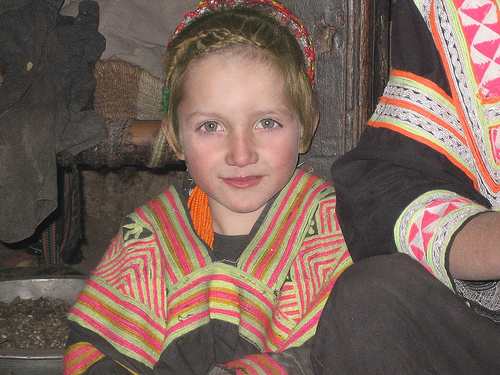
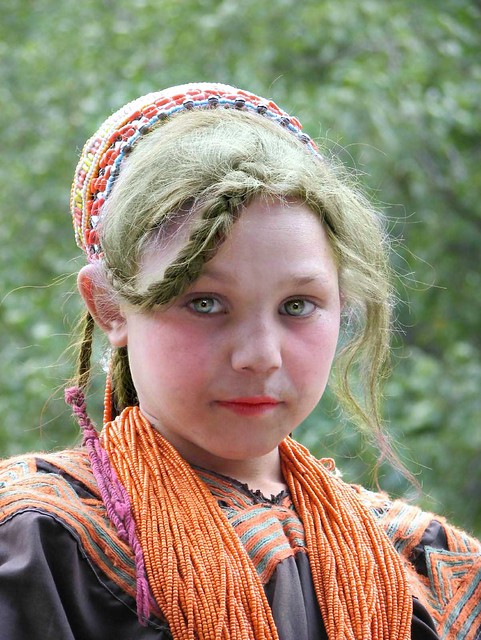
Alexander subsequently had to go up north into the wild mountains each with hidden valleys to subdue the tribes who refused to bow to his power. This area of Pakistan to this day has people who display extreme western features and the common myth ( true or not ) is they are the decendants of the Greeks although I have seen blue and blond hair here which is very rare in Greece. In Pakistan entire population groups within certain areas display extreme features. Most people of this province look Mediterranean although some as below are almost north western European.

Click the image to open in full size.

Click the image to open in full size.

Click the image to open in full size.

We will move on Taxila next. For now can I request people from across the border not to destroy this thread please. I am tired of my country hitting the headlines for the wrong reason. I want to show people this ancient land with a history going back 5,000 years plus. Is there anything wrong with this ? Thank you. Will be back for the next part of the journey through Pakistan.

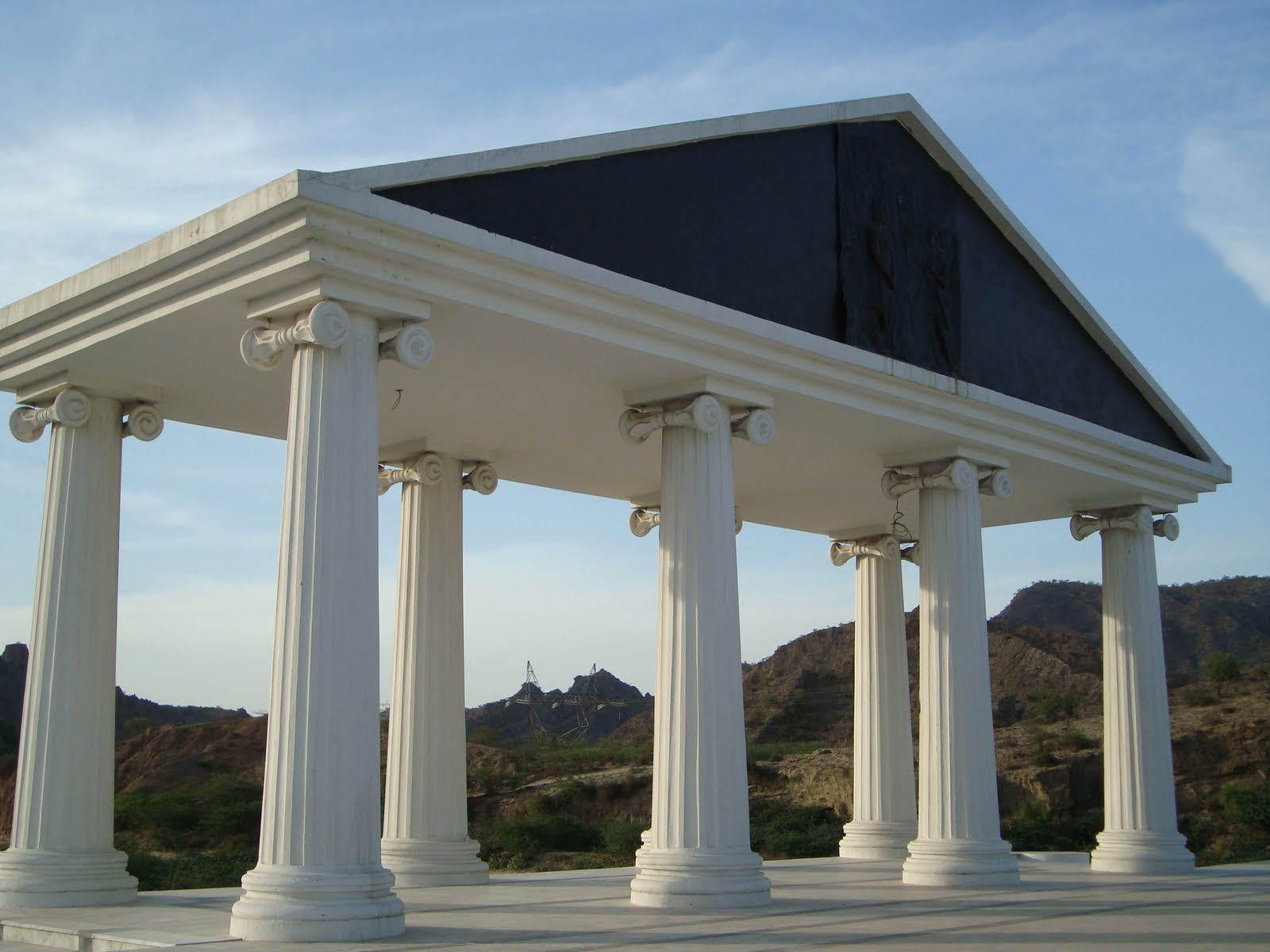
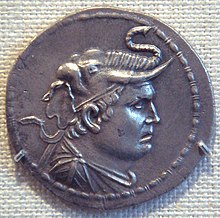
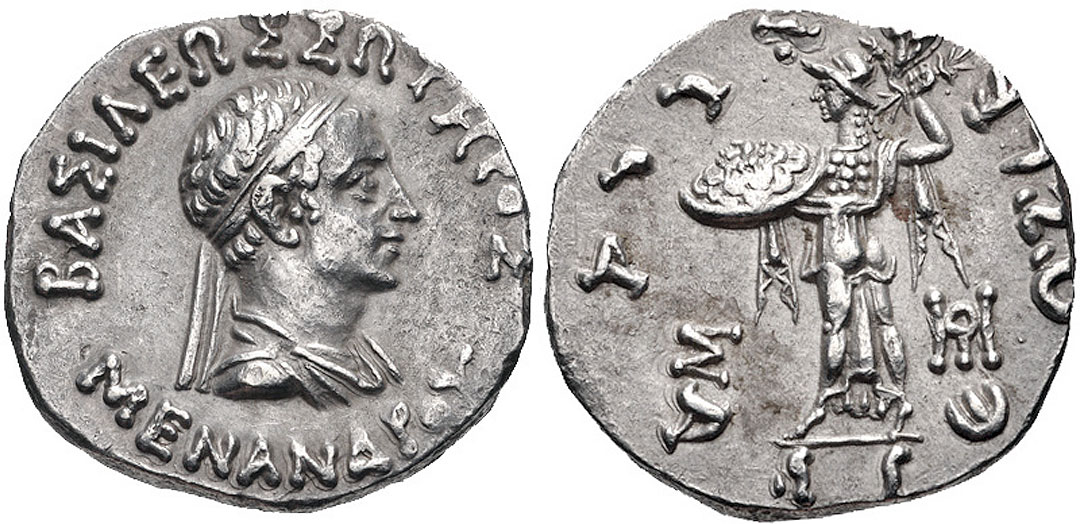
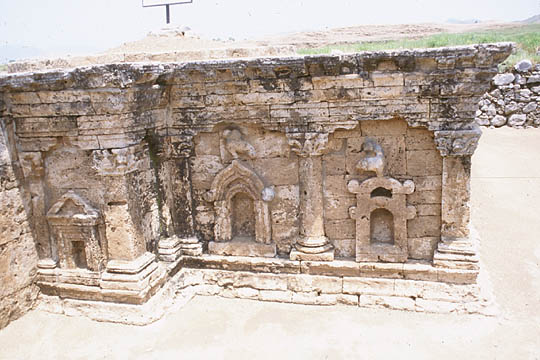
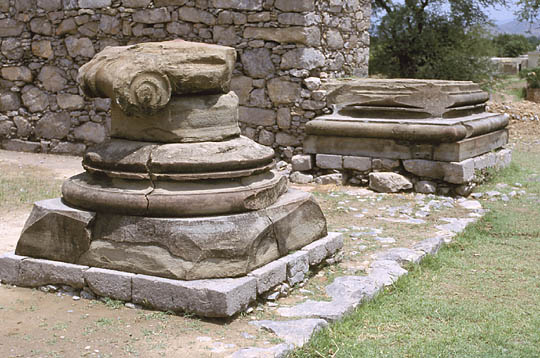
Taxila which I have marked as No 2 Green on the map is adjacent to the Pakistan capital of Islamabad. This is where Alexander was received. This area would subsequently come under the rule of Greek Kingdom. Taxila today is in ruins like Parthenon but it is rich in history. Regularly Greek coins are found which were minted in the Greek era. There is Taxila Musuem which houses large amount of Greek era artifects including coins. Unfortunatly lot of smuggling goes on and precious heritage is sold to rich outsiders to be kept in private collections.

Click the image to open in full size.

Click the image to open in full size.

Click the image to open in full size.

Click the image to open in full size.

Click the image to open in full size.

Double headed Eagle shrine, Taxila, Pakistan showing Greek influence around about 2nd BC. About 15 miles west of Pakistan capital Islamabad.

Click the image to open in full size.

Pakistan Paedia – Archaeological Treasure of Pakistan (Taxila)

Click the image to open in full size.

Double headed Eagle shrine, Taxila, Pakistan showing Greek influence around about 2nd BC. About 15 miles west of Pakistan capital Islamabad.

Click the image to open in full size.

Pakistan Paedia – Archaeological Treasure of Pakistan (Taxila)

After Taxila we leave Khyber Pakhtunwa province ( where the people speak a Persian related language called Pashto ) and pass the federal capital Islamabad on toward the plians of Punjab province. On the map we are moving east and the land starts dropping.

This area is called the Salt Range and the colours are amazing. At times the eroded hills look like mars. As the road cuts through the hills we start droppind down toward the Indus Plain.

Click the image to open in full size.

Click the image to open in full size.
As you drive through this extremly difficult terrain you realise how difficult it must have been for Alexander's army who marched through along this very route. Further down we drop into the plains we hit the a major river which is now known as Jhelum river but to the Greeks it was known as the Hydaspes. Near the river is the modern town of Jhelum in Punjab Province.

It was here on the banks of Hydaspes – marked No 3 blue on the map that a major battle was fought on the banks of Hydaspes or as it is called now River Jhelu

Anyway we are now on No 3 marked blue on map. On the banks of Jhelum river ( to Greeks the Hydaspes ) Alexander had one of the tough battles he had faced against the ruler of Punjab – Porus. Although the Greeks won but the Punjabi's under Porus fought valiantly but lost to Alexander's skill.

However Alexander's horse Bucephalus was killed. Alexander subsequently set up two towns in the vicinty called Alexandia Bucephalous in honour of his horse.

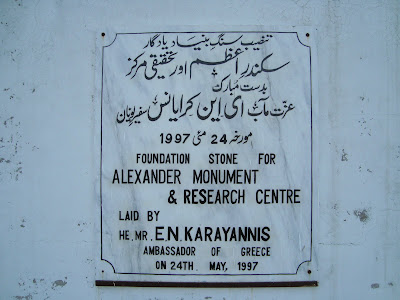
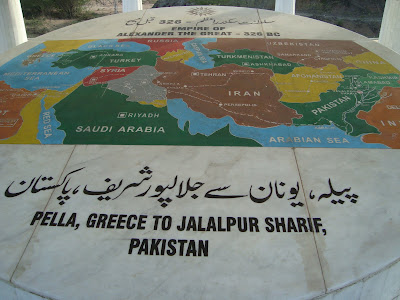
Near where the Battle of Hydaspes was fought today a monument has been built called the Alexandria Monument.

Click the image to open in full size.

Click the image to open in full size.

Foundation stone laid by the Greek Ambassador to Pakistan 1997.

Click the image to open in full size.

From Greece to Pakistan – Alexander.

In addition Alexander set up another town in the area called Nicea which possiblity might be the Pakistani town of Mong not too far from this place. After this Alexander moved east through the flat plains of the Indus valley in todays Punjab, Pakistan generally heading toward Lahore city.

http://historum.com
Powered by Tempera & WordPress.
>

By continuing to use the site, you agree to the use of cookies. more information

The cookie settings on this website are set to "allow cookies" to give you the best browsing experience possible. If you continue to use this website without changing your cookie settings or you click "Accept" below then you are consenting to this.

Close