


Η φωτογραφία μας δείχνει πώς θα είναι το εσωτερικό του ταφικού μνημείου. Προέρχεται απο το ελληνιστική οικία στο λόφο της Αμφίπολης. ΣΥΝΕΧΙΣΤΕ ΤΗΝ ΑΝΑΓΝΩΣΗ


Η φωτογραφία μας δείχνει πώς θα είναι το εσωτερικό του ταφικού μνημείου. Προέρχεται απο το ελληνιστική οικία στο λόφο της Αμφίπολης. ΣΥΝΕΧΙΣΤΕ ΤΗΝ ΑΝΑΓΝΩΣΗ
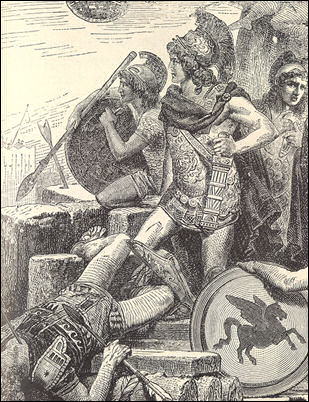
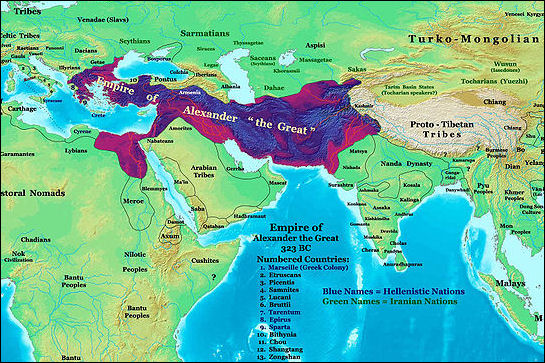
Alexander at the Siege of Tyre Alexander the Great (356 to 324 B.C.) left Macedonia in 334 B.C. at age of 21 with 43,000 foot soldiers and 6,000 horsemen. He would never return home again. After crossing the Hellesport (now known as the Dardanelles), he marched into Asia Minor and then looped around Lebanon, Syria, Israel, Egypt, and Libya before returning to Asia Minor (this took about four years). Then he and his army zigzagged through Iran and Iraq, where important battles were fought (three years), and continued on through the Hindu Kush mountains in Afghanistan and into Pakistan (three years).
Alexander went as far north as present-day Tashkent in Uzbekistan and as far east as Jammu and Armistar in India. He followed the Indus River in present-day Pakistan to the Arabian Sea (two years). The most difficult and costly part of the journey was the trip home via the forbidding Baluchistan desert in southern Pakistan and Iran (one year).
Before setting out on his mission of conquest Alexander arrived unannounced at the Oracle of Delphi. He demanded to see the seeress, and when she refused he dragged her into a temple and forced her to tell his prophecy. Plutarch writes: “As if conquered by his violence, she said, ‘My son, thou art invincible.'”↔
Why died Alexander undertake his mission of conquest and how did Alexander get his men to go along with him on arduous journey of conquest that had little point. Some say the conquest seems to have been a personal matter for Alexander without further meaning. According to historian Jack Keegan, Alexander was comfortably established as ruler of a half-Barbarian Greek city and seemed to have pillaged Persia “largely for the pleasure of it.” Other say Alexander was partly driven by his desire to emulate Achilles and Hercules.
Within two years after becoming king Alexander was ready to do battle with Persia, the most powerful kingdom the world had ever known up until that time. The Persian empire extended from present-day Turkey to Pakistan. Alexander’s aim was to avenge the Persian invasion of Greece by Xerxes a century and a half before.
After sailing the three-mile distance across the Hellespont Alexander cast his spear into the sand and claimed Asia as his “spear-won prize.” Alexander’s first destination was Troy. There he he paid homage to Achilles and Patrokolos at their tomb and offered sacrifices and anointed altars with oil and traded his armor for Achilles’ sacred shield at the Temple of Athena.
Alexander’s first encounter with the Persians was at Granicus, 100 kilometers northeast of Troy. At that time the Persians controlled the Greek cities along the eastern Aegean. There he faced an advance Persian force of 15,000 cavalry and 16,000 infantry, a third of them Greek mercenaries.
Alexander showed great leadership. The Persian army were spread out over a vast area so Alexander’s forces were able to break through the Persian infantry lines and surrounded the mercenaries of the Persian king.
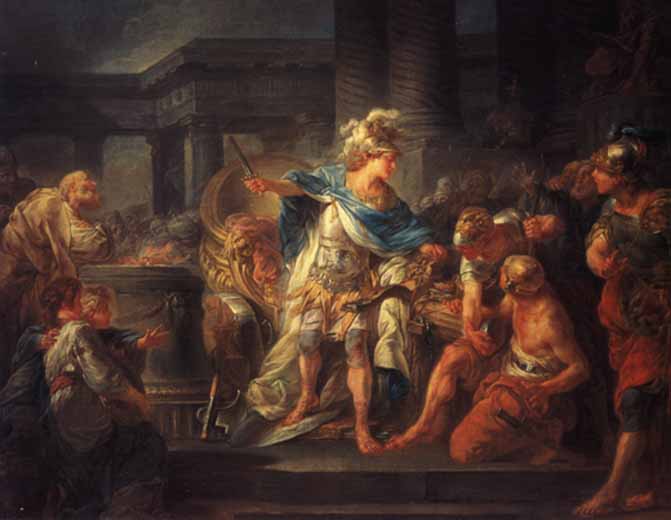
After the Battle of Granicus, the Persians fled inland. In about a year Alexander conquered most of western Asia Minor and the Aegean Greek cities of Ephesus, Halicarnassus, Magnesia, Perge and Side, where he was greeted as a liberator. At Gordium (near Ankara), the ancient court of King Midas, Alexander “solved” the famous puzzle of the Gordium’s knot by severing it with blow from his sword. According to legend whoever undid the intricately twisted knot would become the ruler of Asia. ↔
As Alexander’s army moved eastward they were just their buying time until they would face off again against the Persians in larger, more pivotal battles.
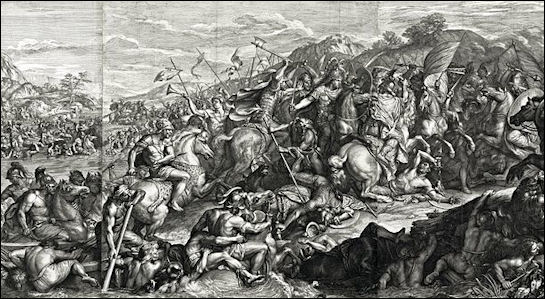
At Issus (near Adana, Turkey) Alexander’s army of about 50,000 men met a Persian force of perhaps 70,000 men. There is some disagreement over the size the Persian force but most historians agree at least it was larger than Alexander’s.
When Alexander’s army arrived in Issus Alexander ordered them to attack almost immediately even though the soldiers were exhausted from a two-day march. Alexander’s cavalry, backed by archers and infantry wielding 5-½ -meter-long pikes outmaneuvered the larger Persian force with well-orchestrated charges. Alexander and his Companions charged into a barrage of arrows and made straight of the chariot of the Persian leader Darius III. Darius freaked and panicked with the Companions bearing down on him and fled, causing the Persian front to collapse and the enemy to lose the battle. Darius fled so quickly he left behind his family, which were captured and held for ransom (although Alexander gave orders that his wife and daughters would not be harmed).
After the battle, Darius offered Alexander one of his daughters in marriage and 10,000 talents in treasures (about a billion dollars in today’s money) and all of the territory west of the Euphrates, but Alexander refused. After conquering Egypt, Palestine, Syria and Lebanon, Alexander ventured to Mesopotamia where his forces finished off the Persian army, opening the way for his conquest of Asia.↔
As Alexander head down the Mediterranean, nearly all the cities that were under Persian control surrendered and opened their gates to Alexander. The only city that put any resistance was Tyre, a former Phoenician island fortress off the coast of Lebanon.
In the early 6th century, King Nebuchadnezzar laid siege to Tyre for 13 years but was unable to conquer it. In 332 B.C., Alexander the Great captured Tyre by using ship-mounted battering rams and catapults to blast a hole in the fortress wall and gangplanks and two large siege towers to launch the assault.
Alexander’s army had spent seven months building a half mile causeway to the island, with debris from an abandoned mainland city, only to be bombarded with stones and arrows when they got near. The Tyrians also launched a boat with blazing cauldrons to set fire to the attackers. This tactic only delayed the inevitable.
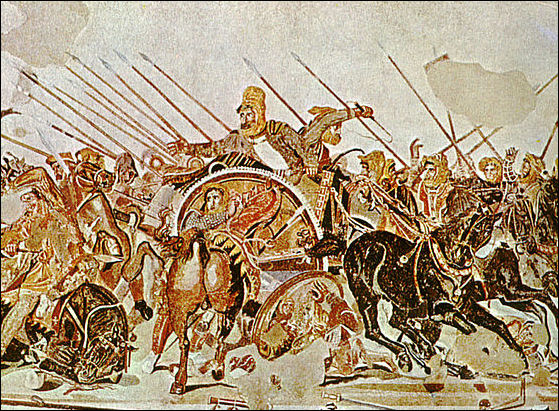
The victory over Tyre added Lebanon as well as Palestine, Syria and Egypt to Alexander’s empire.Alexander was reportedly so enraged by the loss of time and men used to capture Tyre that he destroyed half the city, and rounded up its residents, who were either massacred or sold into slavery. Seven thousand people were slaughtered after the capture, 2,000 young men were crucified and 30,000 people were sold into slavery.
Alexander received a hero’s welcome in Egypt, an unhappy vassal of Persia for nearly 200 years. In Memphis, the Egyptian capital, Alexander was recognized as a pharaoh. Hieroglyphics of Alexander’s adventures adorn temples in Luxor.
In 331 B.C., Alexander the Great trekked 300 miles across the Sahara desert for no military reason to Siwa Oasis (near Libyan border), where he met with the oracle at the Zeus-Amum temple and asked questions about his future and divinity. The oracle greeted Alexander as the son of Amun-Re and gave him the favorable omens he wanted for an invasion of Asia. The 24-year-old Alexander arrived at Siwa by camel. He asked the oracle whether was the son of Zeus. He never revealed the answer to that question.
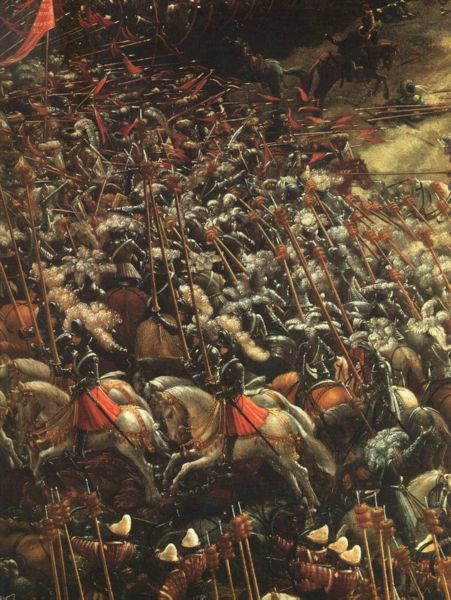
Perhaps the greatest achievement of Alexander’s military campaign was the founding of Alexandria. Arrian wrote that “he himself designed the general layout of the new town, indicating the position of the market square, the number of temples…and the precise limits of its outer defenses.” After Alexander died, Alexandria grew into the center of Hellenistic Greece and was the greatest city for 300 years in Europe and the Mediterranean.
The key battle in Alexander’s campaign took place at Gaugamela (or Arbela, near Mosel in Iraqi Kurdistan, about 420 kilometers north of present-day Baghdad) in 331 B.C. After Alexander rejected Darius’s offers of peace, Darius had little choice but to prepare for all out war, which he did from the Persian winter capital of Babylon.
Alexander’s force was outnumbered 5 to 1. The Persian army was comprised of 250,000 soldiers from 24 different subject or mercenary armies including ones made up of Indians, Bactrians, Dahae, Medes, Mardians, Babylonians, Parthians and Arachosians. Darius’s force was lead by 40,000 Persian cavalry men clad in chain mail with chariots with scythe blades on their wheels. The Persian leader even had some fighting elephants at his disposal (some say this was the first time Europeans were exposed to elephants). Alexander’s army had 40,000 infantry men and a 7,000-strong cavalry.
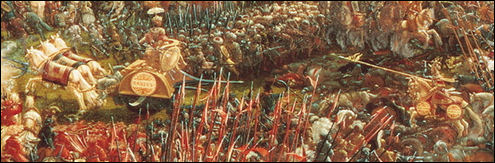
Uncharacteristically, Alexander exercised caution. He waited four days to attack and overslept on the morning of the battle, which was one of the largest and most decisive battles in antiquity. Plutarch wrote, “When his officer came to him in the early morning, they were astonished him not yet awake.”
Darius pinned his hopes on his specially-designed chariots which essentially had twirling swords attached to their wheels. To give these vehicles an advantage Darius even went as far as leveling the battlefield and clearing away trees and hills in an area of eight square miles so the chariots could maneuver on the plain where the battle was fought.
Alexander’s forces were arranged in a rectangular box while the Persians were drawn out in a long line. Alexander knew he was outflanked anyway so his plan was to protect his flanks and draw the Persian’s there so he could attack the middle, where Darius was surrounded by bodyguards.
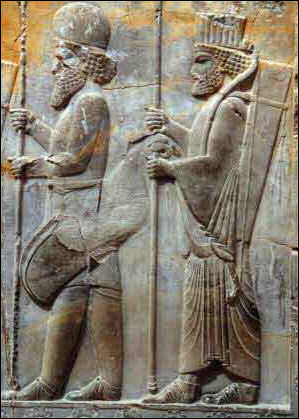
Achaemenid Soldiers
in Persepolis Alexander ordered one wing of his cavalry to charge Darius’s far left flank and another to aim for the far right, leaving his own infantry vulnerable in the center. When the battle began Alexander’s forces moved forward. At the last minute, just as the Persians were set up, Alexander tilted his box, and charged the Persian infantry with a wedge at the right side of the middle. The objective was to draw the Persians to the flanks.
The Persians took the bait. Their cavalry attacked the right flank of Alexander’s rectangular box. When the chariots charged Alexander simply ordered his ranks to part with some soldiers given the task of pulling the drivers to the ground when the chariots passed. The rest were picked off with arrows and javelins.
The Persians then attacked Alexander’s left flank. As Darius’s mounted forces were pulled into opposite direction Alexander and his elite forces took advantage of the weakness in the middle and made their move there. The Companions formed a wedge and opened up a hole and Alexander himself went right after Darius in the heart of the Persian army, splitting it in two.
The Persian king lost his nerve after his chariot driver was killed by javelin and again he fled, on horseback. Ironically the Persians had regrouped and were ready to mount a bold counter attack but when they heard their had leader had abandoned them once gain they abandoned their assault and the Macedonians were able to defeat an army five times their size with relative ease.↔
Alexander pursued Darius, who was able to get away, but returned to the battlefield to oversee the massacre of the Persian army. When the dust cleared, the Persians lost an estimated 40,000 to 90,000 men while Alexander’s army lost only 100 to 500.
A military historian at West Point, Col, Cole Kingseed, told National Geographic: “Alexander’s tactic were offensive. He anticipated what the enemy would do, forced the enemy to react to him. Alexander went with the arm of decision—that’s one thing we stress, that the commander’s place is where the decisive action is.”
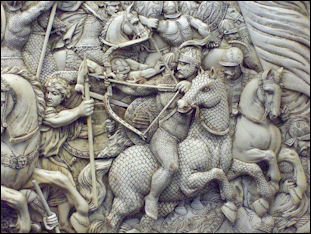
Battle at Gaugamela In less than five years Alexander had defeated the mighty Persians. From Gaugamela Alexander marched his troops victoriously into Babylon, with its gardens and walls, which according to legend were 300 foot high and wide enough to accommodate two chariots riding abreast. Along the way he picked up 15,000 Greek reinforcements.
After a month’s rest Alexander army moved on to Persepolis, the Persian capital, the home of a grand palace with a golden throne and 100-column hall. There Alexander collected almost 3,000 tons in coins, bullion, gold and silver vessels and jewels (worth perhaps billions in today’s dollars). It was one of the richest hordes ever taken. Afterwards Alexander unleashed his soldiers, who formed a drunken mob and burned the palaces of Xerxes to the sound of flutes and songs in revenge against the burning of Athens 150 years before. They also looted art and valuables and killed any male Persians that crossed their path. Great tapestries were placed on the beams of the great palace to set that on fire.
Alexander “accidently” burned down Persepolis in 330 B.C. To carry the treasure of gold, silver and jewels and other goodies back to Greece reportedly required 10,000 mules and 500 camels.
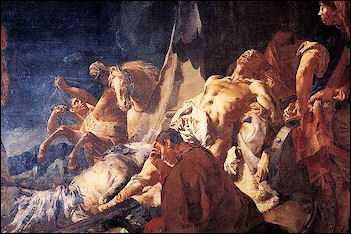
Death of Darius (1746)
by Piazzetta Giovanni The only loose end that needed to be tied was the capture of Darius. Alexander’s army then headed north, moving at an astounding pace of 36 miles a day. At the Caspian gates in the Elburz Mountains (near Tehran) Alexander caught up with Darius. By this time the Persian so feared Alexander that many soldier, according the historian Arrian, “threw themselves over the cliffs.”
Darius himself had been abandoned was found shackled and accompanied by a loyal dog in cart pulled by wounded oxen. He reportedly had been stabbed by his own generals and died after a sympathetic Greek soldier gave him some water. Plutarch wrote: “When Alexander came up, he showed his grief and distress at the king’s death, and unfastened his own cloak, he threw it over the body.”
With the conquest of Persia complete, Alexander now was King Persia as well as Macedonia, and controlled western Asia. Modern Iranians blame Alexander for the decline of the Persian empire. Even today they call him “Alexander the Accursed.”
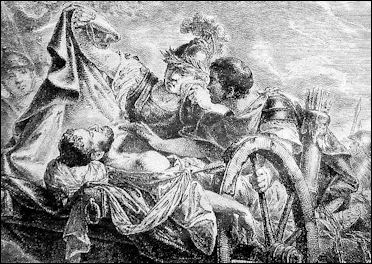
Alexander cloaks body of Darius After Darius’ death rumors spread that the campaign was finished and Alexander was ready to head home. To squash these rumors Alexander called a meeting of his generals and told them, according to a 1st century Roman historian Curtius, “with tears in his eyes, complained he was being brought to a halt in the middle of a brilliant career.”
Alexander then headed into present day Turkmenistan, Afghanistan and Uzbekistan, where he encountered little resistance. By 329 B.C. he had reached present-day Kabul
The nomadic Turkic tribes that live in Central Asia today say that Alexander had two rams horns on the sides of his head and that is why he wore his hair long. Coins minted after his death show Alexander with horns. Later Muslims would call him Iskander Dhulcarnein—Alexander the two horn. In the Turkoman version of the story still told today only Alexander’s barber knew his secret…and he just had to tell someone or something, so he whispered the secret into a well. Reeds began to grow in the well, but whenever someone cut one for a flute, it didn’t make any music it only said “Alexander has two horns.”↔
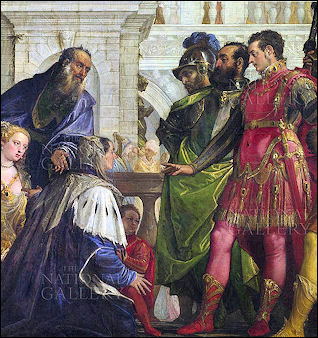
Family of Darius before Alexander Alexander’s goal in Central Asia was to capture Bessus, a Persian traitor and ruler of Bactria. After his men suffered from frostbite and severe hunger while crossing a 3,700-meter-high pass in the Hindu Kush in April, when mountains were still covered in snow, Alexander got his hands on Bessus, who was turned over by his allies. Besses was tied a post on the side of a road. After he was taunted and jeered, his ears and nose were cut off. After that he may have been dismembered but more likely he was crucified.
Central Asia was a major crossroad for Silk Road caravans. Hostels and caravansaries were set up every 17 miles, the distance a camel train covers every day. Alexander captured six cities including Samarkand (then called Maracanda) in three days. He set up a headquarters in Samarkand.
Alexander established a number of garrison towns in western Asia and used them to house troops, encourage trade and defend conquered lands. Herat in Afghanistan is the only of these towns that still remains today. It was known in Alexander’s time as Areion.
Not everything went smoothly. Alexander’s forces were harassed by nomadic horsemen called the Spitamneses. They made lighting strikes and then retreated before the Greeks could do anything about it. This and road weariness made Alexander’s men increasingly restless and anxious to return home.
By this time Alexander was drinking heavily and had adopted modified Persian dress and customs, something that did not endear him to his loyal Macedon troops. He became increasingly paranoid and displayed wild fits of temper at perceived disloyalty. During one drunken party, when Alexander was boasting about his victories, Cleitus, a friend that once saved his life, said that Alexander owed thanks to his father and the Macedonian veterans that had stood by side all for so many years. Alexander was incensed by this remark. He accused Cleitus of being coward to which Cleitus accused him of pandering to the Persians. Enraged all the more, Alexander grabbed a spear and thrust it through his friend’s chest, killing him instantly. Alexander was instantly filled with remorse and pulled the spear from Cleitus’s body and tried to impale himself. Some officers managed to wrestle the spear from him. Alexander shut himself in his tent for days, grieving.
In Hyrcania on the Caspian Sea, Alexander was given a beautiful eunuch named Bagais, who became Alexander’s lover. This move was not popular either, nor was Alexander’s desire to be treated like a god and requiring his troops to prostrate themselves in front of him and kiss him. Ephippus, a contemporary of Alexander, wrote: “In his honor myrrh and other kinds of incense were consumed in smoke; a religious stillness and silence born of fear held fast all whom were in his presence. For he was intolerable, and murderous, reputed to be melancholy mad.”
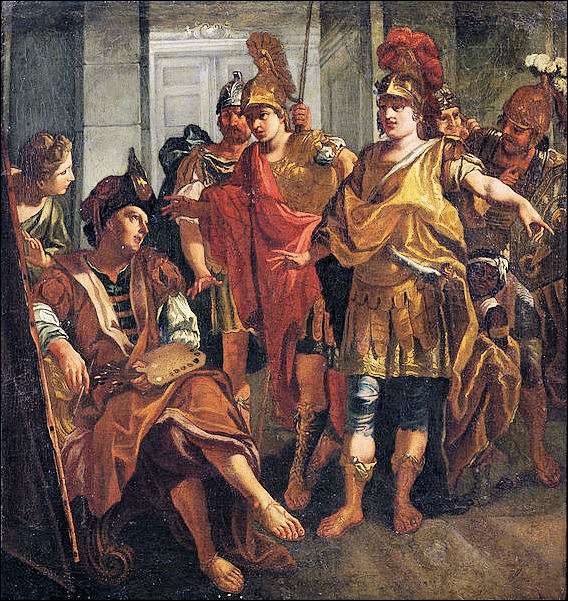
After Central Asia, Alexander then headed into present-day Pakistan because he wanted to add India to his empire. His army of 75,000 men (plus a retinue of perhaps 40,000 more people), now included Persian horseman and many subjects of other conquered kingdoms but only 15,000 Macedonians.
With the Persians gone, Pakistan fell under the under the control of local rulers, none of whom dared to challenge Alexander. His army was able to advance easily and he was given a warm welcome in Taxila. The local ruler there gave him a generous tribute and provided him with fresh soldiers.
In the mountains areas of Central Asia and present-day Pakistan, Alexanders’ armies met fierce resistance from the Dogdians (also known as the Sogdians) and their allies the Masagates (a Saka clan), who retreated to the mountainous areas of the kingdoms and waged guerilla war that halted Alexander’s progress for 18 months.
In the Karakorum range, Alexander’s men used pitons and ropes to assault a supposedly impregnable fortress built into the side of a cliff by the Dogdians at the Rock of Aornos near modern Pir Sar. The soldiers in the fortress had the previous day laughed: “No one can touch us.” When Alexander’s force had taken their positions he said: “Come see my flying soldiers.” The Dogdians in the fortress eventually surrendered and Alexander claimed Roxanne, the daughter of a nobleman, for his wife. Roxanne was reportedly around 12 and Alexander was reportedly quite taken by her beauty. The Rock of Aornos is believed to somewhere in the Hissar mountains but its exact location is unknown.
The Kafir-Kalash, a tribe that lives today in valleys off the Chistral Valley in the North-West Frontier Province of Pakistan, claim to be descendants of five of Alexander the Great’s warriors. The tribe is famous for its their pagan beliefs, lewd songs, provocative dances, partying ways and strange costumes. The women wear black robes, red bead necklaces and cowrie-shell head-dresses.
The Kalash have Caucasian features—sometimes with blonde hair and blue eyes—which gives some credence to their claim they descended from five warriors in Alexander the Great’s army. There are only about 4,000 of them and they have remained pagans despite the fact that everyone around them is Muslim. The Kalash relate a story of Alexander’s bacchanal with mountain dwellers claiming descent from Dionysus. They worship a pantheon of gods, make wine, and practice animal sacrifice. Although Alexander’s armies passed through the Chitral region there is little evidence that they reached the remote valleys where the Kalash live today. Other tribes in Pakistan and Central Asia also claim to be descendants of Alexander’s army.
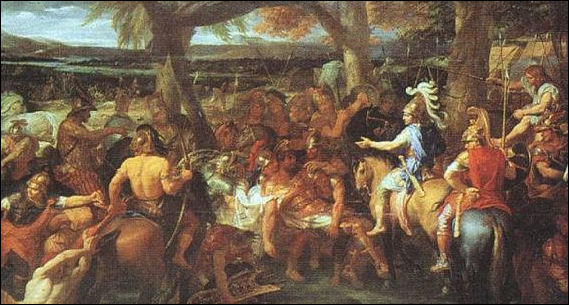
The last great battle of Alexander’s campaign took place at Jhelum on the Indus River (110 kilometers southeast of present-day Islamabad, Pakistan) against King Porus, a massive leader who it is said to have stood nearly seven feet tall and presided over a kingdom that covered much of the Punjab in present-day India and Pakistan.
In the spring of 326 B.C., Alexander’s army engaged King Porus’ force of 35,000 infantrymen, 10,000 cavalry and 200 battle-trained elephants. Curtius wrote, “Porus himself rode an elephant which towered above the other beasts. His armor, with its gold and silver inlay, lent distinction to his unusually large physique.”
The two forces were opposite each other on different sides of the river and Alexander lead his attack in the night during a thunderstorm so the Indian army wouldn’t hear or see him coming. Alexander then concealed part of his cavalry and released the remainder of his army in an attack. Porus committed most army to the Alexander’s charging force and left himself vulnerable to an attack from the concealed cavalry.
In the battle the elephants “kept colliding with friends and foes alike,” according to Arrian. And after several hours the Indians retreated in wild confusion and Porus was captured. Alexander admired Porus’s courage and let him keep his kingdom on the condition he remained loyal to Alexander. Alexander the Great was said to have been rescued from certain death from a charging elephant by a greyhound.
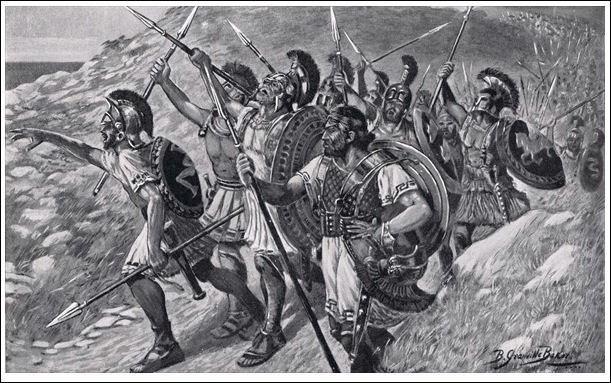
Alexander paused briefly to found a city named Bucephal in honor his horse that died shortly after the battle. The animals died perhaps from old age, perhaps from war wounds. Otherwise Alexander was ready to press on and make further conquests.
But by this time however, the monsoons had set in and Alexander’s men were wet to the bone, tired, homesick and mutinous and perhaps scared of facing off against the Nandas, their next foes, who were referred to in Greeks texts and possessing a formidable army and controlling the Mauryan Empire. Alexander biographer Lane Fox told Smithsonian magazine, “It was pelting with rain, the men were terrified, there snakes everywhere. They were lost and did not feel they could go on anymore.” Historian Peter Green told National Geographic, Alexander was basically screwed by ignorance of geography. He had been telling his men, We’ll just go over the hill, boys—and then suddenly he had the whole of the Ganges plain before him.”
On the banks of the Hyphias (now Beas) River, Alexander ordered his men to head east, the men refused. Alexander was enraged and was little consoled by the words of one of his noble advisors, who told him, “A noble thing, O king, is to know when to stop.” Alexander reacted by saying anyone who disobeyed him would be accused of desertion and went to his tent to sulk. After confining himself to his tent from three days, he consulted his omens and was conveniently told he trouble awaited him in India. On hearing the news his men shouted: “Alexander allowed us, but no others, to defeat him.”Alexander then decided to head back home. In retrospect this may have been a hasty decision as a major Indian army had already been defeated and all of India was within their grasp. ↔
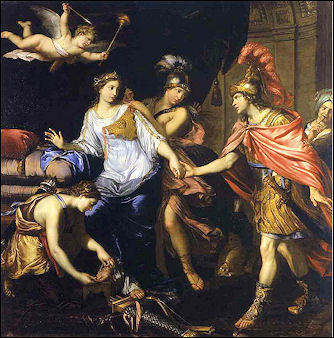
with the Amazons The journey back towards Greece proved to be the most arduous part of the journey—more costly than any battle. Instead of returning home the way they came—over the Hindu Kush. Alexander decided to travel south by river with 1,800 ships through what is now Pakistan to the Arabian Sea, a journey that ended up taking months. First they had to fight their way down the Indus River and resistance was met with slaughter on a genocidal scale. In one attack spearheaded by Alexander himself, the great conqueror took an arrow is his lung and to be carried away in a stretcher, but soon after mounted his horse to show his men he wasn’t finished yet.↔
Alexander’s army of 87,000 infantry, 18,000 cavalry, 52,000 followers arrived at the Arabian Sea, in a part of the world they were unfamiliar with. Because there were to many men to be carried in boats on the Arabian Sea, Alexander’s divided his army, with a small contingent being carried boats and larger contingent journeying overland. A plan was concocted for the army to march overland across the brutal deserts of what is now southern Pakistan and Iran and be supplied by a fleet sailing on Arabian Sea that would meet up with army at various points along the way. That year the monsoon blew the opposite direction and the ships got stuck in Pakistan and were unable to bring supplies to the tens of thousands traveling overland.
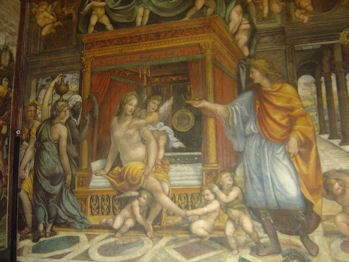
Marriage of Alexander and Roxana Alexander led the largest contingent on a march 1,750 kilometers across the Baluchistan desert, a wasteland more forbidding than the Sahara, and southern Iran. They traveled almost exclusively at night because it was simply too hot during the day. Even at night it travel was difficult as temperatures rarely dropped below 35 degrees C (95 degrees F). Because the supply ships never showed the marchers were forced to subsist on the limited food they brought with them.
The temperatures were blistering and what little water there was largely undrinkable. The trip was so arduous pack animals were butchered and eaten, booty was left behind and more than once the royal stores were broken into. Even then many men died of starvation, thirst and heat.
Alexander suffered along with everyone else. Once he was offered a helmet full of water but he poured it into the sand as a sign that he was willing to share the misery of his troops. Even when there water that could spell trouble too. A large number of his retinue drowned when a flash flood caught them in a canyon.
Alexander’s journey across the deserts of Baluchistan has been compared to Napoleon’s retreat from Moscow. The journey took 60 days. About 15,000 of Alexander’s men, or nearly half the fighting force that accompanied him, perished—more than all the men killed in battle. By contrast, the fleets reached the Iranian coast, delayed but almost intact.
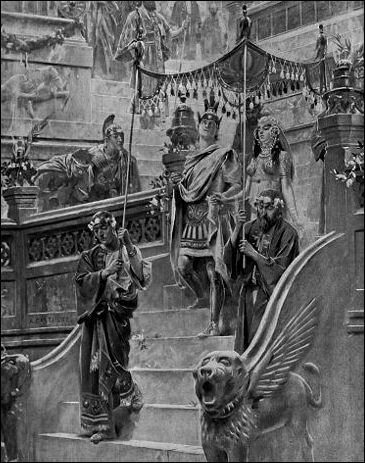
Wedding of Alexander and Roxane In Kirman, Persia Alexander made relations with his men worse when had six of the 20 provincial governors he appointed executed and two more deposed, and then executed 600 men from his own garrisons for raping and pillaging in his absence.
In Susa (Shush, Iran) Alexander took a second wife, Barsine, a daughter of Darius. In a mass wedding—along the lines of those sometimes held by Moonies—10,000 of Alexander’s troops married Persian women and 80 of his officers married daughter of Persian nobles.
Alexander it seemed had become so endeared with Persian culture he had no plans of returning home and instead planned to set up his base of operations in Persia. Some 30,000 noble Persian youths had been taught Greek and methods of Macedonian warfare. As a sort of take off on the Companions they were named the Successors.
By some accounts Alexander’s next destination was Arabia, where he hoped to gain control of area that produced valuable spices. At this time he still “hunted, diced, played ball, joked and banqueted” with his men. In the autumn of 324 B.C., Alexander’s boyhood friend and possible lover Hephaestion became ill with unknown disease and died. Alexander was devastated and had Hephaestion’s doctor crucified.
Image Sources: Wikimedia Commons, The Louvre, The British Museum
Text Sources: New York Times, Washington Post, Los Angeles Times, Times of London, Yomiuri Shimbun, The Guardian, National Geographic, The New Yorker, Time, Newsweek, Reuters, AP, Lonely Planet Guides, Compton’s Encyclopedia and various books and other publications. Most of the information about Greco-Roman science, geography, medicine, time, sculpture and drama was taken from “The Discoverers” [∞] and “The Creators” [μ]” by Daniel Boorstin. Most of the information about Greek everyday life was taken from a book entitled “Greek and Roman Life” by Ian Jenkins from the British Museum [||].
© 2008 Jeffrey Hays
Απουσία μεταλλάξεων Β-Θαλασσαιμίας στους Μινωίτες
Βορειοασιατική πρόσμιξη στην Βόρεια Ευρώπη

Μια σημαντική καινούρια μελέτη ανακάλυψε ένα αναπάντεχο γεγονός για την σύσταση των Ευρωπαϊκών πληθυσμών: οι Ευρωπαίοι και ειδικότερα οι Βόρειοι φαίνεται πως έχουν υποστεί ανάμιξη με ένα πληθυσμιακό στοιχείο το οποίο ομοιάζει με τους πληθυσμούς της βόρειας Ευρασίας (Σιβηρίας) αλλά και τους Ινδιάνους της Αμερικής (οι οποίοι προήλθαν από την Σιβηρία πριν από 15 χιλιάδες περίπου χρόνια).
Αυτή η πρόσμιξη φαίνεται να έχει επηρεάσει σε διάφορους βαθμούς όλους τους Ευρωπαίους, αλλά σε μεγαλύτερο βαθμό τους κατοίκους της βόρειας Ευρώπης. Ο πληθυσμός της Σαρδηνίας φαίνεται να έχει επηρεαστεί στον ελάχιστο βαθμό. Άλλες μελέτες αρχαίου Ευρωπαϊκού DNA έχουν δείξει πως ο Ότζι (μια Νεολιθική μούμια περίπου 5,3 χιλιάδων ετών που βρέθηκε σε έναν παγετώνα στα σύνορα Ιταλίας-Αυστρίας), η Gok4 (μια Μεγαλιθική κάτοικος της Σουηδίας από την ίδια περίπου εποχή), αλλά και ένας κάτοικός της Βουλγαρίας από την εποχή του Σιδήρου όλοι ομοιάζουν σε μεγάλο βαθμό μεταξύ τους και με τους σύγχρονους Σαρδήνιους.
Φαίνεται πως το παρελθόν της Ευρωπαϊκής ηπείρου ήταν πολύ πιο ενδιαφέρον απ’ ό,τι πολλοί νομίζανε. Η χρονολόγηση της πρόσμιξης ανάμεσα στο “Βορειο-ασιατικό” στοιχείο με τους αρχαίους Ευρωπαίους ανάγεται περίπου στο 2,000 π.Χ. με αρκετό εύρος για την εκτίμηση.
Δύο υποθέσεις έγιναν για το πως μπορεί να δημιουργήθηκε αυτό το φαινόμενο. Σύμφωνα με την πρώτη, η πρόσμιξη οφείλεται στην άφιξη Νεολιθικών πληθυσμών στην Ευρώπη από τη Μέση Ανατολή και πρόσμιξή τους με τους Μεσολιθικούς κατοίκους της Ευρώπης οι οποίοι ήταν μετατοπισμένοι γενετικά προς την Ασία, πιθανώς εξαιτίας της ελεύθερης κίνησης κυνηγών-τροφοσυλλεκτών από την ανατολή στη δύση κατά την προϊστορία στην περιοχή της βόρειας Ευρασίας. Η δεύτερη υπόθεση εξηγεί το φαινόμενο με την υπόθεση της εισβολής αναμεμιγμένων Ινδο-Ευρωπαϊκών ομάδων στην Ευρώπη από την πλευρά της Ευρασιατικής στέππας.


Πιο σημαντικά, το γεωργικό δείγμα ομοιάζει με τους Μεσογειακούς λαούς της Ευρώπης, και ιδιαίτερα τους Κυπρίους και Έλληνες. Τα δείγματα των κυνηγών-τροφοσυλλεκτών βρίσκονται εκτός της σημερινής γενετικής ποικιλομορφίας της Ευρώπης, αλλά ομοιάζουν περισσότερο προς τους Φινλανδούς και άλλους Βορειοευρωπαίους.
Φαίνεται πως τουλάχιστον στην αρχική φάση της διάδοσης της γεωργίας στην Ευρώπη δεν υπήρξε μεγάλη ανάμιξη ανάμεσα στις δύο ομάδες. Στην ίδια τη Σκανδιναβία, στα άκρα της Ευρώπης, γεωργοί και κυνηγοί-τροφοσυλλέκτες ζούσαν ξεχωριστά για 1000 χρόνια κι όμως δεν είχαν έρθει σε μεγάλη επαφή μεταξύ τους, με αποτέλεσμα το γεωργικό δείγμα να ομοιάζει ακόμα με τους πληθυσμούς της Μεσογειακής Ευρώπης, από την οποία πιθανότητα προήλθε μερικές χιλιετίες νωρίτερα.

Δεν θα αναλύσω λεπτομερώς όλες τις πτυχές αυτής της ανάλυσης. Όλα τα στοιχεία βρίσκονται εδώ (στα Αγγλικά).
Θα επιμείνω όμως σε ορισμένα σημεία. Χάρη στη συμμετοχή στο Dodecad Project, έχω τώρα ένα δείγμα 20 Ελλήνων (Greek_D) από διάφορες περιοχές εντός και εκτός της σημερινής Ελλάδας, καθώς και ενός Έλληνα της Κύπρου (Greek_Cypriot_D). Το υπάρχον δείγμα κατανέμεται σε τρεις υποομάδες:
Ενδιαφέρον έχει επίσης και ο pop22 όπου βρίσκονται σειρά ατόμων από τον Πόντο διαφόρων εθνικοτήτων/γλωσσών.
Είναι σημαντικό να παρατηρήσουμε πως η τεχνική αυτή κατόρθωσε να ομαδοποιήσει σωστά άτομα που προέρχονται από διαφορετικούς πληθυσμούς. Στους μεν πληθυσμούς που αντιπροσωπεύονται από μεγάλο δείγμα (όπως οι Έλληνες, Τούρκοι, και Αρμένιοι) μπόρεσε να αντοπίσει υποομάδες πληθυσμών. Στους δε πληθυσμούς όπου τα δείγματα είναι μικρά (όπως π.χ. σε διάφορες ομάδες της Βαλκανικής ή στους διάφορους πληθυσμούς του Πόντου) ομαδοποίησε ορθά συγγενείς ή γεωγραφικά κοντινούς πληθυσμούς.
Όσο αυξάνονται ο αριθμός των δειγμάτων, τόσο θα αυξάνεται και η δυνατότητά μας να ανακαλύπτουμε την δομή των διαφόρων πληθυσμών.
Για παράδειγμα, τα μικρά δείγματα Σλοβένων, Σέρβων, Βοσνίων, κτλ. ομαδοποιούνται τώρα στην pop18. Το ίδιο και τα μικρά δείγματα Τούρκων/Αρμενίων/Λαζών/Μουσουλμάνων Ποντίων από τον Πόντο στην ομάδα pop22. Αυτή η ομαδοποίηση θα μπορέσει πιθανότατα στο μέλλον να οδηγήσει σε πιο λεπτομερείς ομάδες, αρκεί να βρεθούν περισσότεροι συμμετέχοντες από τις συγκεκριμένες περιοχές.
Για παράδειγμα, αυτή τη στιγμή υπάρχει μόνο ένας αμιγής Κρητικός στο πρόγραμμα, ο οποίος βρίσκεται με διάφορους άλλους Έλληνες στην ομάδα pop14. Αν συμμετάσχουν αρκετοί Κρητικοί ακόμα, είναι πιθανό να δημιουργηθεί μια “Κρητική ομάδα” αντίστοιχη με αυτοί που έχουν οι πολλοί περισσότεροι Κύπριοι (pop11). Αντίστοιχα, αν συμμετάσχουν πολλοί Σέρβοι και Σλοβένοι, είναι πιθανόν να σπάσει η ομάδα pop18 και να δημιουργηθούν ομάδες Σέρβων και Σλοβένων.
Υπάρχουν επίσης και πληθυσμοί με καμία εκπροσώπηση, όπως Αλβανοί, 100% Ελληνοπόντιοι, 100% Έλληνες από το Ιόνιο, Μαυροβούνιοι, κοκ Είναι προφανές πως αν αυτές οι ομάδες έχουν κοινά γενετικά χαρακτηριστικά, αυτά δεν μπορούν να ανακαλυφθούν εάν δεν υπάρχει κανένας από αυτούς στο πρόγραμμα!

 Στην προηγούμενη ανάρτηση παρουσίασα τα πρώτα αποτελέσματα για το δείγμα των 12 Ελλήνων του Dodecad Project, που καταδεικνύουν την θέση των Ελλήνων ανάμεσα στη Νότιο Ευρώπη και Δυτική Ασία, με μικρότερες επιρροές από τη Βόρεια Ευρώπη, Μέση Ανατολή, και αμελητέες από την Αφρική, τις Ινδίες και την Άπω Ανατολή.
Δυτική Ασία 31.3Σαρδηνία 31.0Βορειοανατολική Ευρώπη 11.7Βορειοδυτική Ευρώπη 11.7Νοτιοδυτική Ασία 8.9Βασκική 5.1Βόρειος Αφρική 0.1Ανατολική Ασία 0.1Ανατολική Αφρική 0.1Νότιος Ασία 0.0Υποσαχάριος Αφρική 0.0
Dodecad Project: η πρώτη δωδεκάδα των Ελλήνων
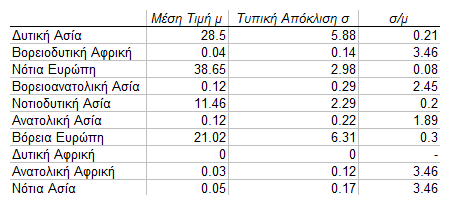
Γενικά οι Έλληνες φαίνεται να έχουν αναμενόμενη σύσταση δεδομένης της γεωγραφικής τους θέσης.

Τέστ ανθρωπομετρικών χαρακτηριστικών. Διευκρινίζεται επίσης και το ξεχωριστό φυλετικό χαρακτηριστικό.


για να κάνετε τον έλεγχο πατήστε εδώ για άνδρες και εδώ για γυναίκες
Μόνο για εκπαιδευτικούς σκοπούς. Φυσικά και ρεαλιστικά δεν αποδεικνύεται τίποτε. Μετρήστε τις αποστάσεις σε χιλιοστά.
τεκμηρίωση: Γενετική

A striking demonstration of the persistence of the Greek genetic signature through time can be found in [1]. The figure on the right is the 4th principal component of variation in Europe and shows a strong cline centered in Greece. Not only is the Greek genetic legacy clearly detectible today, but it is detectible among not only the Greeks, but all their neighboring populations of partial Greek ancestry:


The genetic affinities of human populations can be determined by examining large numbers of polymorphisms. For example, Ayub et al. [2] used 182 tri- and tetra-autosomal microsatellites, which allowed them to create the following tree based on DAS genetic distance between the sampled populations. It is clear that Greeks belong in the Caucasoid cluster of populations (encompassing groups from “North European” to “Burusho” in the figure), and are clearly distinguished from the Asian/Oceanian/American cluster (“Cambodian” to “Mayan Indian”), and even more from the African groups (“San” to “Zaire Pygmy’).

The results of the STRUCTURE runs are pictured below. 
For each number of clusters (K), each cluster is assigned a color. Each individual from the studied populations corresponds to a vertical line, and consists in various proportions of the different clusters. We observe that the Greek individuals belong to the main European-West Asian-North African (Cluster) cluster for K up to 5. At K=6 a “Mediterranean” small cluster (green) emerges which encompasses particularly populations bordering the Mediterranean as well as Armenians. In particular, we observe that there is no visible contribution of the East Eurasian (Mongoloid) pink cluster or of Sub-Saharan African (Negroid) red cluster.
The results of the PCA for the first two principal components are shown below.

While the above studies have examined global population structure, more recent studies have focused on uncovering finer structure within populations of European ancestry themselves. For example [4] studied the ancestry of European Americans using 583 SNP markers. The authors determined that the major feature of European American variation is clinal along a Southeast-Northwest axis, a finding which confirms the above-mentioned work of Cavalli-Sforza [1] based on classical markers. The second most noteworthy feature separates Southeast Europeans from Ashkenazi Jews. The Greek individuals of this study, like their Italian counterparts had typical southeastern characteristics, and were clearly separated from the Ashkenazi Jews.

Another study [6] studied more than 2,500 Europeans using a 500,000-marker Affymetrix chip; this is the most extensive and detailed sampling of European autosomal variation yet. The authors conclude that the levels of heterozygosity and linkage disequilibrium observed in southern Europe are consistent with a settlement of the continent proceeding from the south to the north. Europeans form, with the exception of the Finns, a genetic continuum. Members of each ethnic group cluster together, and overlap partially with neighboring groups, but can be fully distinguished genetically from more distant ones.These results indicate both the relative homogeneity of the European gene pool, but also the fact that they can be distinguished strongly genetically along geographically and even ethnic lines.

The study included a sample of 51 northern Greeks. It is evident that these Greeks (marked by EL), form a homogeneous cluster, none of them falling in the middle of clusters formed by other ethnic groups. Some of the former Yugoslavs (marked by YU) do fall in the middle of the Greek cluster, however. These former Yugoslavs, as well as the two Italian groups (IT1 and IT2) form the Greeks’ closest genetic neighbors. The Yugoslavs are between Greeks and Czechs and Poles, consistent with their having both indigenous Balkan and non-Balkan Slavic origins; the Italians are between Greeks and Spaniards, consistent with their having an Eastern Mediterranean contribution, due perhaps to Neolithic farmers, or ancient (e.g. Greek or Etruscan) colonists.
Shortly after the previous study appeared, another article [7] used the same 500K Affymetrix chip over a sample of 3,192 individuals, including 8 Greeks. While many of the sampled populations are represented by a small number of individuals, thus making generalization more difficult, it is evident that the first two principal components bear an even stronger relationship to the geographical map of Europe. This was probably made possible by the inclusion of a wider range of populations, including many from eastern Europe.

With the caveat of the small population sample numbers, these results are fairly consistent with those of the previous study. Greeks (GR) are once again between their northern neighbors (especially Albanians (AL), Slavomacedonians (MK), Bulgarians (BG), Romanians (RO), and Kosovars (KS)) and Italians (IT). Greek Cypriots (CY) and Turks (TR) also frame the Greek sample on a more southern and eastern direction respectively. The Greeks’ closest neighbors appear to be their immediate northern neighbors, as well as some of the Italians who otherwise appear to be quite variable, some of them being more similar to their Central European neighbors; Northern Balkan Slavic populations (Slovenians (SI), Croats (HR), Bosnians (BA) appear more distant in the direction of Central and Eastern European Slavs.
Studies such as the above [4-7] have shown that in the first two principal components individuals from different European groups tend to cluster with each other. However, these components capture only part of the overall genetic variation: the most salient part that is associated with geography and ethnicity. A new study [8] investigated the overall genetic similarity of individual Europeans, using the dataset also used by [6]. For each individual, a “best overall match” (BOM), i.e., the individual most similar to him was calculated over all the markers. The results are shown in the table below:

Turning to Greeks (EL, recruited in northern Greece), we see that they have BOMs from Norway, Sweden, the UK, Denmark, the Netherlands, Germany, Austria, Switzerland, Italy, and Greece. Conversely, the BOMs of some Dutch, Spanish, Italian, and Greek individuals is a Greek. Overall, the Greek sample consists of 51 individuals, and hence one expects (by chance) that only 1.1 of them would have a Greek BOM. Thus, Greeks have a 7-fold higher than random chance of having a fellow Greek as their BOM. Different European groups vary substantially in this: the aforementioned Finns seem to be most distinct, with most of them being more similar to a co-ethnic than to any other Europeans. Other groups seem to be less so; for example no Austrians (AT) have a fellow Austrian BOM.
The overall BOMs of the Greek individuals is also noteworthy because no matches are observed between Greeks and Eastern Europeans or vice versa. This probably indicates the absence among Greeks of many substantially “Slav-like” individuals; individual Greeks may have “genetic look-alikes” in distant Britain or Scandinavia, but none at all in Eastern Europe. Indeed, they have a greater-than-random number of matches only with the large German sample (DE1) from Kiel, which probably indicates the substantial heterogeneity of this sample, whose members serve as close matches to many European ethnic groups. The study also includes in its supplementary material, a table of the mock false positive rate among different population pairs; this is a measure of genetic distance between them:

Auton et al. [9] studied a sample of Greeks from Greece and Cyprus in a global context of 3,845 individuals based on about 450K SNPs. The results of the STRUCTURE analysis are shown below, with increasing number of clusters starting from K=2 (top row). The studied individuals from Greece (#15) and Cyprus (#9) appear unremarkable in this analysis. It is evident that, in comparison to worldwide populations, the studied Europeans are fairly homogeneous, composed primarily of the “red” component, with no apparent significant contributions from ancestral elements typical of other continental groups.


Οι στοές ήταν κοινές κατά την ελληνιστική περίοδο, από τον 3ο έως τον 1ο αιώνα π.Χ., αλλά νωρίτερα παραδείγματα είναι εξαιρετικά σπάνια.

Η αρχαία Άργιλος βρίσκεται 4 χλμ. δυτικά των εκβολών του ποταμού Στρυμόνα, σε απόσταση 6 περίπου χλμ. από την αρχαία Αμφίπολη, εκτείνεται σε έκταση 150 στρεμμάτων και καταλαμβάνει τον λόφο Παλαιόκαστρο.

Σύμφωνα με την φιλολογική παράδοση ιδρύθηκε το 655 π.Χ. από Ανδρίους και ήταν η παλαιότερη αποικία στην αιγαιακή ακτή και η ανατολικότερη της Άνδρου.
Σκοπός της ίδρυσής της ο έλεγχος της κοιλάδας του Στρυμόνα και της πλούσιας σε αγροτικά προϊόντα, σε ξυλεία και σε μεταλλεύματα ενδοχώρας.
Στο απόγειό της, τον 5ο αιώνα π.Χ., η Άργιλος ήταν μια από τις πλουσιότερες πόλεις της περιοχής.

Η ανασκαφή της Αργίλου είναι μια συστηματική ανασκαφική έρευνα στο πλαίσιο κοινού ελληνοκαναδικού προγράμματος που ξεκίνησε το 1992 και συνεχίζεται.
Υπεύθυνοι των ανασκαφών είναι ο Καναδός καθηγητής Κλασικών Σπουδών του Πανεπιστημίου του Μόντρεαλ Ζαν Περό και ο αρχαιολόγος κ. Ζήσης Μπόνιας προϊστάμενος της ΙΗ΄Εφορείας Αρχαιοτήτων Καβάλας.


On Monday, six days before the general election, the Greek Ministry of Culture published a preliminary report by the osteo-archaeological team studying the skeletal remains found in the mound of Amphipolis in northern Greece. The bones were found in November, since when there had been a lot of speculation about who they might have belonged to. Alexander the Great’s name came up a lot, as did his mother’s, Olympias.
According to the report, the remains of at least five people have been found: one woman, two men, one infant, and another person who, unlike the others, had been cremated. Animal bones were also present. The osteoarchaeologists refrained from speculating about who the people might have been, and didn’t comment on a genetic or other link among the skeletons. But anonymous ‘scholars of the Ministry of Culture’, without citing any specific evidence, said that ‘the most likely scenario points to Olympias.’
The site has been known to archaeologists since the 1960s, but a year and a half ago the superintendent of antiquities in the area decided to restart work, convinced that a ‘big secret’ was hidden under the site, which is part natural hill and part artificial tumulus. She believed it to be a burial mound of the fourth century BC, with a possible unspecified connection to Alexander the Great. Last summer, the archaeologists unearthed a monumental entrance guarded by two headless sphinxes. The prime minister, Antonis Samaras, decided to pay a visit. Samaras had lost his job as foreign minister in 1992 because of his hard line on the naming of the Former Yugoslav Republic of Macedonia.
In front of the entrance, in the shadow of the sphinxes, the prime minister assumed the role of an archaeologist, describing the dimensions of the monument to the nearest centimetre. ‘The land of our Macedonia continues to surprise us and to move and touch us,’ he said, ‘revealing from its womb unique treasures, which all together compose and weave the unique mosaic of our Greek history, of which all Greeks are proud.’ The culture minister later said: ‘We have been waiting 2314 years for this tomb.’
A flood of media stories, blog entries and Facebook comments followed. There’s been even more public excitement over Amphipolis than there was in 1977 when Manolis Andronikos found an unlooted tomb at Vergina in Macedonia, which, he claimed, contained the remains of Alexander’s father, Philip II. Other archaeologists disagreed.
Meanwhile, the cash-strapped culture ministry offered plenty of funding to the Amphipolis dig, and the prime minister was regularly briefed on the progress of the excavation as archaeologists were working frantically to unearth the ‘secret of Amphipolis’ and the ‘occupant’ of the tomb. Access to the site and the dissemination of information about it were tightly controlled. Dissenting voices, who expressed doubts about the chronology of the monument or concerns about the methodology of the dig, were vilified. The Association of Greek Archaeologists wrote an open letter to the ministry, protesting against ‘the publication of working hypotheses as if they were certain conclusions even before the excavation is completed’.
At Amphipolis, treasure-hunting is entangled with national destiny. Macedonia holds a prominent place in the Greek national imagination; Alexander is pre-eminent among the mythic ancestors who conquered the world, civilised the barbarians and accumulated the riches of the orient, and who can perhaps come again to the rescue of their descendants in their time of need.
Never mind that the scattered bones at Amphipolis belonged to several individuals, some human and some animal, of various genders and ages, of uncertain date. There are clear signs of the burial chambers having been looted, and the monument seems to have been used and reused at several times in the past. With the country about to go to the polls, Alexandromania and national treasure-hunting are proving too seductive to be abandoned.
http://www.lrb.co.uk
…νυμφοκόμος γαρ πανδαμάτωρ αδάμαστος Έρως θρασύς…

το έπικό ποίημα του 4ου αι. μ.Χ. των “Διονυσιακών” του Νόννου του Πανοπολίτου σε έκδοση του 1819, στην Λειψία ΣΥΝΕΧΙΣΤΕ ΤΗΝ ΑΝΑΓΝΩΣΗ
By continuing to use the site, you agree to the use of cookies. more information
The cookie settings on this website are set to "allow cookies" to give you the best browsing experience possible. If you continue to use this website without changing your cookie settings or you click "Accept" below then you are consenting to this.


Read J. Harold Ellens’s article “The Ancient Library of Alexandria” as it originally appeared in Bible Review, February 1997. The article was first republished in Bible History Daily in May 2013.—Ed.
In March of 415 C.E., on a sunny day in the holy season of Lent, Cyril of Alexandria, the most powerful Christian theologian in the world, murdered Hypatia, the most famous Greco-Roman philosopher of the time. Hypatia was slaughtered like an animal in the church of Caesarion, formerly a sanctuary of emperor worship.1 Cyril may not have been among the gang that pulled Hypatia from her chariot, tearing off her clothes and slashing her with shards of broken tiles, but her murder was surely done under his authority and with his approval.Cyril (c. 375–444) was the archbishop of Alexandria, the dominant cultural and religious center of the Mediterranean world of the fifth century C.E.2 He replaced his uncle Theophilus in that lofty office in 412 and became both famous and infamous for his leadership in support of what would become known as Orthodox Christianity after the Ecumenical Council of Chalcedon (451), when basic Christian doctrine was solidly established for all time.
Cyril’s fame arose mainly from his assaults on other church leaders, and his methods were often brutal and dishonest. He hated Nestorius, bishop of Constantinople, for example, because Nestorius thought Christ’s divine and human aspects were distinct from one another, whereas Cyril emphasized their unity. At the Council of Ephesus in 431, Cyril arranged for a vote condemning Nestorius to take place before Nestorius’s supporters—the bishops from the eastern churches—had time to arrive. Nor was Cyril above abusing his opponents by staging marches and inciting riots. It was such a mob, led by one of Cyril’s followers, Peter the Reader, that butchered the last great Neoplatonic philosopher, Hypatia.
Cyril is honored today in Christendom as a saint. But at the time of his death, many of his fellow bishops expressed great relief at his departure. Theodoret, bishop of Cyrrhus, wrote that Cyril’s “death made those who survived him joyful, but it grieved most probably the dead; and there is cause to fear lest, finding him too troublesome, they should send him back to us.”3
One reason Cyril had Hypatia murdered, according to the English historian Edward Gibbon, was that Cyril thought Hypatia had the political ear of Alexandria’s chief magistrate, who vigorously opposed Cyril’s ambition to expel from the city those who held different religious views from his own.4 Cyril was also jealous of Hypatia because scholars from all over the world crowded into her lectures in Alexandria, Athens and elsewhere. Socrates (380–450), a church historian from Constantinople, says of Hypatia:
Hypatia’s father, Theon, was a leading professor of philosophy and science in Alexandria. He had prepared a recension of Euclid’s Elements, which remained the only known Greek text of the great mathematician’s work until an earlier version was discovered in the Vatican Library in this century.6 Theon also predicted eclipses of the sun and moon that occurred in 364.
Hypatia, who was born about 355, collaborated with her father from early in her life, editing his works and preparing them for publication. According to one authority, she was “by nature more refined and talented than her father.”7 The extant texts of Ptolemy’s Almagest and Handy Tables were probably prepared for publication by her.8
Such scientific and philosophical enterprises were not new or surprising in Hypatia’s Alexandria, which already boasted a 700-year-old, international reputation for sophisticated scholarship. Founded in 331 B.C.E.9 by command of Alexander the Great, the city contained almost from its beginnings an institution that would remain of immense importance to the world for the next 2,300 years. Originally called the Mouseion, or Shrine of the Muses, this research center and library grew into “an institution that may be conceived of as a library in the modern sense—an organization with a staff headed by a librarian that acquires and arranges bibliographic material for the use of qualified readers.”10
Indeed, the Alexandria Library was much more. It “stimulated an intensive editorial program that spawned the development of critical editions, textual exegesis and such basic research tools as dictionaries, concordances and encyclopedias.”11 The library in fact developed into a huge research institution comparable to a modern university—containing a center for the collection of books, a museum for the preservation of scientific artifacts, residences and workrooms for scholars, lecture halls and a refectory. In building this magnificent institution, one modern writer has noted, the Alexandrian scholars “started from scratch”; their gift to civilization is that we never had to start from scratch again.12In 323 B.C.E., as summer was breaking upon the northern coast of Egypt, Alexander the Great died in Mesopotamia. Within little more than a year, Aristotle died in Chalcis and Demosthenes in Calaurie. To this day, these three gigantic figures, more than any others, save Jesus and Plato perhaps, remain essential to the ideal of civilized life throughout the world. The reason these and other figures remain alive for us today is the ancient library and “university” of Alexandria.13
When Alexander died, his empire was divided among his three senior commanders. Seleucis I Nicator became king of the empire’s eastern reaches, founding the Seleucid empire (312–64 B.C.E.) with its capital at Babylon.14 Antigonus I Monopthalmus (the One-Eyed) took possession of Macedonia, Greece and large parts of Asia Minor, where he established the Antigonid dynasty, which lasted until 169 B.C.E.15 A third commander, Ptolemy, assumed the position of satrap, or governor, of Egypt. Ptolemy made Alexandria his capital, brought Alexander’s body to the city for a royal entombment and quickly embarked upon a program of urban development.16
Ptolemy’s grandest building project was the Alexandria Library, which he founded in 306 B.C.E. Almost immediately the library epitomized the best scholarship of the ancient world, containing the intellectual riches of Mesopotamia, Persia, Greece, Rome and Egypt. Until it was closed in 642 C.E.—when the Arabs conquered Egypt and carried off the library’s treasure—it was the major vehicle by which the learning of the past was kept alive.17 Not only did the library preserve the ancient sciences, but it proved to be a vital philosophical and spiritual force behind the surprising new worlds of Judaism, Neoplatonism and Christianity.
The history of the library and its university center falls into five stages. The first, from its founding in 306 B.C.E. to about 150 B.C.E., was the period of Aristotelian science, during which the scientific method was the dominant feature of scholarly investigation. The second, from 150 B.C.E. to 30 B.C.E., was marked by a decided shift away from Aristotelian empiricism to a Platonic preoccupation with metaphysics and religion. This period coincided with the consolidation of Roman influence in the Mediterranean basin. The third was the age of Philo Judaeus’s influence, from 30 B.C.E. to 150 C.E. The fourth was the era of the Catechetical School, 150 to 350 C.E., and the fifth was the period of the philosophical movement known as the Alexandrian School, 350 to 642 C.E. Together, these five stages cover a thousand years. No other institution of this kind has proved to be so long-lived or so intellectually dominant of its world and subsequent history as Alexandria’s library.
Sometime between 307 and 296 B.C.E., Ptolemy I brought from Athens a noted scholar named Demetrios of Phaleron (345–283 B.C.E.) to undertake his vast library project.
Demetrios set about this task with vigor, providing the course the library was to follow for a millennium. His genius lay in his conception of the library as something more than a receptacle for books; it was also to be a university where new knowledge would be produced. The library’s initial design called for ten halls for housing the books. These halls were connected to other university buildings by marble colonnades. Scholars were extended royal appointments with stipends to live and work in this university community. At the same time, task forces commissioned to acquire books were scouring the Mediterranean. Books were even confiscated from ships moored in Alexandria’s harbor, copied and then restored to their owners. The scriptorium where the copies were made also served as a bookstore, creating a lucrative enterprise with an international clientele.
In 283 B.C.E. Demetrios was succeeded as chief librarian by Zenodotus of Ephesus (325–260 B.C.E.), who held the office for 25 years. This brilliant scholar was a Greek grammarian, literary critic, poet and editor. He continued Demetrios’s work on Homer, making a detailed comparative study of the extant texts, deleting doubtful passages, transposing others and making emendations. He also produced the first critical editions of the Iliad and the Odyssey and set each of them up in the 24 books in which we have them today.
It was probably Zenodotus who established as part of the library the public lending section known as the Serapeion—so named because it was a sanctuary for the god Serapis as well as a public library. He appointed two assistant librarians: Alexander of Aetolia (born c. 315 B.C.E.), to specialize in the Greek tragic and satiric plays and poetry; and Lycophron of Chalcis (born c. 325 B.C.E.), to concentrate on the comic poets. Both of these men became famous in their own right as writers and scholars.One of the things we would most like to have today from the Alexandria library is its catalogue, called the Pinakes, the great work of Callimachus of Cyrene (c. 305–235 B.C.E.), who served under four chief librarians but never rose to that position himself. The full title of the Pinakes is Tablets of the Outstanding Works in the Whole of Greek Civilization.18 Pinakes means “tablets” and probably referred originally to the tablets or plaques attached to the stacks, cabinets and rooms of the library, identifying the library’s wide variety of books from numerous cultures, most of them translated into Greek.a
Although only fragments of the Pinakes have survived, we know quite a lot about it. Most dependable sources agree on the organizational method utilized in the catalogue, which amply demonstrates the sophisticated character of the ancient library. The Pinakes consisted of 120 scrolls, in which all the works in the library were organized by discipline, with a substantial bibliographical description for each work.19 The encyclopedia of knowledge as it has been conceptualized since ancient times is derived from Callimachus’s design. As a leading scholar has noted, “The Western tradition of author as main entry may be said to have originated with Callimachus’s Pinakes.”20
The Pinakes identified each volume by its title, then recorded the name and birthplace of the author, the name of the author’s father and teachers, the place and nature of the author’s education, any nickname or pseudonym applied to the author, a short biography (including a list of the author’s works and a comment on their authenticity), the first line of the work specified, a brief digest of the volume, the source from which the book was acquired (such as the city where it was bought or the ship or traveler from which it was confiscated), the name of the former owner, the name of the scholar who edited or corrected the text, whether the book contained a single work or numerous distinct works, and the total number of lines in each work.21
By the end of Callimachus’s life, the library is purported to have contained 532,800 carefully catalogued books, 42,800 of which were in the lending library at the Serapeion. Two and a half centuries later, in the time of Jesus, it held one million volumes.23
It was officials with the conquering Arab army who last saw the library in its operational state. Undoubtedly much of it was carried off to their royal libraries. It is likely that the character and structure of Callimachus’s Pinakes was used as a model for a brilliant Arabic counterpart from the tenth century known as the Al-Fihrist, or Index, by Ibn-Al-Nadim, which we have in virtually its complete and original form. Surviving fragments of the Pinakes confirm the likelihood of this.24
For its first two centuries, the library at Alexandria continued to be a center for nearly every kind of research in the natural sciences as well as in philosophy and the humanities, employing the scientific method developed by Aristotle, which, thanks to Francis Bacon (1561–1626), forms the foundation of modern science.25
Eratosthenes of Cyrene (275–195 B.C.E.), a student of Callimachus who rose to become chief librarian, is a classic example of the Alexandrian scholar of the period. He was an accomplished mathematician, geographer, astronomer, grammarian, chronographer, philologist, philosopher, historian and poet. He founded the sciences of astronomy, physical geography, geodetics and chronology. He was known as the most learned person of the Ptolemaic age26 and was acclaimed by his contemporaries as second only to Plato as a literary thinker and philosopher.
Eratosthenes dated the Trojan War to about 1184 B.C.E., a date generally accepted in ancient times and respected by many modern scholars. He worked out a calendar that included a leap year, and he calculated the tilt of the earth’s axis. One of his most memorable accomplishments was the invention of an accurate method for measuring the circumference of the earth (see the sidebar to this article).
During his tenure as chief librarian, Eratosthenes brought to Alexandria the official Athenian copies of the three great Attic tragedians: Aeschylus, Sophocles and Euripides. This involved a bit of scurrilous horse-trading: Ptolemy III approved an arrangement for borrowing these precious manuscripts from Athens, pledging the modern equivalent of $4 million as surety.27 With the documents in hand, Ptolemy III then forfeited his deposit, cavalierly retaining the original manuscripts for the Alexandria Library, and instructed the staff to make good copies on fine quality papyrus, which were then sent back to Athens. “The Athenians with both the money and the copies,” one scholar has observed, “also appear to have been satisfied with the deal.”28
Aristophanes of Byzantium (c. 257–180 B.C.E.) followed Eratosthenes as chief librarian and served for about 15 years. He was a man with a photographic memory and could cite at length the literary sources in the library.29 He had read them all. It is said that while judging poetry competitions he regularly detected plagiarized lines, and on a number of occasions, when challenged by the king to justify his criticism, cited the sources and recited the original passages. As a philologist, grammarian and author, Aristophanes produced poetry, dramas and critical editions of the works of his famous namesake, Aristophanes (c. 450–c. 388 B.C.E.), the Greek poet and dramatist.
Near the end of his life, Aristophanes was imprisoned by Ptolemy V Epiphanes for entertaining an offer to move to the great library of Pergamum. Such repression did not create an ideal climate in which scholarship might flourish. After his imprisonment, the library languished under an interim director, Apollonius Eidograph. But in 175 B.C.E. a new chief librarian was appointed, Aristarchus of Samothrace (217–130 B.C.E.), who returned the institution to its grand tradition of high scholarship and scientific sophistication.
Aristarchus was chief librarian for 30 years, from 175 to 145 B.C.E. He is still considered one of the greatest literary scholars because his recension of the works of Homer continues to be the standard text (textus receptus) upon which all modern versions are based. Besides his two critical editions of Homer, he produced similarly erudite editions of Hesiod, Pindar, Archilochus, Alcaeus and Anacreon. He wrote commentaries on the works of all these classical poets as well as on the dramatists Aeschylus, Sophocles and Aristophanes, and on the historian Herodotus.
Aristarchus had been the teacher of Ptolemy VIII Euergetes II, and though the latter gained a reputation for being a monster, the two apparently remained friends. When a civil war and political insurgency against the king arose in 131 B.C.E., Aristarchus accompanied him in his banishment to Cyprus. There Aristarchus died before Ptolemy VIII returned in triumph in 130 B.C.E. to continue his oppressive reign for another 14 years. With his reign, the history of wise and humane Ptolemies and illustrious librarians ended. Thereafter, valuable scholarship continued in Alexandria, such as the work of Philo Judaeus (30 B.C.E.–50 C.E.), the Catechetical School of Clement and Origen (150–350 C.E.) and the Neoplatonic School (350–642 C.E.), but after 130 B.C.E. both kings and scholars were lesser lights. Revolutions, insurrections and persecutions wracked the kingdom as dynastic political intrigue plagued the country, the city and the scholarly community. By the end of Aristarchus’s tenure, such dissatisfaction existed among the scholars regarding the character of the king and the conditions of the scholarly community that Ptolemy VIII imposed a military controller upon the operations of the library.
Considering the extensive accumulation of scientific data collected by the ancient Greeks and Romans, and their advanced methods of empirical research, it is surprising that they did not achieve some key breakthrough in chemistry or physics that would have precipitated an industrial revolution. The Greeks and Romans both understood, for example, the power of steam produced by heated water. The Romans harnessed steam for powering toys. There is some indication that they employed it for powering siege guns. What held them back from utilizing it in steam-driven machinery, which would have enabled that giant leap from mere muscle to mechanical power? They had refined sciences of optics, geometry and physics. What prevented them from imagining and creating a microscope? They understood atomic theory in some coarse way. What prevented them from identifying the components of water as hydrogen and oxygen and thus moving on to the intricacies of chemistry? They seem to have marched right up to the intellectual and scientific threshold for mechanization and then fallen back into a 1,500-year darkness. Their sciences needed to be rediscovered and reinvented in the Renaissance of the 12th to 14th centuries before the next step forward could be made. Why?
The likely answer lies in the area of two cultural circumstances: (1) the shift in Alexandrian Library scholarship from Aristotelian empiricism to Platonic metaphysical speculation in about 100 B.C.E., and (2) the barbarian subduction of Rome in the fifth and sixth centuries C.E.
Increasingly during this period of decline, the wealth and intellectual capital of Alexandria was dissipated in trying to maintain workable relations with the rising power of Rome. As the tribute to Rome increased, and the material investment in the library and its scholarship suffered, the superior intellectual importance, prowess and productivity that had been standard under the early Ptolemies proved impossible to maintain: “The dons were drawn into the political vortex, and those not so inclined were silent. The zest to produce the things of culture was permanently interrupted.”30
One consequence of these disturbing times was an intense turn toward religion. Hellenistic Jews were experimenting with various kinds of theologies.31 In Greco-Roman culture, mystery religions were popular, despite the prominence of the emperor cult. The roots of Christianity, Gnosticism and rabbinic Judaism were already insinuating themselves into the rich soil of this uneasy world. In Alexandria, the scholarly community abandoned its intense, fruitful focus upon empirical science after the mode of Aristotle and lost itself in the scholarly inquiry into the religion and philosophy of Platonism.
Although the decline of the golden age of the ancient library and university center is sad to contemplate, the “sea change” nevertheless ushered in the newly productive era of the Hellenistic Judaism of Philo Judaeus (30 B.C.E.–50 C.E.); the Hellenistic Neoplatonism of Plotinus (205–270 C.E.), Porphyry (c. 234–305 C.E.), Olympius (c. 350–391 C.E.) and Hypatia (355–415 C.E.); and the Hellenistic Christianity of Pantaenus (c. 100–160 C.E.), Clement (c. 150–215 C.E.), Origen (c. 185–254 C.E.), Tertullian (c. 155–225 C.E.), Athanasius (c. 293–373 C.E.) and Cyril of Alexandria (c. 375–444 C.E.). So the scholarly culture of the ancient library became the seedbed of the great philosophies of Judaism and Christianity and thus has continued to influence Western culture for two millennia, showing little sign of abating as we move into the third.
Philo Judaeus was surely one of the most prominent scholars in Alexandria at the turn of the millennium. His life overlaps that of Jesus of Nazareth and is the scholarly bridge between the pre-Christian era of Greek antiquity and the begin ning of Christian history in Alexandria. With the appearance of Philo, Jewish scholarship became a prominent force there. Philo was a member of a distinguished Jewish family in the influential Alexandrian Jewish community. His brother, Alexander the Alabarch, led that community. Philo lived much of his life in contemplation, authoring a large array of books.
The Jewish community included half of the city of Alexandria in Philo’s time and a large part of the general population of Egypt. Philo and his contemporaries considered themselves to be faithful Jews. Hellenized Judaism was generally welcomed by the Jews of Egypt and provided both an interpretation of Judaism for the Greeks and an interpretation of Hellenism for Jewish society, stretching the whole upon the frame of historic Jewish traditions.
Philo sought to demonstrate that Judaism could be accepted by the Greeks for its universal wisdom and superior insight into ultimate truth. The subjects Philo treated and the organization he used reflect the pattern set for scholarship at the library by Callimachus’s Pinakes. Philo systematically addressed the full range of topics that had formed the categories of that great catalogue. His writings include investigations of theology, philosophy, literary criticism, textual analysis, rhetoric, history, law, medicine and cosmology. However, Philo was not simply interested in objective scientific exploration. His greatest motive was to demonstrate that all that is valuable and virtuous in Greek thought and ideals was also epitomized by the biblical patriarchs and heroes of faith of Jewish religious tradition. Philo treated the Greek notion of Logos, for example, as the universal expression of Hebrew Wisdom (Khokhma in Hebrew; Sophia in Greek), God’s self-expression in the material world.
Philo lived at a time when confidence in a world governed by cause and effect had given over to questions about the purpose of life and history. His questions concerned the nature of God; God’s function in the universe as creator, manager and redeemer; and the meaning and destiny of humankind. The primary question for Platonic-minded scholars and laypersons alike was how a transcendent, ineffable God of pure spirit could be linked to a material universe. Moreover, it seemed evident that the material world was shot through with pain and evil. How could a perfect God create a flawed world?
In both the Jewish and Greek traditions that Philo inherited, this problem was solved by a model of the world in which God was separated from the created universe by a series of intermediaries. These were thought of as divine forces, agencies or persons. The main intermediary was the Logos. The Greek Stoic philosophers had made much of the concept of Logos from the time of early Platonism onward. Philo saw Greek tradition as simply another expression of the references to Wisdom in Job 28, Proverbs 1–9, The Wisdom of Ben Sirach, Baruch and other literature in the Hebrew tradition. Philo understood the Logos to be responsible for creating the material universe, supervising it providentially and redeeming it. For Philo, Logos was God’s rationality, both in God’s own mind and in the rational structure of creation. Sophia was the understanding that God has and that humans acquire when they discover God’s Logos in all things. Philo, on occasion, allegorically refers to Logos/Sophia as an angel and, rarely, as a “second God.” In his exposition of Genesis 17 (describing God’s covenant with Abraham), he characterizes God as a trinity of agencies.32
Between 150 and 180 C.E. a Stoic philosopher named Pantaenus was converted to Christianity and became the headmaster, if not the founder, of a Christian institution known as the Catechetical School of Alexandria. This school reflected the long-standing intellectual tradition of the Alexandrian Library and may well have been a part of that scholarly enterprise.33
Pantaenus served as head of the Catechetical School long enough to bring it out of obscurity and then, handing over its leadership to Clement, became a missionary. In India Pantaenus discovered a community of Jewish Christians, disciples of the apostle Thomas, whose faith and life were built around their use of a Hebrew version of the Gospel of Matthew. Pantaenus never returned to Alexandria.34
Clement (c. 150–215 C.E.) was a student of Pantaenus, and Origen (c. 185–254) was very probably a student of Clement. The theological connection between them, as well as their dependence upon Philo’s work of 150 years earlier, urges this conclusion. Clement and Origen seem to have taken over Philo’s model of God’s relationship to the created world, particularly the function of the Logos in creation, providence and salvation.
These two towering figures of early Christian theological development were headmasters of the Catechetical School of Alexandria, which flourished under them and quickly became famous throughout the Christian world. Eusebius (c. 260–348), a church historian, refers to it as “a school of sacred learning established…from ancient times, which has continued down to our own times, and which we have understood was held by men able in eloquence, and the study of divine things.”35
Its relationship to Philo and his classical Greek predecessors has been described as follows:
Clement’s theological and philosophical emphasis differed little from that of Philo, except that the orientation of his notion of the Logos/Sophia doctrine was Christian rather than Jewish. Clement’s aim in his teaching and ministry was to convert to Christianity members of the educated Greek community in Alexandria, the sort of people who would previously have been attracted to Philo’s type of Hellenistic Judaism. “Just as Philo had presented Judaism as the highest form of wisdom and the means by which humankind would come to ‘see God,’ so Clement urged that Christianity was the end to which all current philosophy had been moving…the new melody superior to that of Orpheus.”37
Origen advanced Clement’s ideas and directly identified the Logos with the person of Jesus of Nazareth, thus personifying the Logos. Such personification of the Logos was not uncommon in the world of Philo, Clement and Origen. Indeed, it was a relatively common practice in both Jewish and Greek tradition to conceive of divine powers or agents as identified at various times with specific extraordinary persons. As the divine agency was personified in a human person, the divine was humanized and the human deified.
It was this significant North African theological perspective in the theology of Clement and Origen that dominated Christian thought from the Council of Nicea in 325 C.E. to the Council of Chalcedon in 451 C.E. At these councils the doctrines of the deity of Christ and the trinitarian nature of God were worked out. Thus, there is a straight line between the Alexandria Library, Philo Judaeus’s Hellenistic Judaism and the Christian doctrines of the deity of Christ and the nature of the trinity. This connection is, of course, very complex, and other forces also affected this development, such as the great variety of polytheistic theologies (which propose that there exist intermediary beings between God and creation) present in the Judaisms of 200 B.C.E. to 200 C.E. and that Philo wished to counteract in order to refine and protect Jewish monotheism. However, it is the influence of Philo’s theological and philosophical model (mediated through Clement and Origen to the bishops who met at the great councils), combined with the very speculative allegorical interpretation of scripture under the influence of Neoplatonism (typical of the outlook in Alexandria), that explains the theological move of the councils from a Jesus who was filled with the Logos to a Christ who was the being of God.
As this Judeo-Christian development unfolded, the seeds of the Alexandrian school were sown at the ancient library and its university. Plotinus (205–270 C.E.) established the movement with his articulation of a new kind of Platonism. Many similarities can be seen between this Neoplatonism and Judaism and Christianity in the second and third centuries C.E. Neoplatonism stood for an intense personal spirituality, estimable ethical principles and a theology rooted in the Hellenistic philosophy that so significantly shaped Philo.
Plotinus and his disciple Porphyry (c. 234–305 C.E.) looked for the ultimate religious experience as an ecstatic vision of God, adhered to standards of personal purity that made the most ardent Christian envious and proclaimed that God is revealed in the material world in a trinity of manifestations. This singularly attractive alternative to Christianity was championed in the fourth and fifth centuries in Alexandria by the notable Neoplatonist “saints,” Olympius and Hypatia—bringing us back to where we started.
Although Hypatia was brutally murdered by Cyril for advocating a philosophy he thought was antithetical to “orthodox” Christianity, her brand of Neoplatonism became increasingly attractive to Christian philosophers. By the sixth century, it was taken over by them. Though the Alexandrian school was formally eclipsed when the Arabs destroyed the library—and much of the city—in 642, its spirit survives to this day in its influence over Christianity.
That is the story of the Alexandria Library, too. After destroying the library, the Arabs preserved a large percentage of the ancient volumes—as evidenced by the fact that they possessed, in Greek and Arabic translations, many of the works of the ancient poets, playwrights, scientists and philosophers, including Plato, Aristotle, Euclid and Eratosthenes. When the European Crusaders encountered the Arabic world in the 11th and 12th centuries, those venerable works became known again in Europe, giving rise to the Renaissance. Islamic philosophers and scientists—such as Averröes, a Spanish Arab (1126–1198 C.E.), and Avicenna, a Persian (980–1037 C.E.)—gave the ancient books and their wisdom back to the Western world and taught Christian Europe to know again and prize its roots in ancient Greece.
So the ancient library of Alexandria rose like a phoenix from her own ashes. She has been wounded, perhaps, but has never really died.
J. Harold Ellens’s article “The Ancient Library of Alexandria” originally appeared in the February 1997 issue of Bible Review along with the sidebars “Greco-Roman Philosophers,” “Whither Aristotle’s Library?” “The Perils of the Alexandria Library: Two Ancient Book-Burnings,” “How to Measure the Earth” and “Alexandria Library Redux.” BAS Library Members: Read the article as it appeared in Bible Review.Not a BAS Library member yet? Sign up today.
Notesa. The best-known book collected from a non-Greek culture and translated into Greek at the library was the Hebrew Bible, known in its Greek form as the Septuagint (LXX). It seems to have reached the state of a largely completed and official Greek text between 150 and 50 B.C.E. Philo Judaeus (30 B.C.E.–50 C.E.) obviously knew and worked with a Greek version of the Hebrew Bible.
1. Maria Dzielska, Hypatia of Alexandria, trans. F. Lyra (Cambridge, MA: Harvard Univ. Press, 1995), p. 93. Cf. J. Harold Ellens, The Ancient Library of Alexandria and Early Christian Theological Development, Occasional Papers 27, Institute for Antiquity and Christianity (Claremont: Claremont Graduate School, 1993), pp. 44–51.
2. “Saint Cyril of Alexandria,” in Encyclopaedia Britannica, Micropaedia, 15th ed., vol. 3, cols. 329–330.
3. Theodoret, quoted in The Works of Charles Kingsley, 2 vols. (New York: Co-operative Publishing Society, 1899).
4. Edward Gibbon, The Decline and Fall of the Roman Empire, ed. J.B. Bury, 3 vols., with notes by Gibbon, introduction and index by Bury and a letter to the reader from P. Guedalla (New York: Heritage, 1946).
5. Socrates Scholasticus, Historia Ecclesiastica 7.15, in A.C. Zenos, ed., vol. 2 of The Nicene and Post-Nicene Fathers, 2d ser., ed. Philip Schaff and Henry Wace (Grand Rapids: Eerdmans, 1957), p. 160. See also Edward A. Parsons, The Alexandrian Library, Glory of the Hellenic World: Its Rise, Antiquities, and Destructions (London: Cleaver-Hume, 1952), p. 356.
6. “Theon of Alexandria,” in Encyclopaedia Britannica, Micropaedia, 15th ed., vol. 9, col. 938; “Euclid,” in Encyclopaedia Britannica, Macropaedia, 15th ed., vol. 6, col. 1020; Ellens, Alexandria, p. 44; and Dzielska, Hypatia of Alexandria, pp. 68–69.
7. Dzielska, Hypatia of Alexandria, p. 70, quoting Damascius without citing what source.
8. Dzielska, Hypatia of Alexandria, pp. 70–73.
9. Steven Blake Shubert, “The Oriental Origins of the Alexandrian Library,” Libri 43:2 (1993), p. 143.
10. Shubert, “Oriental Origins,” pp. 142–143.
11. Shubert, “Oriental Origins,” p. 143.
12. Shubert, “Oriental Origins,” p. 143.
13. Ellens, Alexandria, pp. 1–2.
14. Encyclopaedia Britannica, Macropaedia, 15th ed., vol. 16, cols. 501–503.
15. Encyclopaedia Britannica, Macropaedia, 15th ed., vol. 1, cols. 990–991.
16. Encyclopaedia Britannica, Macropaedia, 15th ed., vol. 15, cols. 180–182.
17. For a detailed discussion of the date of the destruction of the library, see Ellens, Alexandria, pp. 6–12, 50–51; and the superbly objective and thorough treatment of the process of the library’s demise by Mostafa El-Abbadi, Life and Fate of the Ancient Library of Alexandria (Paris: UNESCO/UNDP, 1990), pp. 145–179. See also Gibbon, Decline and Fall, vol. 1, pp. 57–58, and vol. 2, chap. 28 (on the destruction of the library); and Parsons, Alexandrian Library, pp. 411–412.
18. Shubert, “Oriental Origins,” p. 144, in which reference is made to the tenth-century C.E. Byzantine Greek volume called the Suidas Lexicon. This lexicon cites the full name of the Pinakes and describes its size as 120 scrolls. Cf. Ellens, Alexandria, p. 3; and F. J. Witty, “The Pinakes of Callimachus,” Library Quarterly 28 (1958), p. 133.
19. Suidas Lexicon; Tzetzes, as cited in El-Abbadi, Life and Fate, p. 101. See also Shubert, “Oriental Origins,” p. 144; and Witty, “Pinakes of Callimachus.”
20. Shubert, “Oriental Origins,” p. 144. It is interesting in this regard that Anne Holmes (“The Alexandrian Library,” Libri 30 [December 1980], p. 21) suggests that the Pinakes may have been a list of authors and books that Callimachus wanted to acquire for the library rather than a catalogue of existing library holdings. This is unlikely because of the detailed bibliographical and critical material incorporated in each entry, including the indication that the book was purchased from some other library source or confiscated from some traveler. Lionel Casson (“Triumphs from the Ancient World’s First Think Tank,” Smithsonian 10 [June 1985], p. 164) urges that the Pinakes was conceivably only an encyclopedia of Greek literary history. In such a case, one wonders why it was called the Pinakes, connecting it with the tiles designating the categories of storage compartments and their contents.
21. El-Abbadi, Life and Fate, p. 100; and Parsons, Alexandrian Library, p. 211. See also J.E. Sandys, A History of Classical Scholarship (Cambridge, UK: Cambridge Univ. Press, 1906–1908), p. 34 n. 3.
22. Parsons, Alexandrian Library, pp. 217–218.
23. Parsons, Alexandrian Library, pp. 110, 204–205. See also El-Abbadi, Life and Fate, pp. 95, 100; and Tzetzes, a 12th-century scholar whose Prolegomena to Aristophanes, also known as Scholium Plautinum, may be found in R. Pfeiffer, History of Classical Scholarship (Oxford: Clarendon, 1968), p. 101.
24. El-Abbadi, Life and Fate, p. 102.
25. Kathleen Marguerite Lea, “Francis Bacon,” in Encyclopaedia Britannica, Macropaedia, 15th ed., vol. 2, cols. 561–566. See also Catherine Drinker Bowen, Francis Bacon, The Temper of a Man (Boston: Little, Brown, 1963).
26. Gilbert Murray, A History of Ancient Greek Literature (New York: Scribner, 1897), p. 387.
27. Casson, “Triumphs.” The ancient sources describe the sum as 15 talents, which would probably exceed $4 million today.
28. Shubert, “Oriental Origins,” pp. 145, 166 n. 8, cites Galen’s Comm. II in Hippocraits Epidem. libri III 239–240, which I have not been able to consult. See also J. Platthy, Sources on the Earliest Greek Libraries (Amsterdam: Hakkert, 1968), pp. 118–119; Holmes, “Alexandrian Library,” p. 290; and P.M. Fraser, Ptolemaic Alexandria (Oxford: Oxford Univ. Press, 1972), p. 325.
29. Vitruvius, De Architectura 7.6–8. See also Parsons, Alexandrian Library, p. 150; and El-Abbadi, Life and Fate, pp. 105, 111. Vitruvius lived during the same period as Julius Caesar, Philo Judaeus and Jesus Christ. He was a famous Roman architect, engineer and city planner. The work cited here is a handbook for Roman architects. His style for architecture and city planning was largely Greek, as he lived at the beginning of the phase of creative Roman architectural style, and his work heavily influenced Renaissance art, architecture and engineering. Pliny the Elder borrowed heavily from Vitruvius in the preparation of his Natural History. As was typical in the ancient world, Pliny does not cite his sources and credit Vitruvius. De Architectura contains ten books on building materials, Greek designs in temple construction, private buildings, floors and stucco decoration, hydraulics, clocks, measurement skills, astronomy, and civil and military engines. He was classically Hellenistic in his perspective.
30. Parsons, Alexandrian Library, p. 152; see also p. 229, where Parsons, citing a letter from Thomas E. Page to James Loeb, declares that “But for the patronage of the Ptolemies and the labor of devoted students in the Museum, Homer…might have wholly perished, and we might know nothing of Aeschylus…We still owe Alexandria a great debt.” Murray (Literature, p. 388) remarks, “Zenodotus, Callimachus [sic], Eratosthenes, Aristophanes of Byzantium, and Aristarchus were the first five librarians; what institution has ever had such a row of giants at its head?”
31. In this regard see, for example, Alan Segal, Two Powers in Heaven, Early Rabbinic Reports about Christianity and Gnosticism (Leiden: Brill, 1977); Maurice Casey, From Jewish Prophet to Gentile God, The Origins and Development of New Testament Christology (Louisville: Westminster/John Knox, 1991); Jarl Fossum, The Name of God and the Angel of the Lord, Samaritan and Jewish Concepts of Intermediation and the Origin of Gnosticism (Tübingen: Mohr, 1985); Gabrielle Boccaccini, Middle Judaism, Jewish Thought, 300 B.C.E.-200 C.E. (Minneapolis: Fortress, 1991).
32. Philo Judaeus, The Works of Philo, trans. C.D. Yonge (Peabody, MA: Hendrickson, 1993). See also Harry A. Wolfson, Philo, 2 vols. (Cambridge, MA: Harvard Univ. Press, 1947).
33. Some scholars question whether there really was a formal catechetical school as early as the second century, rather than just independent teachers; see Roelof van den Broek, “The Christian ‘School’ of Alexandria in the Second and Third Centuries,” in Centres of Learning: Learning and Location in Pre-Modern Europe and the Near East, ed. J.W. Drijvers and A.A. MacDonald (Leiden: Brill, 1995). The preponderance of evidence, however, strongly indicates that there was one; see W.H.C. Frend, The Rise of Christianity (Philadelphia: Fortress, 1984), p. 286; Eusebius’ Ecclesiastical History (Grand Rapids: Baker, 1955), pp. 190–191, 217–255; Schaff and Wace, eds., The Nicene and Post-Nicene Fathers, 2nd ser., vol. 1 (Grand Rapids: Eerdmans, 1952), pp. 224–226, 249–281; and G. Bardy, “Aux origines de l’ecole d’Alexandrie,” Reserches de Science Religieuse 27 (1937), pp. 65–90.
34. Frend, Rise of Christianity, p. 286.
35. Eusebius’ Ecclesiastical History, p. 190. See also Annewies van den Hoek, “How Alexandrian Was Clement of Alexandria? Reflections on Clement and His Alexandrian Background,” HeyJ31 (1990), pp. 179–194.
36. Ernst Wilhelm Bentz, “Christianity,” in Encyclopaedia Britannica, Macropaedia, vol. 4, col. 498.
37. Frend, Rise of Christianity, p. 286.