


Alexander the Great era:In the age of 4th century BC Amphipolis tomb in northern Greece, and speculations regarding its owner, human remains have finally been discovered within a sarcophagus in a secret vault beneath the third chamber of the tomb.


Alexander the Great era:In the age of 4th century BC Amphipolis tomb in northern Greece, and speculations regarding its owner, human remains have finally been discovered within a sarcophagus in a secret vault beneath the third chamber of the tomb.
Almost all eventualities are open, as shown by the theories that have been formulated by the two protagonists thriller of Amphipolis.
Theory 1: Cautious statements the identity of the dead was the Culture Minister Tassos Tasoylas, who has not excluded the likelihood of the Tomb in Megas Alexandros, but stressing that "we studied anthropological the skeleton, You'll get results and then only we will have reliable answer».

Theory 2: For grave prominent Macedonian military spoke the Katerina Peristeri, but to support his theory on Megalou Alexandrou. But pointed out that it's m, Since you won't put lion to commemorate a woman.

Theory 3: No estimate you're not going to make as the General Secretary of the Ministry of culture Lina Mendoni, pending the findings of research and analysis of DNA, which in the past had stated that it is prwimo to make assessments on whether the grave belongs the family of Alexander the great. According to the same is fair to spelled out all opinions, However the facts will come to light by the investigation.

Theory 4: On his grave Megalou Alexandrou or Ifaistiwna Why did the known for the interventions of the archaeologist Dorothy King, indicating that the cremation was common practice in Macedonia, and recalling that "historical sources indicate that only two corpses taricheythikan to return home (r.r.: Macedonia): Alexander the great and Hephaestion».

Theory 5: With his statements to the media the Petros Themelis doubts about whether the skeleton belongs to the official found dead, Noting that the burning was a key element of afirwismoy ( procedure for the nomination of the dead hero to whom are attributed and the analogue values) and so far has not found a partner of Alexander the great buried with the entire skeleton. All of the skeletons that have been identified as today was made. The archaeologist believes that however the dead found yesterday was epiphanes, It was not the central figure of the majestic mound that was created for the sake of.

Theory 6: The Professor of classical archaeology Stella Droygoy express reservations about whether this is afirwismenoy dead monument and stresses that the response will give the natural sciences.

Theory 7: Nearchos, the head of the fleet of Alexander the great, shows with the statements of Professor of archaeology Michael Tiberius, excluding Ifaistiwna, Roxane, and his son Alexander the great.
Laboratory of DNA analysis results will give answers to many questions, from sex until the area in which they resided. If indeed given permission to study the DNA of tombs of Vergina, the comparison with the genetic material of Amphipolis is revealing. However you will need at least a semester for if no clear conclusions.

by exelixionline.gr

"The excavation of the tomb was the best Kasta scientific way, We have an amazing Tomb. A big thank you to all those who gave their souls for this excavation, from the Ministry of culture until the last employee, and beyond that I want to thank the Rector of the Aristotle University of Thessaloniki, He came to our team, and Gregory Tsoka to continue the fight and our work on the Tomb. The excavation has not stopped, We will continue because our yard still preserves many secrets», the archaeologist Caterina Peristeri said during a recent press conference.
From the perspective of the Culture Ministry's General Secretary Lina Mendoni stated that "with the revelation of kibwtioschimoy tomb and skeleton of dead ends this phase of archaeological research. Left a lot to be done for the overall monument which covers the Tumulus Kasta. We are really glad that such an important monument added to the puzzle of history and archaeology of the region. It is very important for the region that such a finding, such an important monument comes to connect with all the other rich finds from the area, forming and filling a very important development resource for the entire Macedonia and country».
The Rector of the Aristotle University of Thessaloniki Pericles Mitkas said that "the UNIVERSITY raised the first time the entire scientific arsenal at the disposal of excavation in Amphipolis. We are delighted that it has chosen the workshop of applied Geophysics to do appropriate investigations of electrical prospecting in Kasta Hill. We will cover the costs of the investigation on the height of 12.000 euro and hopefully will announce and other useful findings in Hill Kasta ".
The Director of the laboratory of applied Geophysics, Professor Gregory Tsokas, He pointed out that the Department will implement the method of electrical resonance which will give them the electrical ground Imaging. He mentioned that "this method has contributed to a decisive role by making known my lab on a global scale and has been awarded for it».

Elena Karavasili
Amphipolis is not only the Hill Kasta, notes the chaplain Fr. Cyril Amphipolis Stavropoulos, While underlining that since he began excavations, started and works from the side of Mayor Costas Melitoy, in order for the site to be upgraded in view of great mobility in the area. "It has increased the interest of buyers, towards the beach Ofrynio from Kavala to Thessaloniki, in order to construct hotels. This is an opportunity for our place, but the Amphipolis is not only the Hill Kasta ".
As he explains the chaplain, Amphipolis is the second city in Europe where the Apostle Paul spoke, and there is the Byzantine citadel where the martyred step of Apostle Paul. «Here martyred Saint Thessaloniki, the Afthos and the Tayrion that we have not yet found the their Tabernacles. It is a historical place. Until the 693 was Diocese, the apostolic succession of the county who say other metropolises due to Amphipolis». He notes at karfitsa.gr, that season he passed Paul the Apostle in Amphipolis inhabiting 60.000 people. "I believe that from now on there will be preparatory work so as not to leave our children, to return the world to the place and to utilize the area», ends.
karfitsa.gr
The discovery of the dead skeleton of Amphipolis on… last moment, have caused worldwide AWE and emotion, but until now had not known the hard work that had to been the excavation group when he was ahead in this new great discovery.
According to the newspaper "Eleftheros typos" bone transport, in order not to create any problem was a really difficult process. The delicate skeletal material should be treated with surgical moves not infected.
How they pulled out from the trench
The bones were removed from the basement to the third Chamber Tomb along with the soil as it does not have to touch human hands. This is because as stated above could be infected. Members of the excavation team who undertook this hard work wore surgical gloves and had taken all necessary precautions. Τα οστά μαζί με το χώμα τοποθετήθηκαν σε νάιλον και στη συνέχεια σε τελάρα και μέσα σε αυτά μεταφέρθηκαν στο αρχαιολογικό μουσείο της Αμφίπολης.
The soils in nylon and then in canvases
Free press mentions as cleaning them would not be there, αλλά από το εξιδεικευμένο εργαστήριο που θα αναλάβει την αποκρυπτογράφησή τους και την εξέταση DNA για να συνθέσουν το προφίλ του νεκρού.
The pathologist George Delaportas reported that when transferring skeletal remains should avoid any contact with this because it can contaminate with the DNA of those who carry. The standard technique is to time none surgical gloves to keep it as clean as possible by foreign elements ", reports.
In accordance with the said Culture Minister Costas Tasoylas speaking today at iefimerida.gr, the examination of the skeleton from the tomb of Amphipolis will take a group of Greek scientists.
by Megan Gannon, News Editor | November 12, 2014 12:10pm ET

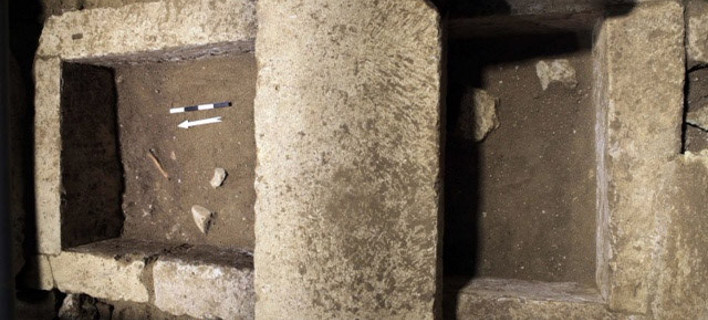
The burial vault inside a tomb at Amphipolis.
Credit: Greek Ministry of Culture
Skeletal remains have been discovered inside a lavish burial complex in Greece that dates back to the era of Alexander the Great. The tomb is thought to be the largest of its kind in the Greek world, and the bone fragments could help solve the mystery of who was buried inside.
Excitement has been building for months as archaeologists venture deeper inside the 4th century B.C. burial complex in Amphipolis, a city in Greece central Macedonia region, located about 65 miles (105 kilometers) east of Thessaloniki. The excavators have found sphinxes, a stunning mosaic floor and artfully crafted female statues standing guard at an interior doorway. But until now, they had not found any trace of a body.
The Greek Ministry of Culture announced today (Nov. 12) that fragmentary skeletal remains were discovered beneath the floor in the tomb's third chamber. [See Photos of the Alexander-Era Tomb's Excavation]

Diagram of burial vault
Credit: Greek Ministry of Culture
The body had apparently been placed within a wooden coffin inside a limestone vault. The archaeologists also discovered metal nails and fragments of glass scattered among the bits of bone.
The excavators, led by Greek archaeologist Katerina Peristeri, have been trying to stave off speculation about who might be buried inside the tomb. But, they said today the complex was probably too expensive to have been bankrolled by a single individual. The size and rich details of the tomb suggest it must have been built for a “prominent figure,” according to a statement from the Greek Ministry of Culture.
In September, the head of the Ministry of Culture, Kostas Tasoulas, said it was highly unlikely that the Amphipolis tomb belonged to Alexander the Great himself, but he later retreated from that statement.
“There are no written documents on where Alexander the Great is buried, this is what I said, and not that the tomb does not belong to Alexander the Great,” Tasoulas told a radio program, according to the Greek Reporter.
Alexander the Great died in Babylon (present-day Iraq) in 323 B.C. Against his last wishes to be thrown into a river, Alexander's generals eventually buried him in Egypt, but the exact location of his final resting place has been lost to history, Archaeology magazine reported.
Excavations have been going on at the so-called Kasta Hill site since 2012, but the dig gained widespread attention this past August after a pair of broken sphinxes were revealed at the entrance to the tomb, which is enclosed by a marble wall that runs about 1,600 feet (490 meters) around the perimeter. Among the more remarkable finds from the excavation was a colorful mosaic floor showing a scene from Greek mythology: the goddess Persephone being abducted by Hades and taken to the underworld.
http://www.livescience.com
 A skeleton has been discovered in the mysterious, richly-decorated tomb from the time of Alexander the Great, Greece culture ministry says.
The site is believed to be the largest ancient tomb to have been discovered in Greece, and has spurred speculation as to whether the ancient conqueror or a member of his family was buried there.
Officials said the remains were clearly those of “a prominent person”, with speculation rife it could be that of Roxana, Alexander's Persian wife, his mother Olympias or one of his generals.
The dead body had been placed in a wooden coffin, which disintegrated over time. The skeletal remains were found both inside and outside the grave buried underground in the innermost chamber at the site.
The skeleton will now “be studied by researchers”, the ministry said in a statement.
“It is probably the monument of a dead person who became a hero, meaning a mortal who was worshipped by society at that time,” the statement said.
“The deceased was a prominent person, since only this could explain the construction of this unique burial complex.”
Katerina Peristeri, the archaeologist in charge of the dig near Amphipolis in northern Greece, is due to reveal the first of her highly anticipated findings on November 29.
The discovery came as archaeologists confirmed another tomb, close to where the treasure-filled burial chamber of Alexander's father Philip II of Macedon was unearthed in 1977, had also survived the centuries intact.
Angelique Kottaridis, who is in charge of the dig at Vergina, 180 kilometres to the west of Amphipolis, said it also dated from Alexander's lifetime, after breaking the news on her Facebook page Tuesday.
Excavations at the site in north-eastern Greece near the city of Thessaloniki began in 2012. They captured global attention in August when archaeologists announced the discovery of vast tomb guarded by two sphinxes and circled by a 497-metre marble wall.
The near-intact sculptures and staggering mosaics found at Amphipolis have been a cheering reminder of past glories for a country mired in economic woes.
The beauty of a sphinx and intricate mosaics of a man driving a chariot and the abduction of Persephone by Pluto have also fuelled theories the tomb was for a very high-status individual.
Whoever the massive fourth-century BC tomb holds, experts said it was highly unlikely to be Alexander himself, who conquered the Persian empire and much of the known world before his death at the age of 32.
After his mysterious end in Babylon he is said to have been buried in Alexandria in Egypt, the city he founded, although no grave has ever been found.
Reuters/AFP

The Sarantos Kargakos on ALPHA for the new finds in the tomb of Amphipolis

The historian and writer Sarantos Kargakos spoke on ALPHA for the new finds in the tomb of Amphipolis and expressed his conviction about the identity of the dead, While proϊdease and new surprises from the possible continuation of excavations in tumulus Kasta. According to Mr. Kargako, the magnificent Tomb refers to Monument «afirwismoy» of the dead, namely a personality located – as it says- between the fatality and theiotitas.
Considers, that this person cannot be other than Alexander the great, as well as stresses, other persons who heard, don't have "afirwistei". Mentions, that in visits before too many years in the region, the locals called the tumulus Kasta as "Queen's Hill" and did not rule out finding and other or other skeletons in the excavation work on the whole tumulus.
See on the interview of Sarantoy Kargakoy in the main newscast of ALPHA.
The necropolis belonged to the Kings of the city and was used for the burial of the mid-5th century until the late 4th century BC.
The sarcophagus is likely to be made for the Abdalwnymo, last King of Sidwnas, they ascended by Alexander after the battle of Issus (333e.g.) and ruled until his death, the 331 e.g.. Constructed of pentelic marble, by Greek artist apparently, When Abdalwnymos was still alive, between the 325 and the 311 e.g..
Gable presence, gutter and Cape into the cover of the sarcophagus refers to ancient Greek temple. The top of the roof is decorated with female heads. On the sides of, but in both pediments, bears reliefs with battles and hunts, full styles with Persian clothing and styles that are either Macedonians or men of other Greek cities. Some of the past wearing a short tunic and bear arms, while others are naked.
The main scene of the sarcophagus is considered the lion hunt in an away side, they are involved in the Abdalwnymos, Alexander, but he and Hephaestion, the close companion of Alexander. The purpose of this show was to strengthen the Royal image of Abdalwnymoy, as the shows involved in the hunt, a literal sport Kings, and even companies with the Conqueror, He had become the great King of Asia.
(Alexander's sarcophagus-upper right is distinguished and lion)
(Osseous and glass ornaments coffin found in tomb of Amphipolis)
Christos Mazanis
Work continued on the Archaeological Serres, in particular in Kasta Hill and third Ward. At a depth of 1, 60 m. from the saved stones of the floor, revealed large CIST Tomb, made of limestone (Sketch, foto 1, 2). CONTINUE THE READING
By continuing to use the site, you agree to the use of cookies. more information
The cookie settings on this website are set to "allow cookies" to give you the best browsing experience possible. If you continue to use this website without changing your cookie settings or you click "Accept" below then you are consenting to this.


