Talk to AUTH. on the occasion of Amphipolis

Speaking to senior students of the Aristotle University of Thessaloniki, at the School of Journalism and Communication, last week, guests of journalist – Professor Anna Panagiotarea known and authoritative journalists talked about the media coverage of the excavation Amphipolis and the context in which it operates the update of the Ministry of Culture. In the pictures the “hostess” k. Panagiotarea and interlocutor journalist of TV 100 k. George Rodakoglou and Theodore Spaneli newspaper “Timer”. Notably poes was an interesting discussion on the occasion of Amphipolis, but extended to the regional press and capabilities cover large claims with facts. What gave a further interesting dimension to the debate that followed was very interesting questions and comments from students.

Mosaics Revealed at Ancient Greek City of Zeugma

mosaic-1-1024x685 Archaeologists discovered three unique mosaics at the Ancient Greek city of Zeugma, in south Turkey, near the borders of Syria.

The ancient city of Zeugma was originally founded as a Greek settlement by Seleucus I Nicator, one of the generals of Alexander the Great, in 300 BC. The population of the city at its peak was approximately 80,000 inhabitants.

CONTINUE THE READING

Skeleton Discovered In Greece Could Be Alexander The Great

Skeleton Discovered In Greece Could Be Alexander The Great - ArtLyst Article image

Greek Archaeologists are waiting with bated breath over a skeleton found in a mysterious and richly-decorated tomb from the time of Alexander the Great – might solve the riddle of who ancient Greece’s biggest burial mound was built for. Having dug their way past huge decapitated sphinxes, and broken through a wall guarded by two caryatids; they then excavated an antechamber decorated with stunning mosaics. Now experts have finally found the body it was all built for, the Greek culture ministry said Wednesday.

CONTINUE THE READING

Living in a Mans World: The Untimely & Brutal Death of Hypatia

Hypatia
The 4th century saw the formal and official transition of the Roman Empire from a wholly pagan state to a shared pagan and Christian entity. In many places, however, Christianity was starting to come out ahead—particularly in the eastern Roman Empire. Alexandria, Egypt was at the center of this struggle. It was a place where there was an amalgamation of pagans, Jews, and Christians sharing one space. Into this religious conflict walked Hypatia, a female scholar and the head of the Platonic school in Alexandria, who met an untimely death in the most brutal and unjust of circumstances.

Hypatia's life is most commonly seen through the lives of the two men in charge of Alexandria during her life: pagan governor Orestes and Bishop Cyril. It was in their life stories that Hypatia was written about, and it is only later literature that attempted to piece together her story outside of the politics of these two men. The evidence of her beginnings stem from two ancient sources: Socrates of Scholasticus, writing only a few years after she died, and John of Nikiu, writing a few hundred years later. Though these men write of Hypatia in relation to Orestes and Cyril, they provide the two most widely circulated theories of who she was during her lifetime, and thus serve as two of the best references.

Born around 350 CE, Hypatia was the daughter of a mathematician. She took an interest in science and math as well, eventually becoming the leading teacher of a Platonic school in Egypt, tutoring students in both astronomy and the philosophy of Plato and Plotis. It was because of her religious beliefs and the subjects she taught that she was later targeted by the Christians of Alexandria—a woman with such knowledge and intellectual skill was considered dangerous in this period. But her death was not solely because of her teachings. The current political struggle between the head of the church of Alexandria (Cyril) and the head of the government (Orestes) needed a scapegoat; since Hypatia was already making waves in society, she was the easiest and best target.

Hypatia teaching a class

Hypatia teaching a class (Image source)

The conflict between Orestes and Cyril was a religious one. Orestes remained a pagan follower with what seemed to be a close, protective relationship with the Jewish community in the city, while Cyril, on the other hand, was a wholly Christian man. As the story goes, the two men were already feuding because of Cyril's attempt to push ecclesiastical reforms throughout Alexandria. Their feud came to a head, however, when Orestes issued an edict dictating the rules of the Jewish dancing exhibitions, a particularly sore subject between the two men. A Christian under Cyril, Heirax, applauded the edict and was then accused by the Jews of having been sent to the hearing to anger and provoke them. To appease his subjects, Orestes had Heirax openly tortured and killed. But the Jews were indeed upset, and unfortunately for Orestes, took matters into their own hands.

In anger, the Jews of the city fooled the Christians into believing their church was ablaze in the middle of the night. According to both Socrates and John, when the Christians fled to the streets to save their beloved sanctuary, they were slaughtered. The result: the Jews were stripped of their worldly goods and banished by Cyril, and Orestes was attacked—supposedly by five hundred monks. It was only after one of these monks, Ammonius, was declared a martyr upon his death that the Christians themselves realized the terrible irony of his martyrdom title. It was at this moment that Hypatia's life was stolen and rewritten to play the part of scapegoat.

According to John of Nikiu, Hypatia was not merely a philosopher and scholar. She was a woman of magical wiles who practiced ' Satanic charms ' and had enchanted the governor Orestes. It seemed that Orestes was known to bring Hypatia into his confidence often, evidenced by numerous ancient and medieval scholars, and because of this the Christians and John of Nikiu seemed to believe that she was behind all the actions and decisions of Orestes. John of Nikiu claims, in a sense, that she charmed Orestes to do her bidding.

llustration from an 1899 edition of Charles Kingsley's 1853 novel Hypatia. Picture shows Hypatia performing a pagan ritual

Illustration from an 1899 edition of Charles Kingsley's 1853 novel Hypatia. Picture shows Hypatia performing a pagan ritual (Wikimedia).

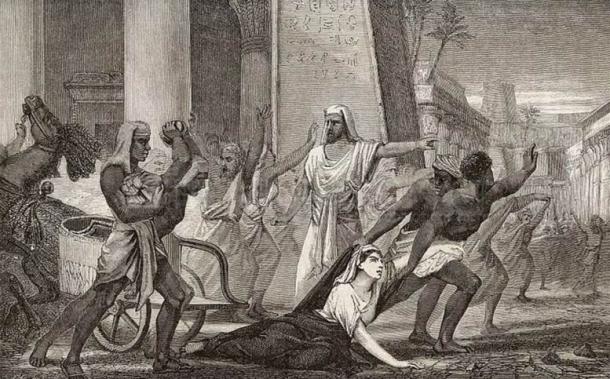
Both Socrates Scholasticus and John of Nikiu—and nearly every other text that describes Hypatia's life—tell the same story of her end, of the actions the Christians took to silence her “power” over Orestes. Hypatia was hunted down and kidnapped by a magistrate called Peter and his fellow Christians and taken to the church at Caesareum. Brutally, she was stripped of her clothes and beaten with tiles or oyster shells, supposedly skinned alive with those very same oyster shells. Then, Hypatia was either ripped to shreds or dragged through the streets until she died. Regardless of the specifics, both men describe a murder so brutal, so callous, Hypatia was definitely treated more like an animal up for the slaughter than a human being accused of ongoing the government. Whether or not she had worked closely with Orestes, the way of her death was horrific and undeserved.

Death of the philosopher Hypatia, in Alexandria

“Death of the philosopher Hypatia, in Alexandria” from the book Vies des savants illustres, depuis l'antiquité jusqu'au dix-neuvième siècle, by Louis Figuier, first published 1866. [Note: this picture has a racist overtone and should not be seen as an accurate representation of Hypatia's killers. However, it does reflect the historical descriptions of Hypatia being dragged through the street]. (Wikimedia)

Despite this, the majority of Hypatia's life has been written about in relation to how her death impacted on the city of Alexandria in the 4th century, not about the injustice of her murder. While she was alive, she was known as a great female philosophical leader. But in history, she is best remembered for the role she was accused of playing in the political struggle between two overconfident, religiously warring men. With her death, many scholars believe the cultural scales in Alexandria tipped: John of Nikiu proclaimed that the final threads of pagan idolatry ended with her, while modern scholars believe that classical and Alexandrian culture completely deteriorated. Regardless of whether this belief is true, whether Hypatia can truly be identified as the end of the height of Alexandrian society, her death did create a political and religious shift throughout Alexandria and the eastern Roman Empire.

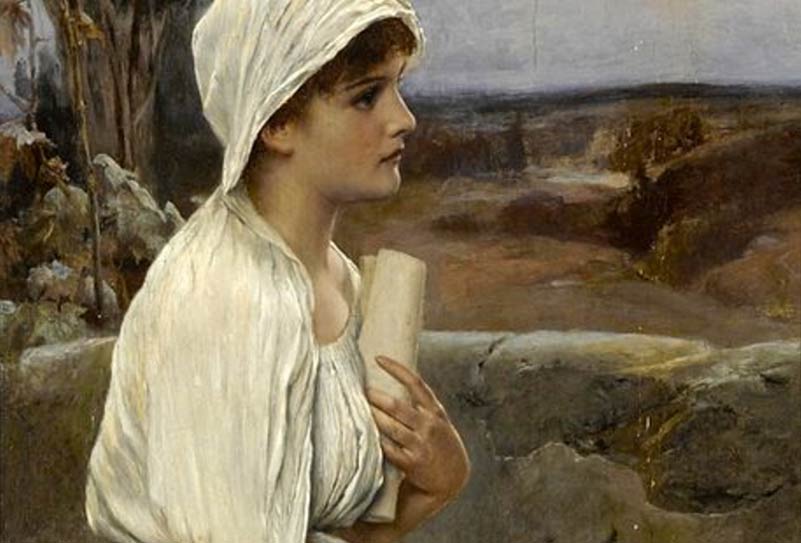
Featured image: ' Hypatia ' by Alfred Seifert, 1901 (Wikimedia).

Sources:

Dzielska, Maria. Hypatia of Alexandria. trans. F. Lyra. (Harvard University Press: Connecticut, 1996.)

Charles, R. H., The Chronicle of John, Bishop of Nikiu: Translated from Zotenberg's Ethiopic Text (New Jersey: Evolution Publishing, 2007.)

Fitzgerald, A., The Letters of Synesius of Cyrene (London: Oxford University Press, 1926.)

Schaefer, Francis. “St. Cyril of Alexandria and the Murder of Hypatia”, The Catholic University Bulletin 8, 1992. pp. 441–453.

Scholasticus, Socrates. Historia Ecclesiastica (Nuvision Publications, LLC: South Dakota, 2013.)

Whitfield, Bryan J. “The Beauty of Reasoning: A Reexamination of Hypatia and Alexandria”. The Mathematics Educator, 1995. pp. 14–21. Accessed November 2, 2014.

Zielinski, Sarah. “Hypatia, Ancient Alexandria's Great Female Scholar.” Smithsonian Magazine. March 14, 2010. Accessed November 2, 2014. http://www.smithsonianmag.com/womens-history/hypatia-ancient-alexandrias-great-female-scholar-10942888/?page=1.

– See more at: http://www.ancient-origins.net/history-famous-people/living-mans-world-untimely-brutal-death-hypatia-002328#sthash.Wjxfxghz.dpuf

History of Wine in Ancient Greece

History of Wine in Ancient GreeceGreece is a country where we are constantly reminded of its ancient history while engaging in modern pursuits. A car speeds through the streets of Athens with the Parthenon in the backdrop. A tourist gazes at the ocean view from the Temple of Poseidon while snapping a picture with his cell phone. Wine is one example of when modern life intersects with ancient tradition because it represents the past, present, and future of the Greek people.

Wine has, in fact, been a part of the Greek culture for centuries. Ancient Greek writers such as Euripedes constantly sang its praises. He said, "Where there is no wine there is no love." So, even then, wine was associated with all the good things life has to offer, such as love. What this means is that the Greeks had to have been making wine for awhile.

Early Production of Wine in Greece

Though early findings of wine production and consumption in Greece began in the Neolithic Period, it was the Minoan Civilization which came about later that really celebrated it. In fact, it is the Minoan civilization that has given us the strongest evidence in support of early wine production.

For example, the Minoan ruins in Malia have large vats that were used for wine storage. Also, one of the first wine presses ever discovered was found in Palakatro, Crete. This suggests that their wine making techniques were fairly sophisticated.

Wine and the Mycenaeans

Wine increased in importance in Ancient Greece during the Mycenaean Period. It is during this time period when wine found its way into other aspects of the culture. For example, this is the time period where early references of Dionysius, the god of wine, can be found.

The Mycenaean Period was also significant because there is evidence that they traded wine with neighboring civilizations such as those in Italy, Sicily, Egypt, Palestine, and Cyprus. When archaeologists found amphoras, the clay pot used to transport wine, in some of the Mycenaean dig sites their conclusion was that wine was one of the items they traded.

Winemaking Throughout the Mediterranean

After some time, the Ancient Greeks settled into various city-states. As people migrated to Greece from other areas of the Mediterranean, they brought their grape vines with them. As groups settled and grew, so did the wine production. In fact, wine making became important all over the Mediterranean, not just in Greece.

As civilizations established throughout the Mediterranean, the wine trade increased. Athens, for example, was a huge market for vintners and wine sellers. The large estates and increased population created a large demand for wine, which contributed in making this a popularly traded item.

Wine was an important part of the culture of Ancient Greece. As the population grew, so did the demand for wine. Since Greece has the ideal climate for growing these grapes, winemaking and trading were both very lucrative. Today, this ancient beverage is still made and enjoyed not only in Greece, but throughout the world.

Categorized in:

This post was written by GreekBoston.com

Apelles – the most famous painter of antiquity

The school of Apelles

According to Pliny, the Apelles flourished during the period of 112is Olympiados i.e. between 332 and of the 329. His collaboration with Ptolemy I of Egypt indicates that there has been active at least until the -305, when Ptolemy was proclaimed King. It is estimated that lived by the -352 until the -300 about. Descended from the Ionian city of Colophon North of Ephesus.

The Apelles was initially a student of Superintendent of Efesioy.
Already an established painter comes in Sicyon. Studying for 12 years in the Painting School with teacher Sikyonia pamphilus which gave a talent time. It is said that he and the painter's neighbor Amfipoliti. During his stay in Sicyon, working with the painter Melanthios for construction of the image of the tyrant Aristratoy. This information gives us the browser Wars (quotes: Plutarch, Vios Aratou, Fri. 13 and Pliny, Natural History, Book 35, Fri. 123). In Sicyon found him Alexander the great and together with the Lysippo took them to the Macedonian Court.

The painter Apelles worked like the environment of Philip II and Alexander the great, Youth Prize by submitting several portraits of them. As reported by Pliny, Alexander the great appreciate his skills. For this reason, Alexander the great had forbidden to paint other than Apelles (Pliny, Natural History, Book 35, Fri. 85). It is noted that Apelles was followed by Alexander the great in his campaign in Asia by Ephesus.

"THE M. Alexander and Kampaspi
in the laboratory of Apelles "
Giovanni Battista Tiepolo (1740)

The Kampaspi. When he was in the Macedonian Court painted the mistress of Alexander Kampaspi which Apelles fell in love with. The table impressed both Alexander the great so later ceded Kampaspi to Apelles.

According to Pliny, Alexander the great called by Apelles to painted a portrait of pallakidas Kampaspis and he fell in love. The table impressed both Alexander so that later gave as a gift to the painter.

Other great works of Apelles is:

"Alexander Keraynoforos" in the Temple of Artemis at Ephesus for which ameifthike with the hefty amount of 20 Gold talents (Pliny, Book 35, Fri. 92). Plutarch in "Fortune or Virtue Of Alexander", says that "one of the Alexandrwn of Philip was invincible, the Apelloy's inimitable ". The same writer says, also, for the same table, that gave the skin color of Alexander faiotero, While the face and chest were an amazing reddish whiteness.

For the ' Emergent Venus "the Apelles to use as a model the beautiful courtesan and mistress of Praxiteles Phryne. Strabo writes that Apelles inspired the theme of the table when she saw the famous courtesan Fryni being bathed in Elefsina. The table was dedicated to the Temple of Asklepios on Kos.

The Calumny of Apelles
Sandro Botticelli (1495)

"The Slander". Particular mention should be made to the table of Apelles "slander", which is preserved in a copy by Sandro Botticelli who painted based on description by Lucian for table of Apelles in the treatise "radiws mi pisteyein On of diaboli" i.e. that will not easily believe the slander. The story refers to the painter Antifilo who enochleito because the Macedonian King of Egypt Ptolemy I the special evaluation Lagoy showed in spite of Apelles in this. For this reason, the Antifilos maligning the Apelles in Ptolemy that allegedly participated in the conspiracy of the eparch of Tyre Theodota against Ptolemy. Ptolemy exorgisthike of Apelles but when later learned the truth this embarassed him and a) donated to Apelles 100 talents and b) Antifilo gave him like a slave. In response the Apelles in slander, due to which PB, He painted the famous painting "Slander" i.e. slander.

To that describes table Lucian:

The Calumny of Apelles, (minutes)
Sandro Botticelli,

"On the right sits a man with very large ears, almost identical with those of Midas, suggesting the hand to Slander while still standing off of. Around him stood two women, ignorance, I think, and Doctrine. On the other hand approaching the Slander, woman too beautiful, full of fervor and irritation, like to show rabies and rage, keeping the torch lit left hand and with the other hand dragging by the hair a young stretching their hands to heaven and calls witnesses the gods. Preceding katwchros and ugly man, with piercing look, that seems to have become a skeleton by long illness. One might think that that is the envy (jealousy). Additionally, the following two other Slander women who encourage the dress and decorate. As I told the Guide, one is Affected and other fraud. Then followed some woman with looks completely mournful, dressed in black tatter about truly. This was called, I think, Repentance. This, well, targeted towards the back with tears and full casting sidelong glances at the shameful Truth that drew ".

The Apelles was famed for the richness of colors of. Had discovered color preparation methods from a variety of different substances that even today is unknown. Use a paint that way nobody else has been able to emulate. Lauded by all the sincerity of the artist, who said that falls short of the Melanthiou in the layout, Asklipiodwroy not in symmetry and measure, for which the admired. Also referred to as an innovator in the field of technical, having devised a special preparation method of mixing of substances of ivory color (Pliny, Book 35, Fri. 25). The use of help in maintaining and protecting works while also affect potential and ease of colors.

The main feature of the art of Apelles was the delicacy of the features of, the plausibility of colors of, the immeasurable grace, kalloni, expressiveness of forms and avoid any overselling and in plan and in the colours. It is estimated that the first alligorikes pictures painted and Apelles personifications of ideas like thunder, ignorance, the reputation of, the envy, the slander, the truth. Pindar wrote that Apelles «meilicha» works for mortals and this placed in children's aristocratic of the lawsuit, the deep music of education, the innate kindness and grace that is a gift of the gods. Pliny (Natural History, Book 35, Fri. 88) argued that Apelles was superior to the painters that succeeded and by those who were followers of. Said that the portraits were so lifelike, so a metwposkopos could predict the age of the person depicted, and to make projections for the future of.

Amphipolis: What can we expect from the examination of skeletal remains

The Dr. If. Papathanassiou speaks to Ana-MPA

"In and out of the grave, found the skeleton of a dead. It is obvious that the anthropological material will be examined by specialists. Is, equally, obvious that all investigations will be made which requires modern science». With these words, the announcement of the Ministry of culture and sport, informed the new, very important findings from Amphipolis and the excavations carried out by the Ephorate of Antiquities of Serres in Kasta namely Hill in the third Chamber of the monument. Ποιοι όμως είναι αυτοί οι ειδικοί επιστήμονες που εξετάζουν το ανθρωπολογικό υλικό, what stages it passes such a study, and what conclusions can be drawn;
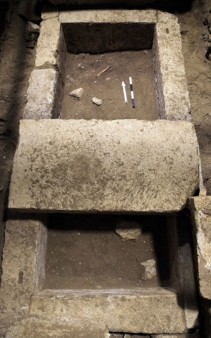
"The physical (or biological) anthropology is a branch of anthropology to the study of natural (or biological) residue of human osteologikwn. Subdivision of the bioarchaiologia is that its purpose is the interdisciplinary study of anthropological remains of modern man (homo sapiens) within the framework of their cultural archaeological, "says Ana-MPA Dr Anastasia Papathanasiou, archaeologist of the Inspectorate Paleoanthropology and Paleontology, specializing in bioarchaiologia.

The bioarchaiologoi certainly have plenty to give to excavations with anthropological findings, like those of Amphipolis. "The study of human bone provides a range of information regarding both the cause of death and the way of life of a particular man and an entire population" says Ms. Papathanasiou. Among these are the sex, the age, some particular morphological elements, the height, possible diseases and injuries, the standard of living, eating habits, movement from one area to another.

However, in order to assess these elements, account should be taken of a number of macroscopic, microscopic and chemical analysis. But before all you need to become a proper fix. ' Before anaskafoyn bones, It is important that reflected their position inside the Tomb. In this way we understand if they are disturbed or if it is in the anatomical position, If you are going for removal or primary burial. Also, you will need to know the position of the bones and other artifacts. It is different to find a vase at some point inside the Tomb, another over the dead and another in the foot. It is a lot of information from the first fix. It is also very important in an excavation can be found bones, as in graves, from the outset there is a specialist in human bones» bioarchaiologos says.

After cleaning the bones, the second step is the macroscopic study. "I.e. to determine sex, the age, the stature and if there are pathological changes. Likely be able to see the cause of death, the stress which maybe passed during his lifetime, Some morphological characteristics and, in particular, information that the person, the height of the, anything can be comments from the bones and teeth ' mentions and complements that a tiny and radiographic study may give additional data on injuries, fractures, tumors, mikrotribes teeth, bone density etc..

The third stage is the chemical analyses, with the radiocarbon dating with carbon 14 comes first, as it can identify chronologiseis artifacts with very small error range. "This is the first thing that must be done, especially when there are questions about dating a finding and if we know that the bones be undisturbed, IE not have transferred from elsewhere. The next step is the analysis with stable isotopes, as carbon, nitrogen, sulfur and strontium that give valuable information about nutrition and mobility of people of the past "notes Ms. Papathanasiou. Adds: "The isotopes generally are based on the principle that you get from your environment that gives. For example, the teeth are only created in childhood, but bones updated continuously, so if there are differences in the teeth of the bones, It means that something changed in the life of, some different diet or move. Depending on the isotope that count each time».

As for the possibility of determination of DNA, Ms. Papathanasiou notes that it "may determine sibling relationships or specific genetic diseases. But another modern DNA, that's easy to isolations, another ancient and mainly the nuclear, in which there is a lot of cross-contamination. Also can not saved enough quantity of collagen, so it is possible to become radioactive carbon dating to be safe or stable isotopes. In the case of course of historical times might find all this, unless the conditions of the soil is very poor or is burnt bones, where the going gets tough. Generally the preserve plays a very big role "explains, Stressing that every hardware and location varies on storage conditions and is purely at the discretion of each excavator the methodology to be followed. End, with regard to the time needed to draw conclusions, This depends on the workshop and the workload may have and can range from a few weeks to a few months.

Amphipolis: Τα οστά του Ριχάρδου του Γ’ δείχνουν το όνομα του νεκρού

Amphipolis: The G. Richard bones' shows the name of the deceased

At the Institute of genetics and Biotechnology at the University of Manchester has already been sent since last August, genetic material from the tomb of Philip, as well as from the Prince's Tomb in Vergina.

CONTINUE THE READING