Peristeri on Amphipolis: The skeletons may be remnants of sacrifices or looters

Peristeri GR IBNABy Spiros Sideris

“We need to focus on the monument, not the bones, which for me do not mean a lot. You cannot perform datings from the dead. For me the skeletons are meaningless. They mislead the investigation”.

These are the statements of the head of the excavation team at Amphipolis, Katerina Peristeri, in an interview with the Real News. Indeed, she goes even further saying that “for me issue of the ‘skeletons’ does not say anything. The area was so disturbed that you cannot draw clear conclusions. The robbers had ravaged everything. Because, as you can see, the burial chamber where they were looking for great treasures sustained a lot of damage, an enormous destruction”.

As for who the skeletons belong to, she was said: “There are many assumptions we can make. The skeletons may have been remnants of sacrifices, may even belong to the looters. Besides, the skeletal material was not in one place”.

Referring to the main dead she said: “Who is the main dead? There is a large piece of skeletal material from the dead found lower than the rest, ie close to the floor, and belongs to a short man, 1.60m. Even this skeleton, however, was scrambled by the robbers. And there is the other thing, if indeed the dead was so precious, they may had even taken him”.

In the same interview Katerina Peristeri speaks for all the other issues that have arisen: answers to her critics, expresses bitterness, describes her feelings for the blows she received, while she talks in detail about the “unique burial complex”, making extensive reference to the first phase of excavation and what comes next

– See more at: http://www.balkaneu.com/peristeri-amphipolis-skeletons-remnants-sacrifices-looters/#sthash.FfRdVrIZ.dpuf

The destruction of the Great Library of Alexandria

The destruction of the Great Library of Alexandria

Alexandria, one of the greatest cities of the ancient world, was founded by Alexander the Great after his conquest of Egypt in 332 BC.  After the death of Alexander in Babylon in 323 BC, Egypt fell to the lot of one of his lieutenants, Ptolemy. It was under Ptolemy that the newly-founded Alexandria came to replace the ancient city of Memphis as the capital of Egypt. This marked the beginning of the rise of Alexandria. Yet, no dynasty can survive for long without the support of their subjects, and the Ptolemies were keenly aware of this. Thus, the early Ptolemaic kings sought to legitimize their rule through a variety of ways, including assuming the role of pharaoh, founding the Graeco-Roman cult of Serapis, and becoming the patrons of scholarship and learning (a good way to show off one’s wealth, by the way). It was this patronage that resulted in the creation of the great Library of Alexandria by Ptolemy. Over the centuries, the Library of Alexandria was one of the largest and most significant libraries in the ancient world. The great thinkers of the age, scientists, mathematicians, poets from all civilizations came to study and exchange ideas.  As many as 700,000 scrolls filled the shelves. However, in one of the greatest tragedies of the academic world, the Library became lost to history and scholars are still not able to agree on how it was destroyed.
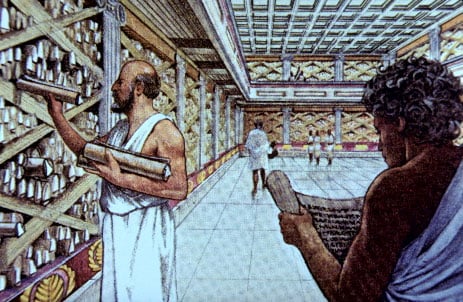
Library of Alexandria

An artist’s depiction of the Library of Alexandria. Image source.

Perhaps one of the most interesting accounts of its destruction comes from the accounts of the Roman writers. According to several authors, the Library of Alexandria was accidentally destroyed by Julius Caesar during the siege of Alexandria in 48 BC. Plutarch, for instance, provides this account:

when the enemy tried to cut off his (Julius Caesar’s) fleet, he was forced to repel the danger by using fire, and this spread from the dockyards and destroyed the great library.
(Plutarch, The Life of Julius Caesar, 49.6)

This account is dubious, however, as the Musaeum (or Mouseion) at Alexandria, which was right next to the library was unharmed, as it was mentioned by the geographer Strabo about 30 years after Caesar’s siege of Alexandria. Nevertheless, Strabo does not mention the Library of Alexandria itself, thereby supporting the claim that Caesar was responsible for burning it down. However, as the Library was attached to the Musaeum, and Strabo did mention the latter, it is possible that the library was still in existence during Strabo’s time. The omission of the library can perhaps be attributed either to the possibility that Strabo felt no need to mention the library, as he had already mentioned the Musaeum, or that the library was no longer the centre of scholarship that it once was (the idea of ‘budget cuts’ seems increasingly probable). In addition, it has been suggested that it was not the library, but the warehouses near the port, which stored manuscripts, that was destroyed by Caesar’s fire.

The second possible culprit would be the Christians of the 4th century AD. In 391 AD, the Emperor Theodosius issued a decree that officially outlawed pagan practices. Thus, the Serapeum or Temple of Serapis in Alexandria was destroyed. However, this was not the Library of Alexandria, or for that matter, a library of any sort. Furthermore, no ancient sources mention the destruction of any library at this time at all. Hence, there is no evidence that the Christians of the 4th century destroyed the Library of Alexandria.

The last possible perpetrator of this crime would be the Muslim Caliph, Omar. According to this story, a certain “John Grammaticus” (490–570) asks Amr, the victorious Muslim general, for the “books in the royal library.” Amr writes to the Omar for instructions and Omar replies: “If those books are in agreement with the Quran, we have no need of them; and if these are opposed to the Quran, destroy them.” There are at least two problems with this story. Firstly, there is no mention of any library, only books. Secondly, this was written by a Syrian Christian writer, and may have been invented to tarnish the image of Omar.

Unfortunately, archaeology has not been able to contribute much to this mystery. For a start, papyri have rarely been found in Alexandria, possibly due to the climatic condition, which is unfavourable for the preservation of organic material. Secondly, the remains of the Library of Alexandria itself have not been discovered. This is due to the fact that Alexandria is still inhabited by people today and only salvage excavations are allowed to be carried out by archaeologists.

While it may be convenient to blame one man or group of people for the destruction of what many consider to be the greatest library in the ancient world, it may be over-simplifying the matter.  The library may not have gone up in flames at all, but rather could have been gradually abandoned over time. If the Library was created for the display of Ptolemaic wealth, then its decline could also have been linked to an economic decline. As Ptolemaic Egypt gradually declined over the centuries, this may have also had an effect on the state of the Library of Alexandria. If the Library did survive into the first few centuries AD, its golden days would have been in the past, as Rome became the new centre of the world.

Featured image: One of the theories suggests that Library of Alexandria was burned down. ‘The Burning of the Library of Alexandria’, by Hermann Goll (1876).

By Ḏḥwty

References

Empereur, J.-Y., 2008. The Destruction of the Library of Alexandria: An Archaeological Viewpoint. In: M. El-Abbadi & O. M. Fathallah, eds. What Happened to the Ancient Library of Alexandria?. Leiden; Boston: Brill, pp. 75-88.

Haughton, B., 2011. What Happened to the Great Library at Alexandria. [Online] Available at: http://www.ancient.eu.com/article/207/
[Accessed 8 May 2014].

Newitz, A., 2013. The Great Library at Alexandria was Destroyed by Budget Cuts, Not Fire. [Online] Available at: http://io9.com/the-great-library-at-alexandria-was-destroyed-by-budget-1442659066
[Accessed 8 May 2014].

Plutarch, Life of Julius Caesar,
[Perrin, B. (trans.), 1919. Plutarch’s Lives. London: William Heinemann.]

Wikipedia, 2014. Destructionn of the Library of Alexandria. [Online] Available at: http://en.wikipedia.org/wiki/Destruction_of_the_Library_of_Alexandria
[Accessed 8 May 2014].

    – See more at: http://www.ancient-origins.net/ancient-places-africa-history-important-events/destruction-great-library-alexandria

Η αντιμετώπιση των μη-Ελλήνων από τους Έλληνες κατά την Ελληνιστική περίοδο

 784px-jean_auguste_dominique_ingres_apotheosis_of_homer_1827

 Εμείς, οι Αλεξανδρείς, οι Αντιοχείς, Οι Σελευκείς,
κ’ οι πολυάριθμοι Επίλοιποι Έλληνες Αιγύπτου και Συρίας
Κ’ οι εν Μηδεία, κ’ οι εν Περσίδι, κι όσοι άλλοι.
Με τες εκτεταμένες επικράτειες,
Με την ποικίλη δράσι των στοχαστικών προσαρμογών.
Και την Κοινήν Ελληνική Λαλιά
Ως μέσα στην Βακτριανήν την πήγαμεν, ως τους Ινδούς.
(Απόσπασμα από το «Στα 200 π. Χ. » του Κ. Καβάφη.)

ΣΥΝΕΧΙΣΤΕ ΤΗΝ ΑΝΑΓΝΩΣΗ

About golden ratio

The Golden Ratio – a sacred number that links the past to the present

There is one thing that ancient Greeks, Renaissance artists, a 17th century astronomer and 21st century architects all have in common – they all used the Golden Mean, otherwise known as the Golden Ratio, Divine Proportion, or Golden Section.  Precisely, this is the number 1.61803399, represented by the Greek letter Phi, and considered truly unique in its mathematical properties, its prevalence throughout nature, and its ability to achieve a perfect aesthetic composition.

According to astrophysicist Mario Livio:

Some of the greatest mathematical minds of all ages, from Pythagoras and Euclid in ancient Greece, through the medieval Italian mathematician Leonardo of Pisa and the Renaissance astronomer Johannes Kepler, to present-day scientific figures such as Oxford physicist Roger Penrose, have spent endless hours over this simple ratio and its properties. But the fascination with the Golden Ratio is not confined just to mathematicians. Biologists, artists, musicians, historians, architects, psychologists, and even mystics have pondered and debated the basis of its ubiquity and appeal. In fact, it is probably fair to say that the Golden Ratio has inspired thinkers of all disciplines like no other number in the history of mathematics.

In mathematics and the arts, two quantities are in the golden ratio if their ratio is the same as the ratio of their sum to the larger of the two quantities. When the Golden Mean is conceptualised in two dimensions it is typically presented as a regular spiral that is defined by a series of squares and arcs, each forming “Golden Rectangles”.

This symbolic potential arises because of the way the mean’s spiral shape resembles growth patterns observed in nature and its proportions are reminiscent of those in human bodies. Thus, these simple spirals and rectangles, which served to suggest the presence of a universal order underlying the world, were thereby dubbed “golden” or “divine”.

The Golden Ratio in History

The golden ratio has fascinated Western intellectuals of diverse interests for at least 2,400 years. The earliest known monuments believed to have been built according to this alluring number are the statues of the Parthenon in Greece, dating back between 490 and 430 BC.  However, there are many who have argued that it goes back much further than this and that the Egyptians were well versed in the properties of this unique number.

According to some historians, the Egyptians thought that the golden ratio was sacred.  Therefore, it was very important in their religion.  They used the golden ratio when building temples and places for the dead.  In addition, the Egyptians found the golden ratio to be pleasing to the eye.  They used it in their system of writing and in the arrangement of their temples.  The Egyptians were aware that they were using the golden ratio, but they called it the “sacred ratio.”

The first recorded definition of the golden ratio dates back to the period when Greek mathematician, Euclid (c. 325–c. 265 BC), described what he called the “extreme and mean ratio”. However, the ratio’s unique properties became popularised in the 15th century when aesthetics were a vital component of Renaissance art and geometry served both practical and symbolic purposes.  As the famous mathematician, astronomer, and astrologer, Johannes Kepler (1571 – 1630) wrote:

Geometry has two great treasures: one is the Theorem of Pythagoras, and the other the division of a line into extreme and mean ratio; the first we may compare to a measure of gold, the second we may name a precious jewel.

The Golden Ratio in Architecture

Many artists and architects have proportioned their work to approximate the golden ratio, with the belief that the outcome will be more aesthetically pleasing.  Using any of these ratios, an architect can design a door handle that has a complementary relationship to its door, which in turn has a similar relationship to its enclosing wall, and so on.  But more than this, the golden ratio has been used for the façade of great buildings from the Parthenon to the Great Mosque of Kairouan and all the way through to modern landmarks such as the Sydney Opera House and the National Gallery in London.

The Golden Ratio in Nature

Perhaps what is most surprising about the Golden Ratio is that it can be seen as a naturally occurring phenomenon in nature.   The golden ratio is expressed in the arrangement of branches along the stems of plants and the veins in leaves.   It can be seen in the skeletons of animals and humans and the branching of their veins and nerves.  It can even be seen in the proportions of chemical compounds and the geometry of crystals. Essentially, it is all around us and within us and for this reason, German psychologist Adolf Zeising (1810 – 1876) labelled it a ‘universal law’:

in which is contained the ground-principle of all formative striving for beauty and completeness in the realms of both nature and art, and which permeates, as a paramount spiritual ideal, all structures, forms and proportions, whether cosmic or individual, organic or inorganic, acoustic or optical; which finds its fullest realization, however, in the human form.

As a result of the unique properties of this golden proportion, many view the ratio as sacred or divine and as a door to a deeper understanding of beauty and spirituality in life, unveiling a hidden harmony or connectedness in so much of what we see.

By April Holloway

– See more at: http://www.ancient-origins.net/unexplained-phenomena/golden-ratio-sacred-number-links-past-present-001091#sthash.wE7t6PVy.dpuf

Η επιστημονική μελέτη των ευρημάτων της Αμφίπολης ωριμάζει στο χρόνο της


Η ανασκαφή της Αμφίπολης αποτελεί ένα ξεχωριστό αρχαιολογικό πεδίο ερευνών που κανένας επιστήμονας δεν μπορεί να το αναλύσει σε διάστημα λίγο μηνών όσο καλός και εάν είναι.

Με δεδομένο το γεγονός ότι πέρασαν οκτώ μόλις μήνες από την ανακάλυψη του ταφικού μνημείου στο Λόφο Καστά της Μεσολακκιάς ,η εμμονή όσων επιμένουν να δημοσιευθούν τα τελικά αποτελέσματα μελετών , αγγίζει τα όρια του παραλογισμού.
Στο χώρο των αρχαιολόγων θεωρείται αδιανόητο να παρουσιαστεί σε επιστημονικό συνέδριο και μάλιστα σε μια ενότητα λίγων λεπτών, μια εμπεριστατωμένη εργασία που δεν έχει ολοκληρώσει καν τον κύκλο της.
Η απουσία λοιπόν της διεπιστημονικής ομάδας της Κατερίνας Περιστέρη από την 28η Επιστημονική συνάντηση αρχαιολόγων 5 έως 7 Μαρτίου που θα γίνει στο ΑΠΘ, καταδεικνύει την σοβαρότητα με την οποία αντιμετωπίζονται οι μελέτες των αρχαιολογικών ευρημάτων .
Η ενημέρωση για τις αρχαιολογικές εξελίξεις στο τύμβο Καστά από τον Αύγουστο, κάλυψε στο μέγιστο βαθμό όλο το κοινό που την παρακολουθούσε και την παρακολουθεί, αλλά τώρα ήρθε η ώρα της επιστημονικής μελέτης που προϋποθέτει πολύ εργασία και εμπεριστατωμένη ανάλυση. Κάτι ως «ένα βασανιστήριο» θα λέγαμε ,για όσους συμμετέχουν σ αυτή τη διαδικασία.
Εξάλλου δεν πρέπει να περνάει απαρατήρητο το γεγονός ότι υπάρχουν περιπτώσεις ανασκαφών όπου οι αρχαιολόγοι μελετητές δεν τηρούν το προβλεπόμενο όριο των πέντε χρόνων που οφείλουν να δημοσιεύσουν τα αποτελέσματα τους. Μερικοί μάλιστα έχουν ξεπεράσει κατά πολύ τα όριο αυτό. Γνωστή είναι μέσα από αλλεπάλληλα δημοσιεύματα, είναι η περίπτωση της Καλλιόπης Λαζαρίδη που εδώ και 31 χρόνια δεν προχώρησε στην επιστημονική δημοσίευση του Εφηβαρχικού Νόμου που ανακαλύφθηκε στην Αμφίπολη το 1984.
Εάν συγκρίνουμε λοιπόν δυο περιπτώσεις που αφορούν την ίδια περιοχή θα πρέπει να αναρωτηθούμε τους λόγους που στη μια περίπτωση, επιμένουμε τόσο πολύ και στην άλλη δεν γνωρίζουμε απολύτως τίποτα.
Ο αναπληρωτής Υπουργός Πολιτισμού Νίκος Ξυδάκης θα πρέπει ίσως να στραφεί προς αυτήν την κατεύθυνση αναζήτησης στοιχείων αφού με την καθιέρωση της τριμελούς επιτροπής θα εξετάσει τα θέματα της Αμφίπολης. Κύρια αποστολή της επιτροπίας αυτής πρέπει να είναι η ουσιαστική ανάδειξη και τεκμηρίωση των ευρημάτων στο σύνολο τους και όχι η συγκριτική πολιτικολογία. Κάθε άλλη προσπάθεια καπέλωσης των επιστημόνων που ήδη συμμετέχουν στην ανασκαφή του τάφου στο λόφο Καστά θα εγείρει θέμα ηθικής και μεροληπτικής στρατηγικής κάτι που η προηγούμενη διοίκηση του ΥΠΠΟΑ θεωρούσε αδιαπραγμάτευτα στοιχεία.
Η ανασκαφές λοιπόν στην Αμφίπολη παρουσιάζουν ιδιαιτερότητες και μεγάλη σπουδαιότητα , γι αυτό θα ήταν προτιμότερο να αποτελέσουν ως εκπαιδευτικό πεδίο δράσης αντικείμενο ενός ευρύτερου επιστημονικού συνεδρίου μέσα από μια συνολική διαδικασία που θα μπορούσε να παρουσιαστεί υπό την αιγίδα του Αριστοτελείου Πανεπιστημίου Θεσσαλονίκης.
Σε αυτό το συνέδριο μπορούν να συμμετέχουν όλοι οι ερευνητές, από τους συνεργάτες του έργου του αείμνηστου Δημήτρης Λαζαρίδη, έως τους συνεχιστές του, όπου ο καθένας θα παρουσιάσει την ενότητα του. Παράλληλα μπορεί να δοθεί η ευκαιρία σε όσους επιστήμονες επιθυμούν να υποβάλλουν ερωτήματα, απορίες και ενστάσεις. Αυτό όμως προϋποθέτει την ολοκλήρωση του ερευνητικού έργου στο τύμβο Καστά μαζί με τη συνέχεια της ανασκαφής που θα ξεκινήσει το Μάιο και σύμφωνα μ εκτιμήσεις επιφυλάσσει και άλλα ευχάριστα νέα.

του Γιώργου Ροδάκογλου

http://www.thousandnews.gr

Η ΤΑΦΗ ΤΟΥ Μ.ΑΛΕΞΑΝΔΡΟΥ ΚΑΙ Η ΠΕΡΙΠΕΤΕΙΑ ΤΩΝ ΛΕΙΨΑΝΩΝ ΤΟΥ

Alexander the Invincible

 Όπως είναι γνωστό, ο Μ.Αλέξανδρος πέθανε στη Βαβυλώνα το 323 π.Χ. Εκεί οι νεκροί κατά τους Ηρόδοτο, Στράβωνα και Στοβαίο δεν μουμιοποιούνταν ούτε καίγονταν αλλά θάπτονταν τοποθετημένοι μέσα σε μέλι ή κερί. Το ίδιο έγινε, όπως προκύπτει και για τη σορό του Μ.Αλεξάνδρου που ενώ προοριζόταν να ταφεί στη Μακεδονία οδηγήθηκε το 321π.Χ. από τη Δαμασκό κατά τρόπο βίαιο από τον Πτολεμαίο Α’ στην Αίγυπτο (Παυσανίας, Αρριανός, Αιλιανός). Εκεί κατά τις επικρατέστερες πληροφορίες τάφηκε στην ιερή πόλη Μέμφη “σύμφωνα με το Μακεδονικό νόμο ο οποίος προέβλεπε καύση των νεκρών” (Παυσανίας, Πάριον Χρονικόν, Κούρτιος Ρούφος).

ΣΥΝΕΧΙΣΤΕ ΤΗΝ ΑΝΑΓΝΩΣΗ

Οι λευκές μούμιες της Κίνας και οι ενδείξεις ότι οι Έλληνες του Μεγάλου Αλεξάνδρου, έφθασαν μέχρι την αρχαία Κίνα…

  Οι λευκές μούμιες της Κίνας και οι ενδείξεις ότι οι Έλληνες του Μεγάλου Αλεξάνδρου, έφθασαν μέχρι την αρχαία Κίνα
Λόγω της ξηρασίας της ερήμου, πολλά χαρακτηριστικά δεν έχουν αλλοιωθεί εντελώς
tarim-mummies08

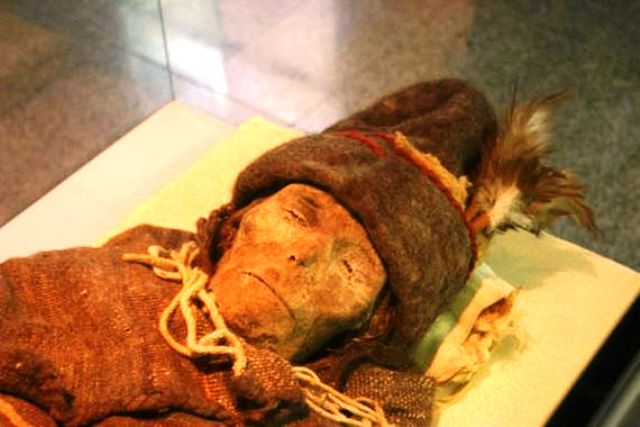
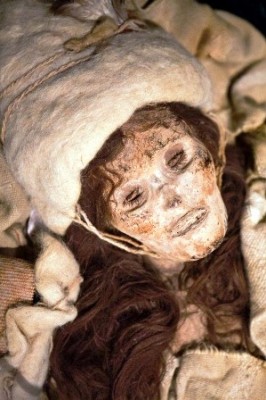
Στη «λεκάνη» του Ταρίμ, στην επαρχία Xinjang της Κίνας, βρίσκεται η έρημος Τάκλα Μακάν, στην οποία ανακαλύφθηκαν μούμιες με ευρωπαϊκάχαρακτηριστικά.
Οι μούμιες είναι σχεδόν 4000 ετών, αφού χρονολογούνται από το 2000 π.χ. Λόγω του χρώματός τους,  έχουν ονομαστεί  «λευκές μούμιες». Εξαιτίας της ξηρασίας της ερήμου, πολλές από τις μούμιες διατηρούν τα χαρακτηριστικά τους, ενώ σώζονται και αρκετά ενδύματα. Τα αποτελέσματα των επιστημονικών ερευνών είναι εντυπωσιακά, καθώς αποδεικνύουν την ύπαρξη μεταναστών από την Ευρώπη στην ευρύτερη περιοχή του Ταρίμ.
Οι μούμιες δεν έχουν σχιστά μάτια και είναι ψηλότερες από τους Ασιάτες. Το χρώμα των μαλλιών τους έχει κυρίως ξανθές και καστανές αποχρώσεις και το πρόσωπο φέρει «γωνίες». Τα ρούχα που δεν έχουν αλλοιωθεί, καθώς και κάποια ταφικά ευρήματα παραπέμπουν σε Ευρωπαϊκούς λαούς. Κατά καιρούς, έχει καταγραφεί η ύπαρξη Ευρωπαίων στην περιοχή. Ο ρωμαίος αυτοκράτορας Κλαύδιος είχε λάβει κάποιες αναφορές για την ύπαρξη ανθρώπων στη «λεκάνη» του Ταρίμ, που είχαν ανοιχτοκίτρινα μαλλιά, γαλανά μάτια και ύψος πολύ μεγαλύτερο από αυτό των Ασιατών. Οι αναφορές δεν είναι ιστορικά τεκμηριωμένες και δεν αποτελούν ασφαλή πηγή, ωστόσο ενισχύουν την άποψη των ερευνητών.

*Έζησαν Έλληνες στην περιοχή του Ταρίμ;*

45a06d9cfc9d359f0654f1ab7875c086

Ο κινέζος ιστορικός Σίμα Κιάν έχει καταγράψει στο αρχείο του την ιστορία του πρεσβευτή του αυτοκράτορα Γου, Ζανγκ Κιάν, ο οποίος είχε σταλεί στη Δύση προς αναζήτηση συμμάχων εναντίον των Ούνων. Κατά τη διάρκεια του ταξιδιού, πιάστηκε αιχμάλωτος και όταν κατάφερε να δραπετεύσει, βρέθηκε στην έρημο Τάκλα Μακάν, όπου συνάντησε τους
«Νταϊουάν» (εικάζεται Δαναούς). Τους περιέγραψε, λευκούς, με γενειάδα, όχι σχιστά μάτια και ανέφερε ότι είχαν στην κατοχή τους άλογα, όμορφα κτίρια και αντικείμενα και αγάλματα. Η περιοχή στην οποία κατοικούσαν εικάζεται ότι ήταν η Αλεξάνδρεια η Εσχάτη, μια από τις πόλεις που είχε ιδρύσει ο Μ. Αλέξανδρος, άρα αν ισχύει η εικασία, οι άνθρωποι που περιέγραψε ο Ζανγκ Κιάν, ήταν Έλληνες. Όταν ο απεσταλμένος επέστρεψε, μίλησε για τους ανθρώπους που συνάντησε στον αυτοκράτορα, ο οποίος ενδιαφέρθηκε κυρίως για τα άλογα. Έτσι ξεκίνησε η επαφή και η ανταλλαγή προϊόντων.
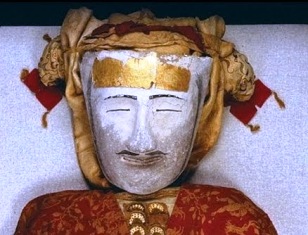
Με βάση τα στοιχεία αυτά, είναι πιθανή η ύπαρξη Ελλήνων στην ευρύτερη περιοχή. Η ενδυμασία της μούμιας παραπέμπει σε Ευρωπαίους της εποχής  Τα αποτελέσματα των ερευνών δείχνουν ότι οι μούμιες, έχουν ανομοιογενή
καταγωγή. Αυτό δικαιολογείται από τη «μίξη» των λαών ή από την ύπαρξη και άλλων φυλών για εμπορικούς κυρίως λόγους. Οι μούμιες που ανακαλύφθηκαν, δημιουργούν πολιτικό ζήτημα στην πόλη, αφού στο παρελθόν, οι κάτοικοι της περιοχής, είχαν ζητήσει την ανεξαρτησία τους, υποστηρίζοντας ότι δεν είναι Κινέζοι.
Τα αποτελέσματα των ερευνών δείχνουν ότι μπορεί να έχουν δίκιο.

Η ενδυμασία της μούμιας παραπέμπει σε Ευρωπαίους της εποχής

mixanitouxronou